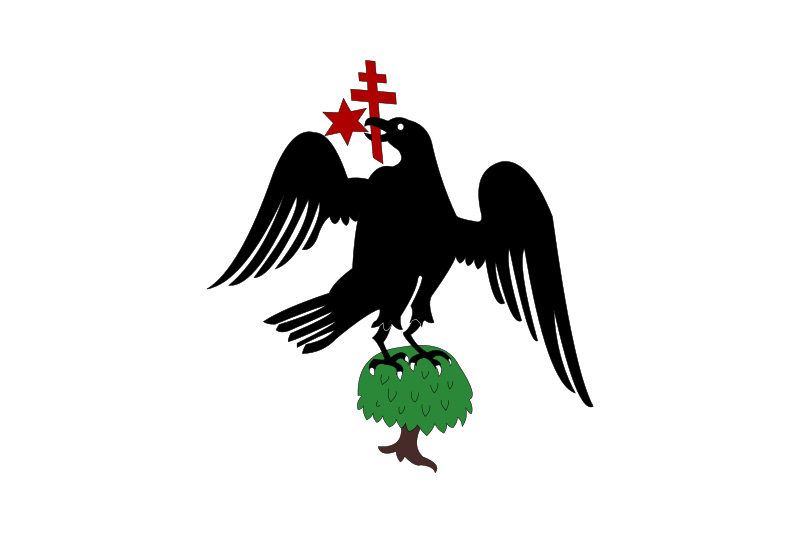
File:Flag_of_Wallachia.svg · Wikimedia Commons · See Wikimedia Commons
Wallachia
Sign in to saveAlso known as Valachia, Walachia, Țara Românească
Wallachia is a geographical region of modern-day Romania, as well as one of the two historical Romanian principalities that laid the foundation for the establishment of the modern Romanian state. It is situated north of the Lower Danube and south of the Southern Carpathians. Wallachia was traditionally divided into two sections, Muntenia (Greater Wallachia) and Oltenia (Lesser Wallachia). Dobruja could sometimes be considered a third section due to its proximity and brief rule over it. Wallachia as a whole is sometimes referred to as Muntenia through identification with the larger of the two t
Wallachia is a historical region in what is now Romania that, along with another principality, formed the basis for modern Romania's creation. Located between the Danube River and the Carpathian Mountains, it was traditionally split into two main sections and played a significant role in Romanian history and state development.
AI-generated from the Wikipedia summary — may contain errors.
Key facts
- Country.date_event6
- 1834–1835
- Country.national_motto
- "Justice, Brotherhood" (1848)
- Country.native_name
- Țeara Rumânească (Old Romanian)
- Country.conventional_long_name
- Principality of Wallachia
- Country.common_name
- Wallachia
- Country.life_span
- 1330–1862
- Country.era
- Middle Ages Early modern period Modern history
- Country.status
- Vassal
- Country.empire
- Ottoman Empire
- Country.government_type
- Elective absolute monarchy
- Country.status_text
- Independent state 1330–1417, with posterior restorations of independence Ottoman vassal (1417–1862, with interruptions) de facto Russian protectorate (1829–1854) International protectorate (1856–1859)
- Country.event_pre
- 'Dismounting' by Radu Negru
- Country.date_pre
- 1290
- Country.event_start
- Independence
- Country.date_start
- 1330
- Country.event2
- Ottoman suzerainty for the first time
- Country.date_event2
- 1417
- Country.event3
- Long and Moldavian Magnate wars
via Wikipedia infobox
Wikidata facts
- Instance of
- historical region
- Named after
- Principality of Wallachia
- Demonym
- Wallachian
- Country
- Romania
- Continent
- Europe
- Capital
- Câmpulung
- Official language
- Romanian
- Image
- Man Curtea de Arges.SV.jpg
Show 4 more facts
- Commons category
- Wallachia
- topic's main category
- Category:Wallachia
- different from
- Principality of Wallachia
- P8168
- Hypocnemis
Sources (6)
via Wikidata · CC0
~44 min read
Encyclopedic overview
30 sectionsContents
- Etymology
- History
- Ancient times
- Early Middle Ages
- Establishment of state
- 1400–1600
- Mircea the Elder to Radu the Great
- Mihnea cel Rău to Petru Cercel
- 17th century
- Russo-Turkish Wars and the Phanariotes
- From Wallachia to Romania
- Early 19th century
- 1840s–1850s
- Society
- Slavery
- Wallachian insignia
- Flags
- Coats of arms and other insignia
- Military forces
- Geography
- Map gallery
- Population
- Historical population
- Current population
- Cities
- See also
- Notes
- References
- Bibliography
- External links
Wallachia is a geographical region of modern-day Romania, as well as one of the two historical Romanian principalities that laid the foundation for the establishment of the modern Romanian state. It is situated north of the Lower Danube and south of the Southern Carpathians. Wallachia was traditionally divided into two sections, Muntenia (Greater Wallachia) and Oltenia (Lesser Wallachia). Dobruja could sometimes be considered a third section due to its proximity and brief rule over it. Wallachia as a whole is sometimes referred to as Muntenia through identification with the larger of the two traditional sections.
Wallachia began to form as a principality around the 13th century, following the gradual unification of several smaller Romanian political entities. By 1330, the state had consolidated following Basarab I's victory in the Battle of Posada against the Kingdom of Hungary, ushering in a period of relative independence. In 1417, Wallachia was forced to accept the suzerainty of the Ottoman Empire for the first time; this suzerainty lasted until the mid-19th century. However in general Wallachia was able to preserve autonomy within the Empire as well as experience interruptions to Ottoman rule brought about by local rulers such as Vlad the Impaler and Michael the Brave and later external powers such as the Polish–Lithuanian Commonwealth and the Russian Empire.
Excerpted from Wikipedia’s “Wallachia” article, available under the CC BY-SA 4.0 licence.
Gallery (52)
On the map
3 mapped locations
Available in 77 languages
- Español
- Français
- Deutsch
- 中文
- 日本語
- Русский
- Português
- Italiano
- العربية
- Afrikaans
- Albanian
- Armenian
- azb
- Azerbaijani
- Bahasa Indonesia
- Basque
- be_x_old
- Belarusian
Show 58 more
- Bosnian
- Bulgarian
- Catalan
- Central Kurdish
- Croatian
- Czech
- Danish
- Egyptian Arabic
- Esperanto
- Estonian
- Extremaduran
- Finnish
- Galician
- Georgian
- Greek
- Hausa
- Hebrew
- Hungarian
- Icelandic
- Ido
- Kazakh
- Kurdish
- Kyrgyz
- Latin
- Latvian
- Lithuanian
- Macedonian
- Malay
- Nederlands
- Norwegian
- Norwegian Nynorsk
- nrm
- Occitan
- Polski
- Romanian
- Sardinian
- Scots
- Scottish Gaelic
- Serbian
- Serbian (Latin)
- simple
- Slovak
- Svenska
- Tamil
- Tiếng Việt
- Türkçe
- Tyap
- Ukrainian
- Urdu
- Uzbek
- Venetian
- Waray
- Western Panjabi
- Wu Chinese
- zh_yue
- فارسی
- ไทย
- 한국어
via Wikidata sitelinks · CC0