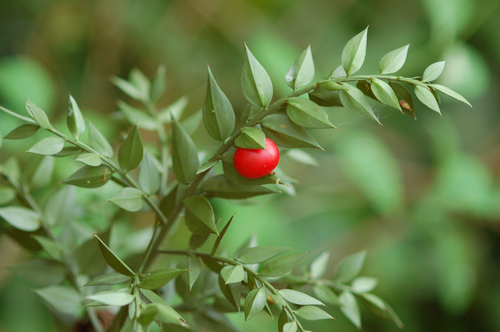
(c) rudyclaeys, some rights reserved (CC BY-NC) · cc-by-nc
Ruscus
Sign in to saveRuscus, commonly known as '''butcher's-broom''', is a genus of six species of flowering plants, native to western and southern Europe, Macaronesia, northwestern Africa, and southwestern Asia east to the Caucasus. In the APG III classification system, it is placed in the family Asparagaceae, subfamily Convallarioideae (formerly the family Ruscaceae). Like many lilioid monocots, it was formerly classified in the family Liliaceae.
Species
butcher's-broom
GENUS
- KingdomPlantae
- PhylumTracheophyta
- ClassLiliopsida
- OrderAsparagales
- FamilyAsparagaceae
假叶树属(学名:Ruscus)是假叶树科下的一个属,为直立亚灌木植物。该属共有约7种,分布于马德拉群岛、欧洲南部、地中海地区或至高加索地区。
via GBIF · Kew POWO
Museum specimens
- Specimen records
- 122
- With media
- 62
- Family
- Asparagaceae
- Collections
- DEK, UNIVERSITY OF ALBERTA MUSEUMS, US, NHA, MADUG-UG, TEX
- Recorded in
- United States, Canada, Portugal, Mexico, Greece, France, Turkey, Brasil
Research
163 papers- Ruscus Genus: A Rich Source of Bioactive Steroidal Saponins.Planta medica · 2016
- Peripheral Edema: Evaluation and Management in Primary Care.American family physician · 2022
- Efficacy of Ruscus extract, HMC and vitamin C, constituents of Cyclo 3 fort®, on improving individual venous symptoms and edema: a systematic review and meta-analysis of randomized double-blind placebo-controlled trials.International angiology : a journal of the International Union of Angiology · 2017
- The place of Ruscus extract, hesperidin methyl chalcone, and vitamin C in the management of chronic venous disease.International angiology : a journal of the International Union of Angiology · 2017
- Ruscus aculeatus (butcher's broom). Monograph.Alternative medicine review : a journal of clinical therapeutic · 2001
via PubMed
Wikidata facts
- Instance of
- taxon
- Image
- Ruscus streptophyllus, Ribeira da Janela, Madeira 352115467.jpg
Show 8 more facts
- taxon rank
- genus
- Commons category
- Ruscus
- taxon name
- Ruscus
- topic's main category
- Category:Ruscus
- taxon common name
- 假叶树属
- has fruit type
- berry
- taxonomic type
- Ruscus aculeatus
via Wikidata · CC0
~7 min read
Encyclopedic overview
11 sectionsContents
- Species
- Uses
- Medicinal plants
- History
- Indications
- Current Use
- Culinary
- Toxicity
- References
- Bibliography
- External links
Ruscus, commonly known as '''butcher's-broom', is a genus of six species of flowering plants, native to western and southern Europe, Macaronesia, northwestern Africa, and southwestern Asia east to the Caucasus. In the APG III classification system, it is placed in the family Asparagaceae, subfamily Convallarioideae (formerly the family Ruscaceae). Like many lilioid monocots, it was formerly classified in the family Liliaceae.
The species are evergreen shrub-like perennial plants, growing to approximately tall. They have branched stems that bear numerous cladodes (flattened, leaf-like stem tissue, also known as phylloclades) long and broad. The true leaves are minute, scale-like, and non-photosynthetic. The flowers are small, white with a dark-violet centre, and situated on the middle of the cladodes. The fruit is a red berry in diameter. Some species are monoecious while others are dioecious.
Excerpted from Wikipedia’s “Ruscus” article, available under the CC BY-SA 4.0 licence.