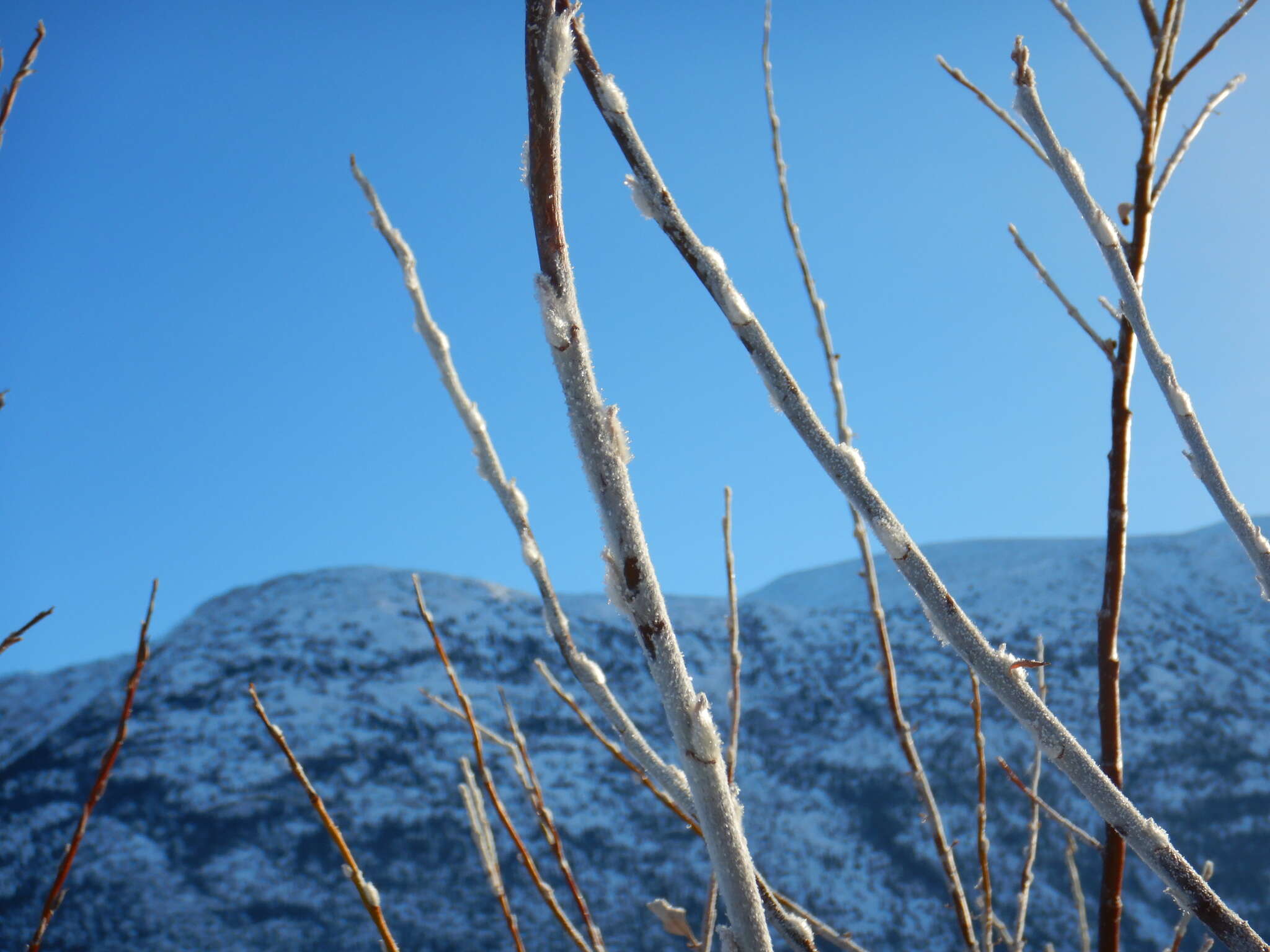
Salix alaxensis
Also known as Alaska willow, feltleaf willow
Art der Gattung Weiden (Salix)
Species
Least ConcernSPECIES
- KingdomPlantae
- PhylumTracheophyta
- ClassMagnoliopsida
- OrderMalpighiales
- FamilySalicaceae
Native toAlaska, Alberta, Aleutian Is., British Columbia, Buryatiya, Kamchatka, Magadan, Manitoba, Northwest Territories, Nunavut, Québec, Yakutiya
Observations recorded3,796
More info for the terms: adventitious, capsule, density, fruit, seed, shrub, treeThis description covers characteristics that may be relevant to fire ecology and is not meant for identification. Keys for identification are available (e.g., [17,52,70,97,113,141]).Morphology: Feltleaf willow is a tree or shrub 2 to 33 feet (0.5-10 m) tall [17,52,89,97,141]. It typically grows in clumps of 5 to 20 stems [51]. Branches are typically erect, but in exposed High Arctic and alpine sites feltleaf willow may have a prostrate or semiprostrate form [17,76,141]. Trunks may be 4 to 7 inches (10-18 cm) in diameter [141]. Heavy browsing commonly hedges feltleaf willows [20,75,125]. Leaves are deciduous, alternate, and simple. They are 2.0 to 4.3 inches (5-11 cm) long and 0.4 to 1.6 inches (1-4 cm) wide [52,76,141]. The inflorescence is a catkin. Male catkins are 1.2 to 2.0 inches (3-5 cm) long, and female catkins are 2.0 to 5.9 (5-15 cm) long [97]. The fruit is a capsule, which splits open to release the seeds. A tuft of hairs plumes each seed [76]. Willow roots are typically shallow [69]. Feltleaf willow sometimes forms adventitious roots [78]. Stand structure: Feltleaf willow stands are open to