
Samoa
Sign in to saveAlso known as Western Samoa, Independent State of Samoa, ws, SAM
Samoa, officially the Independent State of Samoa, is an island country in Polynesia, part of Oceania, in the South Pacific Ocean. It consists of two main islands (Savai'i and Upolu), two smaller, inhabited islands (Manono and Apolima), and several smaller, uninhabited islands, including the Aleipata Islands (Nuʻutele, Nuʻulua, Fanuatapu and Namua). Samoa is located west of American Samoa, northeast of Tonga, northeast of Fiji, east of Wallis and Futuna, southeast of Tuvalu, south of Tokelau, southwest of Hawaii, and northwest of Niue. The capital and largest city is Apia.
OverviewAI-generated
Samoa, officially the Independent State of Samoa, is a sovereign island country located in Insular Oceania and Polynesia. Its capital is Apia. The nation is a member of the United Nations, the Commonwealth of Nations, the World Trade Organization, and the International Bank for Reconstruction and Development. It uses the Samoan tālā and Western Samoan pound as currency. English and Samoan are the official languages. The top-level Internet domain is .ws, and the telephone country code is +685.
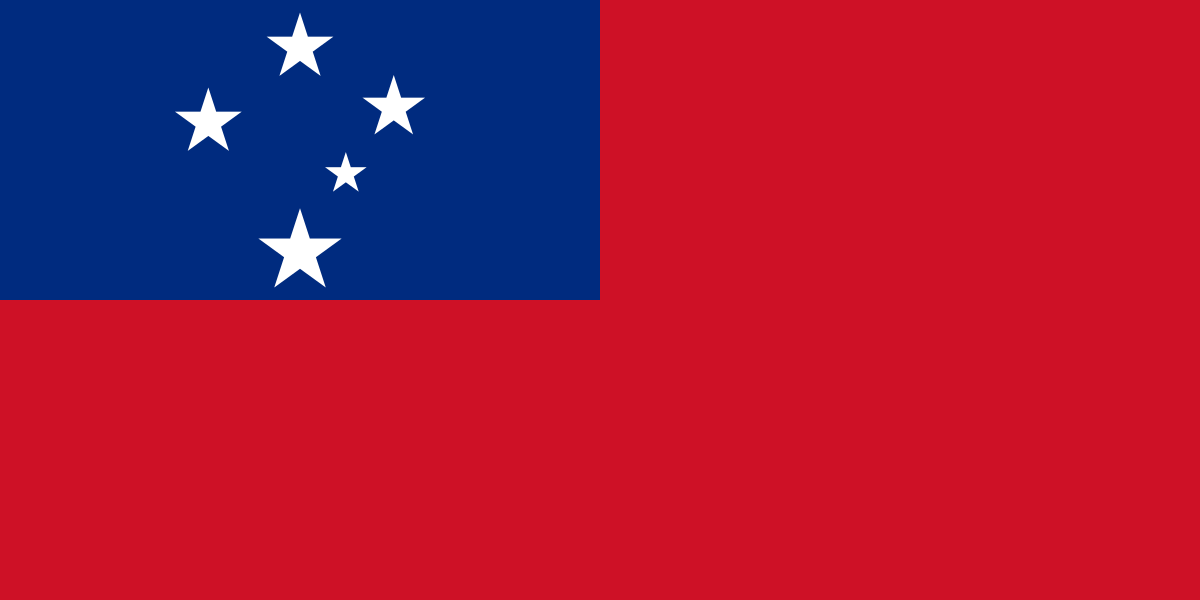
The country has a population of 200,010 according to one source, 205,557 according to another, and 218,019 according to a third. Its area is 2,842. The anthem is The Banner of Freedom, and the flag is the flag of Samoa. Samoa contains the administrative territorial entities of A'ana, Aiga-i-le-Tai, Atua, and Va'a-o-Fonoti. It is described by sources including the Brockhaus and Efron Encyclopedic Dictionary and the Encyclopædia Britannica 11th edition. The time zone is UTC+13:00.
Synthesized by Vinony from 68 facts across 9 sources: Wikidata, REST Countries, Open Meteo, Openweathermap, World Bank, OpenStreetMap, PubMed, Vinony graph, Geo. Generated from structured data (not the Wikipedia text) and checked against those facts — may still contain errors.
Weather now
7-day forecast
via Open-Meteo
Country

- Capital
- Apia
- Population
- 205,557
- Region
- Oceania · Polynesia
- Demonym
- Samoan
- Currencies
- WST (T)
- Languages
- English, Samoan
- Calling code
- +685
- Drives on
- Left
- Gini
- 38.7 (2013)
- FIFA code
- SAM
- TLD
- .ws
- Timezones
- UTC+13:00
via REST Countries
Indicators · World Bank
- GDP
- $1.2B(2024)
- Population
- 218,019(2024)
- Life expectancy
- 71.8 yrs(2024)
- Unemployment
- 5 %(2025)
- Urban population
- 17.5 %(2024)
- Internet users
- 21.2 %(2014)
- Forest area
- 57.6 %(2023)
- Renewable energy
- 35.9 %(2022)
via World Bank Open Data · CC BY 4.0
Place details
- Locality
- Fataloa
- Region
- Faʻasaleleaga
- Country
- Sāmoa
- Population
- 196,130
- Timezone
- Pacific/Apia
via OpenStreetMap · GeoNames
Wikipedia views (30d)
81,573 totalvia Wikimedia Pageviews API
Key facts
- Country.conventional_long_name
- Independent State of Samoa
- Country.common_name
- Samoa
- Country.image_flag
- Flag of Samoa.svg
- Country.image_coat
- Coat of arms of Samoa.svg
- Country.symbol_type
- Coat of arms
- Country.national_motto
- Faʻavae i le Atua Sāmoa"Samoa is founded on God"
- Country.national_anthem
- O Le Fuʻa o le Saʻolotoga o Sāmoa"The Banner of Freedom"File:SamoaAnthem.ogg
- Country.image_map
- Samoa on the globe (Polynesia centered).svg
- Country.map_caption
- Location of Samoa
- Country.image_map2
- Samoa - Location Map (2013) - WSM - UNOCHA.svg
- Country.map_caption2
- Map of Samoa
- Country.capital
- Apia
- Country.largest_city
- Apia
- Country.official_languages
- Samoan, English
- Country.religion_year
- 2021
- Country.ethnic_groups_year
- 2021
- Country.demonym
- Samoan
- Country.government_type
- Unitary parliamentary republic
via Wikipedia infobox
Research
1,795 papers- Military Medicine in American Samoa-Connecting With Indo-Pacific Partners.Military medicine · 2022Pierce BT, Pucci JU, Rich EL et al.DOI: 10.1093/milmed/usab296
- Tenacious Endemic Typhoid Fever in Samoa.Clinical infectious diseases : an official publication of the Infectious Diseases Society of America · 2020Sikorski MJ, Desai SN, Tupua S et al.DOI: 10.1093/cid/ciaa314
- Curbing the 2019 Samoa measles outbreak.The Lancet. Infectious diseases · 2020Champredon D, Shoukat A, Singer BH et al.DOI: 10.1016/S1473-3099(20)30044-X
- Is Samoa Prepared for an Outbreak of COVID-19?Asia-Pacific journal of public health · 2021Olayemi LO, Boodoosingh R, Sam FADOI: 10.1177/1010539520927283
- Control and elimination of lymphatic filariasis in Oceania: Prevalence, geographical distribution, mass drug administration, and surveillance in Samoa, 1998-2017.ReviewAdvances in parasitology · 2021Graves PM, Joseph H, Coutts SP et al.DOI: 10.1016/bs.apar.2021.03.002
- Culturally Competent Interventions for Child Sexual Abuse: A Scoping Review of the Literature and the Implications for American Samoa.Journal of child sexual abuse · 2023Tuaau KDOI: 10.1080/10538712.2023.2269146
- Type 2 Diabetes Prevalence, Control and Management within Fiji,Kiribati, Samoa, the Solomon Islands, Tonga, and Vanuatu: A ScopingReview with a Systematic Approach.Current diabetes reviews · 2024Kuek TDOI: 10.2174/0115733998260306231025151814
- Western Samoa.Department of State publication. Background notes series · 1985United States. Department of State. Bureau of Public Affairs
via PubMed
Wikidata facts
- Instance of
- country
- Official name
- Западное Самоа
- Demonym
- Samóch
- Country
- Samoa
- Contains
- Palauli
- Continent
- Oceania
- Capital
- Apia
- Official language
- Samoan
- Currency
- Western Samoan pound
- Population
- 200010
- Area
- 2842
- Head of government
- Fiamē Naomi Mataʻafa
- Head of state
- Tufuga Efi
- Legislature
- Legislative Assembly of Samoa
- Anthem
- The Banner of Freedom
- Shares border with
- United States
- Highest point
- Silisili
- Official website
- www.samoagovt.ws
- Image
- Beach on Upolu Island, Samoa, 2009.jpg
- Life expectancy
- 73
- Nominal GDP
- 832421565
- Calling code
- +685
- Licence plate code
- WS
Show 55 more facts
- Mains voltage
- 230
- Motto
- Samoa Hardd
- Flag
- flag of Samoa
- Coat of arms
- coat of arms of Samoa
- top-level Internet domain
- .ws
- topic's main category
- Category:Samoa
- category for people who died here
- Category:Deaths in Samoa
- category for people born here
- Q13464105
- category for films shot at this location
- Category:Films shot in Samoa
- category of associated people
- Category:Samoan people
- diplomatic relation
- Germany
- Commons gallery
- Sāmoa
- mobile country code
- 549
- lowest point
- Pacific Ocean
- driving side
- left
- geography of topic
- geography of Samoa
- marriageable age
- 19
- topic's main Wikimedia portal
- Portal:Samoa
- short name
- Западное Самоа
- office held by head of government
- Prime Minister of Samoa
- language used
- Samoan
- office held by head of state
- O le Ao o le Malo
- number of out-of-school children
- 10419
- has characteristic
- free country
- total fertility rate
- 4.086
- maritime identification digits
- 561
- native label
- Western Samoa
- inception
- 1962-01-01
- twinned administrative body
- Auckland
- Unicode character
- 🇼🇸
- central bank
- Central Bank of Samoa
- culture
- culture of Samoa
- history of topic
- history of Samoa
- VAT rate
- 15
- P6413
- Samoa
- economy of topic
- economy of Samoa
- demographics of topic
- demographics of Samoa
- edition or translation of
- Snow White
- Human Development Index
- 0.707
- hashtag
- Samoa
- on focus list of Wikimedia project
- Wikipedia:Vital articles/Level/4
- Gini coefficient
- 38.7
- Inequality-adjusted Human Development Index
- 0.613
- P8168
- Tommy Prim
- Commons category
- Samoa
- P12749
- Limousin
- birth rate
- 26.997
- male population
- 113375
- death rate
- 5.45
- rural population
- 183207
- female population
- 109007
- urban population
- 39175
- Commonwealth Sport country code
- SAM
Sources (15)
via Wikidata · CC0
Travel guide
Understand
The main islands are the result of countless volcanic eruptions, leaving easily visible volcanic cones all over both islands. None of the volcanoes are active, but small earthquakes often rock the island, reminding people of the volcanoes' presence. In September 2009 the south coast of Upolu Island was hit by a devastating tsunami, with much loss of life.
The last volcanic eruption was in 1911, on Savaii. The eerie, lifeless lava fields that remain from this event can be visited easily, since the only sealed road on Savai'i goes right through the middle.
Both islands are almost entirely covered by lush vegetation, although almost none of it is the original rainforest that covered the island before humans arrived. Most of the land area is given over to farms or semi-cultivated forest, providing food and cash crops for the locals. Since Samoa has been inhabited for over three thousand years, the cultivated lands around villages can often seem like deepest, darkest jungle.
The population is around 205,000 in 2021, but many more Samoans live outside the country, particularly in New Zealand, Australia and the United States.
Get around
thumb|right|250px|A typical Samoan bus
See
This is just a summary of what to see. Consult Apia, Savaii and Upolu for more detailed information.
National Parks. There are several national parks in both Upolu and Savaii. These offer tropical vegetation, numerous birds and some interesting lakes. Falealupo Rainforest Preserve on Savaii has a short canopy walkway and you can sleep in the trees. Lake Lanoto'o National Park on Upolu has a fascinating lake where introduced goldfish thrive and grow to amazing sizes. At O le Pupu Pue National Park you can find Togigoiga Waterfalls, the Ma Tree and the Coastal Lava Cliff Walk. thumb|right|250px|Sopoaga Falls on Upolu Island
Waterfalls. The inland areas of Savaii and Upolu have some spectacular waterfalls, some with 100m drops. Those on Upolu are a bit more accessible. Papase'ea Sliding Rocks on Upolu have only a slight drop but the vegetation on the falls permits an interesting slide into the pool below. Blowholes. Savaii has some spectacular blowholes caused by the sea forcing water up through tubes in volcanic rocks. Caves. There are interesting caves on both islands. Lava Fields. Parts of Savaii are covered by lava rock, following various eruptions by Mt. Matavanu. There is a large lava field at the end of the O le Pupu Pue National Park Coastal Lava Cliff walk and also some interesting cave like formations at the To Sua Ocean Trench. Villages. Although Western-style buildings are gaining in popularity, traditional Samoan fales are still found everywhere. These are of an o…
Do
Below is just an indication of things to do in Samoa. For more detailed information, see Upolu, Savaii and Apia.
A Samoan Tattoo. This traditional art form is very much a part of the Samoan culture. There are different designs for women and men; in the case of men the tattoo can cover half the body. Beware that the tattooing process can be very painful, but if you think you can take the pain ask at your hotel or guest house for advice on local tattoo artists. Get married. Samoa is a popular place to get married and spend your honeymoon. Several hotels and resorts offer special packages on their web sites and they will make all the arrangements. Golf. Golf is very popular in Samoa. There is even a suggestion that the Daylight Saving Time was introduced primarily so that executives could get in a round of golf after work before it got dark. All courses are on Upolu. Two are close to Apia, one near the airport and a nine-hole course is found on the south coast. Diving. Scuba diving is a relatively new activity in Samoa. Both Upolu and Savai'i have great dive spots, with around 900 fish species and 200 types of coral. There are dive companies operating on both islands. Fishing. Samoa is a popular fishing destination. Fish in the local waters include blue and black marlin, sailfish, yellowfin, and the giant trevally. Most charter companies operate out of Apia harbour.
Eat
thumb|Roasting a pig on an umu Eating is an extremely important part of Samoan life. They often take food with them when they travel. Samoan food is not highly spiced or seasoned. It uses ingredients that are relatively unfamiliar to most Westerners, such as breadfruit, taro (or talo), taro leaves, cooked green bananas and raw fish. Umu. The umu is the traditional method used for cooking. A fire is built and stones placed on it. When the fire is down to the embers the ingredients, such as green bananas, breadfruit, taro, fish, palusami and pork are placed on the stones. It is then covered with banana leaves and left to cook. Oka is the way Samoans prepare raw fish. It consists of small bits of fish that are marinated in a mixture of lemon juice, coconut cream, salt and finely chopped onions. Palusami is made from taro leaves and coconut cream. The coconut cream, onions and some taro are wrapped in whole taro leaves and cooked in an umu. Well cooked, this can be unforgettable and you should not leave Samoa without trying it. Corned beef. Samoa rapidly adopted this import and it is widely used as an accompaniment to Umus and other dishes.
Unfortunately it is difficult to find these delicacies, maybe partly because western food is more “cool”, partly because the average tourists want to eat what they eat at home. The usual things you get are more or less good imitations of western-style or Chinese food. The market in Apia is a good place if you want to try some of the local stu…
Drink
No significant gathering in Samoa, whether official or for pleasure, is complete without the 'Ava (or kava) ceremony at the beginning. Kava's scientific name is Piper methysticum, which means intoxicating pepper. The roots of the plant are used to produce a mildly narcotic drink that is passed around meetings following strict rules. However, you do not need to participate in a Samoan cultural event to try it. On some days it can be purchased at Apia's central market (marketi fou).
The local beer is Vailima beer. It's cheap and you can buy it everywhere.
Non-alcoholic beverages and bottled water are available in all roadside stores. Coke, Fanta and Sprite are available in 750 ml glass bottles for about WS$4. You will need a bottle opener for these if you want to take them with you to drink later; otherwise stores will have a bottle opener available. Bottled water is available in a range of sizes.
Alcohol is plentiful in the bars. There's not that much in most stores and it tends to be expensive. Le Well near the market in Apia (ask any taxi driver) has a good range at the best prices. For heavy drinkers, the cheapest liquor is generally vodka in large (1.75 L) plastic bottles. This may be bought from supermarkets and bottle shops and is also available in smaller 750 ml bottles for about WS$25. Imported wines are generally very expensive, although not as expensive as in the restaurants.
There are lots of smaller bars and night spots to check out. Also every hotel has a bar …
Sleep
thumb|right|250px|A fale in a village near Apia
Beach fales are an enjoyable and inexpensive way to stay in Samoa. A list can be obtained from the Samoa Tourism Authority ([email protected]), but the best way to know where to stay is to ask other travelers. Samoa is not very big and tourism is limited, so you will bump into the same people once in a while making it easy to exchange information.
With the explosion in accommodation it is now less necessary for those wanting to visit the remoter parts of Samoa, particularly Savaii, to stay in villages, which was fairly common in the past. However, this is still possible. If you want to stay in, or even just visit, a village it is important to remember not to offend local culture. See Respect, below.
There is also a good range of resorts, hotels and guest houses in Samoa. Accommodations are listed under Apia, Upolu and Savaii. Please do not list them here.
Stay safe
Samoa is a generally safe destination. Crime rates are low and people are very helpful and friendly. Items do, sometimes, get stolen. With sensible precautions, however, the threat of this happening should be minimal.
Free roaming dogs can be a safety problem in the capital Apia. The Government of Samoa (GoS) passed the Canine Control Act in 2013 as an initial step toward addressing dog management. Most dogs won't see you as a threat, and will ignore you, if you ignore them. Pretending to pick up a rock will usually scare them away.
Stay healthy
thumb|Sunbathing on Upolu Samoa is a malaria-free zone. However, there are occasional outbreaks of dengue fever and (since 2014) chikungunya, so precautions should be taken such as using mosquito nets and insect repellent. Note that the mosquito that transmits dengue normally bites during the day.
Drink bottled water. It's cheap and readily available.
There are no known poisonous animals or insects on land, although centipedes can give you a very painful bite. In the water beware of purple cone shells, sea urchins, fire coral, etc. If not using fins, wearing footwear while snorkelling is highly recommended.
Some travellers have reported a violent allergic reaction to the ceremonial drink kava. Symptoms include a very obvious rash and swelling to the neck and face area, sweating and discomfort. Medical attention should be sought immediately and a prescription for Prednisolone usually does the trick. It takes from 12 to 24 hours for the effects to noticeably subside.
There are two hospitals in Apia and one on Savaii at Tuasivi, a couple of miles north of the ferry wharf at Salelologa.
Respect
Samoa is very religious, with most of the population following the Anglican denomination. This means that Sunday is generally respected as a holy day and most shops and businesses are closed. You should not walk through villages on Sundays.
Many villages have a prayer curfew in place at sundown. This normally lasts around half an hour. You should be careful to avoid walking through villages at this time to avoid causing offence.
Samoan culture is governed by strict protocols and etiquette. Although allowances are made for foreigners, it is wise to avoid revealing clothing and to comply with village rules which are enforced by the village matai (chiefs), although Apia is quite relaxed in these traditions.
Women going topless is taboo, and they should only wear swimwear at the beach. Shorts should be knee length. Shirts should be worn when not at the beach. A lavalava (sarong) is nearly always acceptable attire.
Other simple things, such as removing shoes before entering a house (or, for that matter, budget accommodation), should be observed.
The main island of Upolu is known as the "modern" island, where most northern coast villages are quite relaxed with the old strict traditions, whilst Savai'i is the more traditional island, but has become more relaxed. But nude bathing is definitely taboo.
Travel guide from Wikivoyage (CC BY-SA 4.0)
~40 min read
Encyclopedic overview
44 sectionsContents
- Etymology
- History
- Geological history
- Early history
- 19th century
- German Samoa (1900–1914)
- New Zealand rule (1914–1961)
- Flu pandemic
- Mau movement
- Independence
- Government and politics
- Administrative divisions
- Human rights
- State religion
- Military and police
- Geography
- Climate
- Ecology
- Economy
- Tourism
- Agriculture
- Transport
- Air travel
- Inter-island ferries
- Public transportation
- Road infrastructure
- Ports
- Cycling and walking
- Demographics
- Health
- Ethnic groups
- Languages
- Religion
- Education
- Culture
- Media
- Tattooing
- Contemporary culture
- Sport
- See also
- Notes
- References
- Further reading
- External links
Samoa, officially the Independent State of Samoa, is an island country in Polynesia, part of Oceania, in the South Pacific Ocean. It consists of two main islands (Savai'i and Upolu), two smaller, inhabited islands (Manono and Apolima), and several smaller, uninhabited islands, including the Aleipata Islands (Nuʻutele, Nuʻulua, Fanuatapu and Namua). Samoa is located 64 km (40 mi; 35 nmi) west of American Samoa, 889 km (552 mi; 480 nmi) northeast of Tonga, 1,152 km (716 mi; 622 nmi) northeast of Fiji, 483 km (300 mi; 261 nmi) east of Wallis and Futuna, 1,151 km (715 mi; 621 nmi) southeast of Tuvalu, 519 km (322 mi; 280 nmi) south of Tokelau, 4,190 km (2,600 mi; 2,260 nmi) southwest of Hawaii, and 610 km (380 mi; 330 nmi) northwest of Niue. The capital and largest city is Apia.
The Lapita people discovered and settled the Samoan Islands around 3,500 years ago. They developed a Samoan language and Samoan cultural identity. Because of the Samoans' seafaring skills, pre-20th-century European explorers referred to the entire island group, including American Samoa, as the "Navigator Islands". The country became a colony of the German Empire in 1899 after the Tripartite Convention, and was known as German Samoa. German administration ended in August 1914 after New Zealand troops bloodlessly occupied the colony at the start of World War I. New Zealand officially gained control of the region as a League of Nations mandate in 1920, when it became the Territory of Western Samoa. After being converted into a United Nations Trust Territory in 1946, Western Samoa gained independence on 1 January 1962 and officially returned to its original pre-occupation name Samoa on 4 July 1997.
Excerpted from Wikipedia’s “Samoa” article, available under the CC BY-SA 4.0 licence.
Gallery (59)
On the map
6 mapped locations
Available in 217 languages
- Español
- Français
- Deutsch
- 中文
- 日本語
- Русский
- Português
- Italiano
- العربية
- हिन्दी
- Abkhazian
- Achinese
- Afrikaans
- Albanian
- Albanian
- Amharic
- ami
- Angika
Show 198 more
- Aragonese
- Armenian
- Arpitan
- Asturian
- azb
- Azerbaijani
- Bahasa Indonesia
- Balinese
- Bambara
- Bangla
- Banjar
- Bashkir
- Basque
- bat_smg
- Batak Toba
- be_x_old
- Belarusian
- Betawi
- Bhojpuri
- Bikol
- Bishnupriya
- Bislama
- Bosnian
- Breton
- Bulgarian
- Buriat
- Burmese
- Catalan
- cbk_zam
- cdo
- Cebuano
- Central Kurdish
- Chechen
- Cheyenne
- Cornish
- Crimean Tatar
- Croatian
- Czech
- Danish
- Divehi
- dty
- Egyptian Arabic
- Esperanto
- Estonian
- Extremaduran
- Faroese
- Fiji Hindi
- Fijian
- Filipino
- Finnish
- fiu_vro
- Friulian
- Gagauz
- Galician
- gcr
- Georgian
- Gilaki
- Goan Konkani
- Gothic
- Greek
- Guarani
- Gujarati
- Haitian Creole
- Hakka Chinese
- Hausa
- Hawaiian
- Hebrew
- Hungarian
- hyw
- Icelandic
- Ido
- Iloko
- Inari Sami
- Interlingua
- Interlingue
- Inuktitut
- Irish
- Jamaican Creole English
- Javanese
- Kannada
- Kara-Kalpak
- Karachay-Balkar
- Kashubian
- Kazakh
- Kinyarwanda
- Kotava
- Kurdish
- Kyrgyz
- Ladino
- Latin
- Latvian
- Ligurian
- Limburgish
- Lingua Franca Nova
- Lithuanian
- lld
- Lombard
- Low German
- Lower Sorbian
- Luxembourgish
- Macedonian
- Malagasy
- Malay
- Malayalam
- Maltese
- Manipuri
- Manx
- Māori
- Marathi
- Mazanderani
- Minangkabau
- Mingrelian
- Mongolian
- Moroccan Arabic
- Navajo
- Nederlands
- Northern Frisian
- Northern Sami
- Norwegian
- Norwegian Nynorsk
- Occitan
- Odia
- Old English
- olo
- Ossetic
- Pampanga
- Papiamento
- Pashto
- Piedmontese
- Polski
- Punjabi
- Quechua
- rki
- Romanian
- Samoan
- Sanskrit
- Sardinian
- Scots
- Scottish Gaelic
- Serbian
- Serbian (Latin)
- Shan
- Shona
- Sicilian
- Silesian
- simple
- Sindhi
- Sinhala
- Slovak
- Slovenian
- Somali
- Sundanese
- Svenska
- Swahili
- szy
- Tahitian
- Tajik
- Tamil
- Taroko
- Tatar
- tay
- Telugu
- Tibetan
- Tiếng Việt
- Tigrinya
- Tok Pisin
- Toki Pona
- Tongan
- Tumbuka
- Türkçe
- Udmurt
- Ukrainian
- Upper Sorbian
- Urdu
- Uyghur
- Uzbek
- Venetian
- Veps
- Volapük
- Waray
- Welsh
- Western Frisian
- Western Mari
- Western Panjabi
- Wolof
- Wu Chinese
- Xhosa
- Yakut
- Yoruba
- Zaza
- Zeelandic
- zh_classical
- zh_min_nan
- zh_yue
- Zhuang
- فارسی
- ไทย
- 한국어
via Wikidata sitelinks · CC0