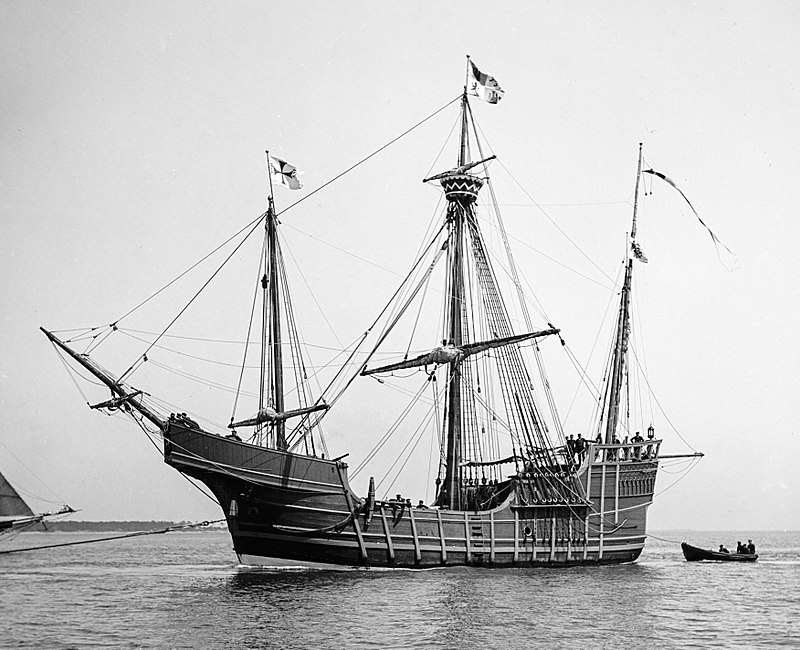
File:Kolumbus-Santa-Maria.jpg · Wikimedia Commons · See Wikimedia Commons
Santa Maria
Sign in to saveAlso known as Santa María, Santa Maria (ship), Sta. Maria, caravel Santa Maria, nao Santa Maria, Marigalante, Santa Maria (nao), Santa Maria (Columbus)
carrack used by Christopher Columbus
Key facts
- Name
- Santa María de la Inmaculada Concepción (originally La Gallega )
- Namesake
- Immaculate Conception of the Blessed Virgin Mary
- Owner
- Juan de la Cosa
- Stricken
- 25 December 1492
- Fate
- Ran aground
- Type
- Carrack
- Displacement
- est. 150 metric tons of displacement
- Tons burthen
- est. 108 tons BM
- Length
- est. hull length 19 m (62 ft) est. keel length 12.6 m (41 ft)
- Beam
- est. 5.5 m (18 ft)
- Draught
- est. 3.2 m (10 ft)
- Propulsion
- sail
- Armament
- 4 × 90 mm bombards , 50 mm culebrinas
- Notes
- Captained by Christopher Columbus
via Wikipedia infobox
Wikidata facts
- Instance of
- nau
- Official name
- Santa Maria
- Participant in
- first arrival of Christopher Columbus to America
- Owned by
- Juan de la Cosa
- Operator
- Spanish Navy
- Image
- Christopher Columbus on Santa Maria in 1492..jpg
- Height
- 3.4
- Width
- 7.5
- Length
- 26
- Significant event
- first arrival of Christopher Columbus to America
- Has use
- exploration
Show 6 more facts
- country of registry
- Crown of Castile
- powered by
- sailing
- Commons category
- Santa María (ship, 1482)
- draft
- 2.1
- beam
- 7.92
- location of creation
- Santander
via Wikidata · CC0
~10 min read
Encyclopedic overview
Christopher Columbus on Santa María in 1492, oil Colombo monument One of Santa María's alleged anchors on display at Musée du Panthéon National Haïtien Ship model at Fort San Cristóbal, San Juan, Puerto Rico
La Santa María de la Inmaculada Concepción ( Spanish: [la ˈsãn̪.t̪a maˈɾi.a ð̞e̞ la ĩm.ma.kuˈla.ð̞a kõn̟.θeβ̞ˈθjõn] lit. 'The Holy Mary of the Immaculate Conception'), or La Santa María (Spanish: [la ˈsãn̪.t̪a maˈɾi.a]), originally La Gallega (Spanish: [la ɡaˈʝe.ɣ̞a]), The Galician, was the largest of the three small ships sailed by Christopher Columbus in his first expedition across the Atlantic Ocean in 1492, with the backing of the Spanish monarchs. Her master and owner was Juan de la Cosa.
Excerpted from Wikipedia’s “Santa Maria” article, available under the CC BY-SA 4.0 licence.