
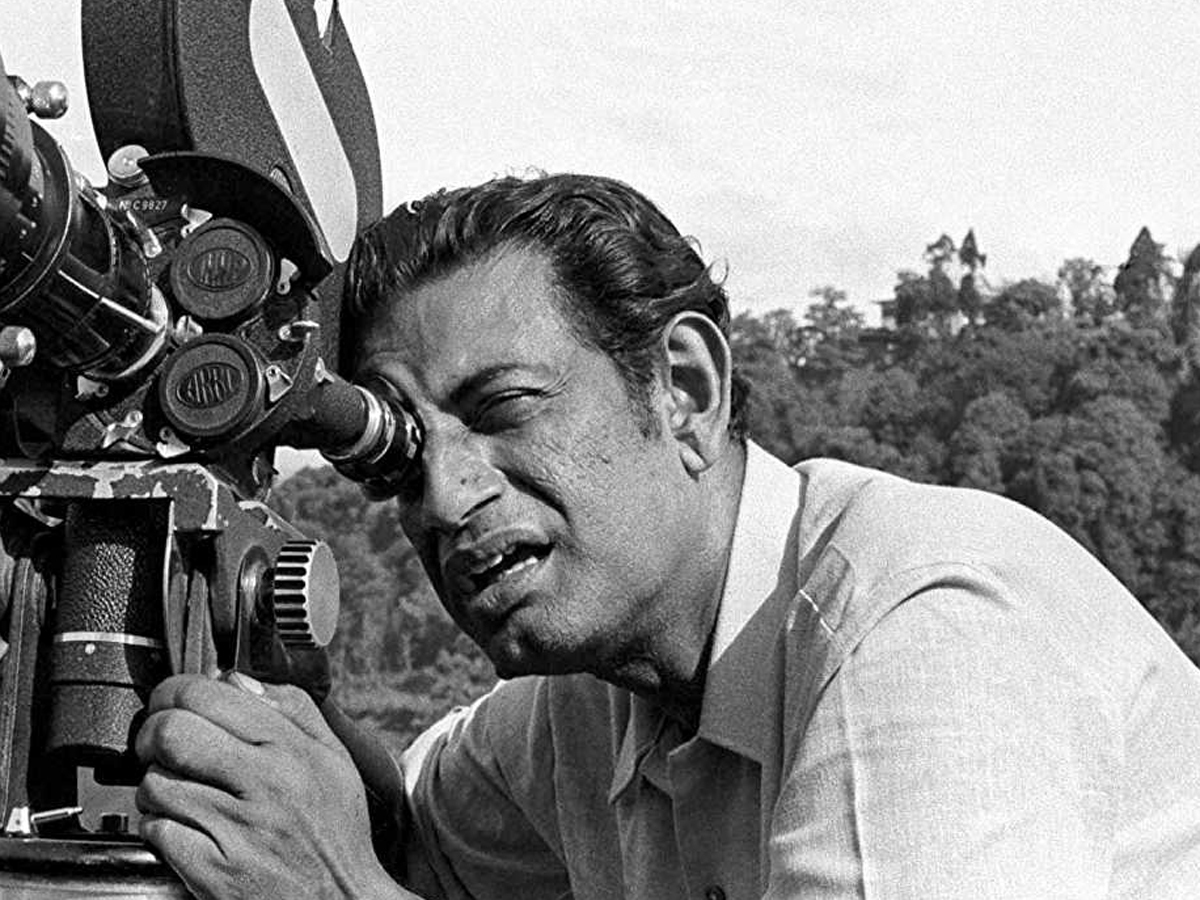
File:Satyajit_Ray_in_New_York_(cropped).jpg · Wikimedia Commons · See Wikimedia Commons
Satyajit Ray was an Indian filmmaker and writer who created influential films and stories during the 20th century. His work is considered important to cinema history and Indian culture, though the specific details of his impact and legacy would require additional context to fully explain.
AI-generated from the Wikipedia summary — may contain errors.
Film & TV
Calcutta, Bengal Presidency, British India [now India]
Satyajit Ray (2 May 1921 – 23 April 1992) was a Bengali Indian filmmaker, widely regarded as one of the greatest filmmakers of the 20th century. Ray was born in the city of Calcutta into a Bengali family prominent in the world of arts and literature. Starting his career as a commercial artist, Ray was drawn into independent filmmaking after meeting French filmmaker Jean Renoir and viewing…
Known for
- Manik da: The Mystique of Pather Panchali — Self (archive footage)2021
- Feluda: 50 Years of Ray's Detective — Self (archival footage)2019
- Ray: Life and Work of Satyajit Ray — Self (archive footage)1999
- The Tree — Self (archive footage)1998
- Satyajit Ray — Self1985
- The Music of Satyajit Ray — Self1984
- Indian Talkie — Self1981
- Creative Artists of India: Satyajit Ray — Self1974
- Spécial cinéma — Self1974
- The Inner Eye — Narrator (voice)1972
via TMDB
Official website
Satyajit Ray Org: Life, films and filmmaking of Satyajit Ray
Satyajit Ray Org has a mission of promoting discussion and study of Satyajit Ray’s films and filmmaking. Satyajit Ray (1921-1992), an Indian filmmaker and among the dozen or so great masters of world cinema, is known for his humanistic approach to cinema.
satyajitray.org →SatyajitRay.org has a mission of promoting study and discussion of Satyajit Ray’s films and filmmaking. SatyajitRay.org is not affiliated in any way with any Satyajit Ray Trust or the Ray family. The initial resources for this site were provided by Maanvi Media, a Bombay based media company. The site is designed and maintained by Sunil Singh, currently living in the San Francisco Bay Area, CA, USA. For over 30 years, Sunil has been a professional in the fields of Software Product Management, Solutions Architecture, User Experience Design, media and filmmaking. He has led design & production teams for software applications and media projects, including enterprise web applications, corporate web sites, marcom videos, documentary films/videos, print and TV commercials, and documentaries. Before moving to the Bay Area, Sunil was the founding CEO/Principal Designer of Maanvi Media at Bombay for over six years, where he led design and production of media projects for large corporate, multinational clients and nonprofit organizations.
Read more on their site →Excerpt from the official site · 11,048 chars · not written by Vinony
Wikidata facts
- Instance of
- human
- Gender
- male
- Citizenship
- India
- Place of birth
- Kolkata
- Place of death
- Kolkata
- Spouse
- Bijoya Ray
- Child
- Sandip Ray
- Father
- Sukumar Ray
- Occupation
- film critic
- Educated at
- Presidency University
- Languages spoken
- Bangla
- Native language
- Bangla
- Religion
- Hinduism
- Award
- Golden Lion
- Notable work
- Pather Panchali
- Official website
- www.satyajitray.org
- Image
- Satyajit Ray in New York (cropped).jpg
- Residence
- Kolkata
Show 17 more facts
- topic's main category
- Category:Satyajit Ray
- Commons category
- Satyajit Ray
- date of birth
- 1921-05-02
- name in native language
- সত্যজিৎ রায়
- date of death
- 1992-04-23
- nominated for
- Filmfare Award for Best Director
- influenced by
- Vittorio De Sica
- start of work period
- 1950-00-00
- filmography
- Satyajit Ray filmography
- end of work period
- 1991-00-00
- cause of death
- cardiovascular disease
- writing language
- Bangla
- related category
- Category:Films scored by Satyajit Ray
- IPA transcription
- ˈʃɔtːodʒit ˈrai̯
- P8168
- Bild
- manner of death
- natural causes
- described at URL
- baike.sogou.com/v56128542.htm
Sources (15)
via Wikidata · CC0
~40 min read
Encyclopedic overview
Satyajit Ray ( Bengali: [ˈʃotːodʒit ˈrae̯] ; 2 May 1921 – 23 April 1992) was an Indian film director, screenwriter, author, lyricist, magazine editor, illustrator, calligrapher, and composer. He is widely considered to be one of the greatest and most influential film directors in the history of cinema. He is celebrated for works including The Apu Trilogy (1955–1959), The Music Room (1958), The Big City (1963), Charulata (1964), and the Goopy–Bagha trilogy (1969–1992).
Ray was born in Calcutta to author Sukumar Ray and Suprabha Ray. Starting his career as a commercial artist, Ray was drawn into independent film-making after meeting French filmmaker Jean Renoir (who was in India to make his film The River) and viewing Vittorio De Sica's Italian neorealist film Bicycle Thieves (1948) during a visit to London. He started work on his first film after he returned from London.
Excerpted from Wikipedia’s “Satyajit Ray” article, available under the CC BY-SA 4.0 licence.
Gallery (10)
Available in 130 languages
- Español
- Français
- Deutsch
- 中文
- 日本語
- Русский
- Português
- Italiano
- العربية
- हिन्दी
- Afrikaans
- Albanian
- Albanian
- Aragonese
- Armenian
- Assamese
- Asturian
- azb
Show 111 more
- Azerbaijani
- Bahasa Indonesia
- Bangla
- Bashkir
- Basque
- bat_smg
- Bavarian
- be_x_old
- Belarusian
- Betawi
- Bislama
- Bosnian
- Breton
- btm
- Bulgarian
- Buriat
- Burmese
- Catalan
- Central Kurdish
- Chechen
- Cornish
- Crimean Tatar
- Croatian
- Czech
- Danish
- dty
- Egyptian Arabic
- Esperanto
- Estonian
- Fiji Hindi
- Filipino
- Finnish
- Galician
- Georgian
- Goan Konkani
- Greek
- Guarani
- Gujarati
- Haitian Creole
- Hebrew
- Icelandic
- Ido
- Iloko
- Kannada
- Kanuri
- Kazakh
- kbp
- Kurdish
- Latin
- Latvian
- Limburgish
- Lithuanian
- Lombard
- Low German
- Luxembourgish
- Madurese
- Maithili
- Malagasy
- Malay
- Malayalam
- Marathi
- Minangkabau
- Mingrelian
- Moroccan Arabic
- Nederlands
- Nepali
- Newari
- Norwegian
- Norwegian Nynorsk
- Occitan
- Odia
- Pampanga
- Piedmontese
- Polski
- Punjabi
- Quechua
- roa_tara
- Romanian
- Rusyn
- Sanskrit
- Santali
- Serbian
- Serbian (Latin)
- simple
- Sindhi
- Sinhala
- Slovenian
- Svenska
- Swahili
- Tajik
- Tamil
- Tatar
- Telugu
- Tiếng Việt
- Tulu
- Türkçe
- Ukrainian
- Urdu
- Uzbek
- Veps
- Waray
- Welsh
- Western Panjabi
- Wu Chinese
- Yiddish
- Zaza
- zh_min_nan
- zh_yue
- فارسی
- ไทย
- 한국어
via Wikidata sitelinks · CC0