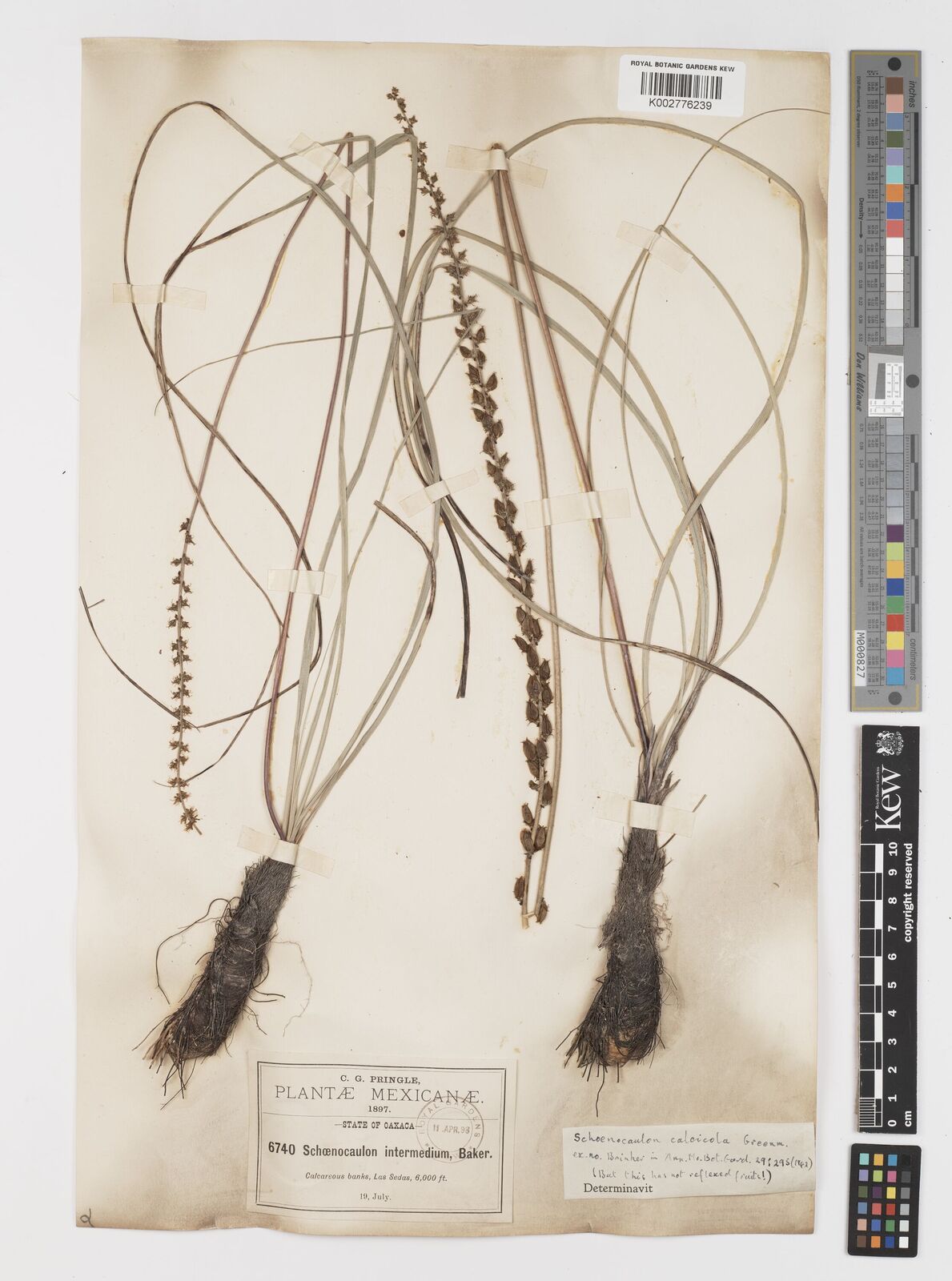
Schoenocaulon · Kew POWO · Kew Plants of the World Online
Schoenocaulon
Sign in to saveSchoenocaulon is a North American genus of perennial herbaceous flowering plants, ranging from the southern United States to Peru. It is a member of the Melanthiaceae, according to the APG III classification system, and is placed in the tribe Melanthieae. Unlike other genera in the tribe, the flowers are arranged in a spike; depending on the species the flower stalks for each flower are either very short or completely absent. Feathershank is a common name, the medicinally used S. officinale is called Sabadilla (pronunciation: /sab-uh-dil-uh/, IPA: /ˌsæb əˈdɪl ə/).
Species
GENUS
- KingdomPlantae
- PhylumTracheophyta
- ClassLiliopsida
- OrderLiliales
- FamilyMelanthiaceae
via GBIF · Kew POWO
Museum specimens
- Specimen records
- 128
- With media
- 79
- Family
- Melanthiaceae
- Collections
- ECOSUR, INECOL, FC-UNAM, IEA-UAT, IBUNAM, CIIDIR-IPN
- Recorded in
- Mexico, United States
Wikidata facts
- Instance of
- taxon
- Parent taxon
- Melanthiaceae
- Image
- Schoenocaulon officinale - Köhler–s Medizinal-Pflanzen-262.jpg
Show 5 more facts
- taxon rank
- genus
- taxon name
- Schoenocaulon
- Commons category
- Schoenocaulon
- topic's main category
- Category:Schoenocaulon
Sources (1)
via Wikidata · CC0
~2 min read
Encyclopedic overview
1 sectionsContents
- References
Schoenocaulon is a North American genus of perennial herbaceous flowering plants, ranging from the southern United States to Peru. It is a member of the Melanthiaceae, according to the APG III classification system, and is placed in the tribe Melanthieae. Unlike other genera in the tribe, the flowers are arranged in a spike; depending on the species the flower stalks for each flower are either very short or completely absent. Feathershank is a common name, the medicinally used S. officinale is called Sabadilla (pronunciation: /sab-uh-dil-uh/, IPA: /ˌsæb əˈdɪl ə/).
Plants generally grow in chaparral, oak, or pine forests. Grazing has narrowed the natural ranges of some species to only steep, rocky terrain. Mexico is the center of Schoenocaulon diversity, with 22 endemic species - some with distributions limited to single mountain ranges. The two species with the widest distributions, S. yucatanense (sometimes treated as part of S. ghiesbreghtii) and S. officinale (sabadilla), may have been spread by pre-Columbians who used the seeds as pesticides.
Excerpted from Wikipedia’s “Schoenocaulon” article, available under the CC BY-SA 4.0 licence.