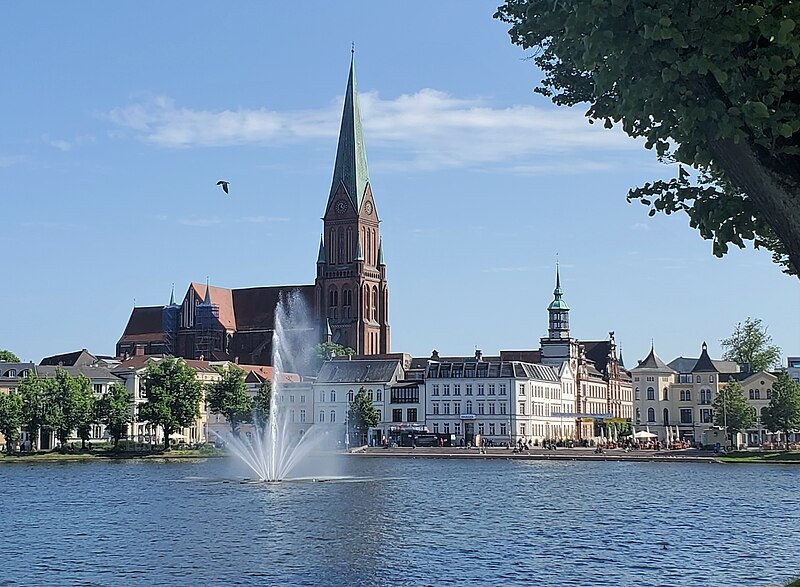
File:2023_Schwerin,_Dom,_Pfaffenteich.jpg · Wikimedia Commons · See Wikimedia Commons
Schwerin
Sign in to saveSchwerin () is the capital and second-largest city of the northeastern German state of Mecklenburg-Vorpommern as well as of the region of Mecklenburg, after Rostock. It has around 96,000 inhabitants, and is thus the least populous of all German state capitals.
Schwerin is the capital of Mecklenburg-Vorpommern, a state in northeastern Germany, and serves as the administrative center for the Mecklenburg region. Despite being a state capital, it is the least populous among all German state capitals, with approximately 96,000 residents.
AI-generated from the Wikipedia summary — may contain errors.
Weather now
7-day forecast
via Open-Meteo
Place details
- Locality
- Schwerin
- Region
- Mecklenburg-Vorpommern
- Country
- Deutschland
- Population
- 3,202
via OpenStreetMap · GeoNames
Key facts
- German place.area
- 130.46
- German place.type
- Town
- German place.image_coa
- DEU Schwerin COA.svg
- German place.image_flag
- Flagge Schwerin.svg
- German place.state
- Mecklenburg-Vorpommern
- German place.district
- urban
- German place.elevation
- 38
- German place.postal_code
- 19053, 19055, 19057, 19059, 19061, 19063
- German place.area_code
- 0385
- German place.licence
- SN
- German place.Gemeindeschlüssel
- 13 0 04 000
- German place.divisions
- 18 boroughs
- German place.website
- schwerin.de
- German place.mayor
- Bernd Nottebaum
- German place.leader_term
- 2026–30
- German place.Bürgermeistertitel
- Oberbürgermeister
- German place.party
- CDU
- UNESCO World Heritage Site.Name
- Schwerin Residence Ensemble
via Wikipedia infobox
Wikidata facts
- Official name
- Schwerin
- Country
- Germany
- Located in
- Grand Duchy of Mecklenburg-Schwerin
- Population
- 98733
- Area
- 130.52
- Elevation
- 52
- Time zone
- UTC+02:00
- Body of water
- Stör
- Shares border with
- Nordwestmecklenburg District
- Founded by
- Henry the Lion
- Official website
- www.schwerin.de
- Image
- 2019 - Schweriner Schloss - 1.jpg
- Dialing code
- 0385
- Licence plate code
- SN
Show 21 more facts
- twinned administrative body
- Växjö Municipality
- Commons category
- Schwerin
- postal code
- 19063
- topic's main category
- Category:Schwerin
- inception
- 1161-00-00
- category for people born here
- Category:Births in Schwerin
- category for people who died here
- Category:Deaths in Schwerin
- category of associated people
- Category:People from Schwerin
- Commons gallery
- Schwerin
- native label
- Schwerin
- short name
- Shw
- member of
- Mayors for Peace
- described by source
- Granat Encyclopedic Dictionary
- male population
- 46054
- female population
- 49764
- different from
- Schwerin
- P6482
- Schwerin
- P11012
- 1779
- P12749
- Jérémy Toulalan
- hashtag
- Schwerin
Sources (11)
via Wikidata · CC0
Travel guide
Understand
thumb|View over Schwerin
Zuarina was founded as a Slavic fortress in the 10th or 11th century. In the 12th century, it was conquered by Germans and the region was Christianised. Schwerin was made the seat of a county, that later evolved into the Duchy of Mecklenburg. While Schwerin remained the political centre, the Hanseatic seaports Rostock and Wismar were more prosperous and grew faster.
Around 1765, Duke Frederick II ("the Pious") moved his residence to Ludwigslust, a Baroque new town planned on a drawing board, 40 km south of Schwerin (like Louis XIV of France had moved his residence from Paris to Versailles). In 1837, the capital was moved back to Schwerin. Grand Duke Frederick Francis II who was on the throne from 1842 to 1883 had Schwerin's castle completely rebuilt in a fancyful, romantic style. It is now known as a "fairytale castle" or "Neuschwanstein of the north".
During the Cold War and German partition, Schwerin was one of East Germany's 15 district seats. Despite Rostock being larger, Schwerin remains the state capital of Mecklenburg-Western Pomerania, re-established after Germany's re-unification of 1990. Its regained political importance and its location within the Hamburg Metropolitan Region notwithstanding, Schwerin's population dropped by 30% between 1989 and 2012, recovering slightly since then. With around 98,000 inhabitants it is the smallest German state capital and the only state capital not to be a "Großstadt", a city above 100,000, as defined …
See
thumb|Schweriner Schloss (Schwerin Palace)
Do
thumb|Mecklenburg State Theatre Cycle around Lake Schwerin (), or only the nearer half of it (Innensee, )
Go next
Wismar, medieval seaport and mercantile city of the Hanseatic League, Unesco World Heritage, 30 km north (30 min by train) Ludwigslust, Mecklenburg's secondary residence during the Baroque era, dubbed "Versailles of Northern Germany", 38 km south (35 min by train) Poel, island in the Baltic Sea, 45 km north (one hour by train and bus via Wismar) Ratzeburg, former capital of the tiny Duchy of Lauenburg, surrounded by four lakes, 47 km west (1 hr 20 min by train via Büchen) Boltenhagen, Baltic sea resort, 50 km northwest (1 hr 20 min by train and bus via Wismar) Güstrow, 60 km east (50–55 min by train via Bützow or Bad Kleinen) Lübeck, 70 km northwest (1 hr 10 min by train via Bad Kleinen) Kühlungsborn, posh seaside resort, 75 km north Rostock, East Germany's major international port and biggest city of Mecklenburg-Western Pomerania, 90 km northeast (50–60 min by train) Stralsund, to see the Ozeaneum (2 hr by train) Prora, with treetop walks and tower.
Travel guide from Wikivoyage (CC BY-SA 4.0)
~20 min read
Encyclopedic overview
22 sectionsContents
- History
- Early years
- Recent times
- Population
- Geography
- Lakes
- Islands
- Boroughs
- Climate
- Education
- Transport
- Main sights
- Museums
- Crime rate
- Governance
- Twin towns – sister cities
- Notable people
- Aristocracy
- Sport
- Gallery
- References
- External links
Schwerin () is the capital and second-largest city of the northeastern German state of Mecklenburg-Vorpommern as well as of the region of Mecklenburg, after Rostock. It has around 96,000 inhabitants, and is thus the least populous of all German state capitals.
Schwerin is located on the southwestern shore of Lake Schwerin (Schweriner See), the second-largest lake of the Mecklenburg Lake Plateau after the Müritz, and there are eleven other lakes within Schwerin's city limits. The city is surrounded by the district of Northwestern Mecklenburg to the north, and the district of Ludwigslust-Parchim to the south. Schwerin and the two surrounding districts form the eastern outskirts of the Hamburg Metropolitan Region. The name of the city is of Slavic origin, deriving from the root "zvěŕ" (wild animal) or "zvěŕin" (game reserve, animal garden, stud farm).
Excerpted from Wikipedia’s “Schwerin” article, available under the CC BY-SA 4.0 licence.
Gallery (28)
On the map
3 mapped locations
Available in 109 languages
- Español
- Français
- Deutsch
- 中文
- 日本語
- Русский
- Português
- Italiano
- العربية
- हिन्दी
- Afrikaans
- Albanian
- Aragonese
- Armenian
- Aymara
- azb
- Azerbaijani
- Bahasa Indonesia
Show 90 more
- Basque
- Bavarian
- be_x_old
- Belarusian
- Breton
- Bulgarian
- Catalan
- Cebuano
- Central Kurdish
- Chechen
- Chuvash
- Croatian
- Czech
- Danish
- Egyptian Arabic
- Esperanto
- Estonian
- Finnish
- Galician
- Georgian
- Greek
- Hakka Chinese
- Hebrew
- Hungarian
- Icelandic
- Ido
- Interlingua
- Interlingue
- Irish
- Kazakh
- Kurdish
- Kyrgyz
- Latin
- Latvian
- Lithuanian
- lld
- Lombard
- Low German
- Lower Sorbian
- Macedonian
- Malagasy
- Malay
- Marathi
- Mingrelian
- Nederlands
- Nepali
- Northern Frisian
- Norwegian
- Norwegian Nynorsk
- Novial
- Occitan
- Old English
- Ossetic
- Piedmontese
- Polski
- Quechua
- Romanian
- Rusyn
- Sardinian
- Saterland Frisian
- Scots
- Scottish Gaelic
- Serbian
- Serbian (Latin)
- Silesian
- simple
- Slovak
- Svenska
- Swahili
- Tatar
- Tiếng Việt
- Türkçe
- Ukrainian
- Upper Sorbian
- Urdu
- Uzbek
- Venetian
- Veps
- Volapük
- Waray
- Welsh
- Western Frisian
- Wu Chinese
- Yoruba
- Zeelandic
- zh_min_nan
- zh_yue
- فارسی
- ไทย
- 한국어
via Wikidata sitelinks · CC0