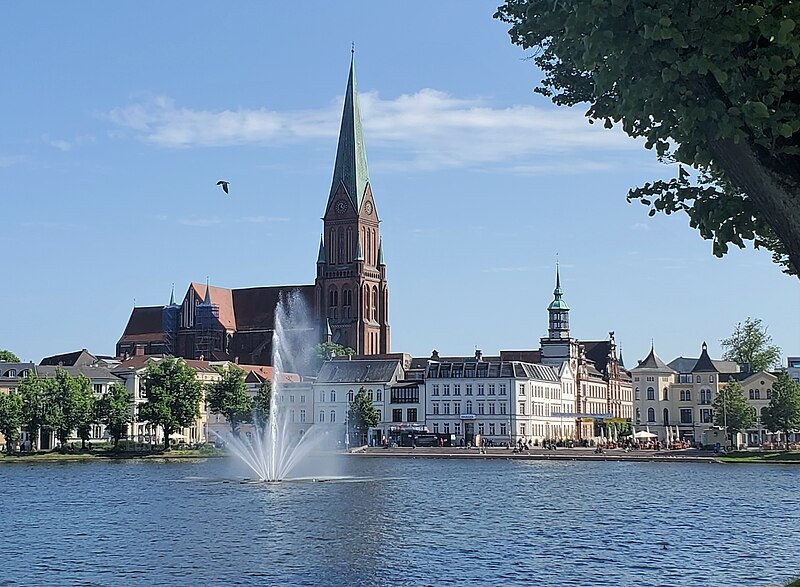
File:2023_Schwerin,_Dom,_Pfaffenteich.jpg · Wikimedia Commons · See Wikimedia Commons
Schwerin
capital do estado alemão de Mecklemburgo-Pomerânia Ocidental
AI overview
Schwerin is the capital of Mecklenburg-Vorpommern, a state in northeastern Germany, and serves as the administrative center for the Mecklenburg region. Despite being a state capital, it is the least populous among all German state capitals, with approximately 96,000 residents.
AI-generated from the Wikipedia summary — may contain errors.
Weather now
cached 2h ago12°overcast clouds
93% 2.7 m/s OpenWeatherMap
7-day forecast
via Open-Meteo
Place details
- Locality
- Schwerin
- Region
- Mecklenburg-Vorpommern
- Country
- Deutschland
- Population
- 3,202
via · GeoNames
Travel guide
Understand
thumb|View over Schwerin
Zuarina was founded as a Slavic fortress in the 10th or 11th century. In the 12th century, it was conquered by Germans and the region was Christianised. Schwerin was made the seat of a county, that later evolved into the Duchy of Mecklenburg. While Schwerin remained the political centre, the Hanseatic seaports Rostock and Wismar were more prosperous and grew faster.
Around 1765, Duke Frederick II ("the Pious") moved his residence to Ludwigslust, a Baroque new town planned on a drawing board, 40 km south of Schwerin (like Louis XIV of France had moved his residence from Paris to Versailles). In 1837, the capital was moved back to Schwerin. Grand Duke Frederick Francis II who was on the throne from 1842 to 1883 had Schwerin's castle completely rebuilt in a fancyful, romantic style. It is now known as a "fairytale castle" or "Neuschwanstein of the north".
During the Cold War and German partition, Schwerin was one of East Germany's 15 district seats. Despite Rostock being larger, Schwerin remains the state capital of Mecklenburg-Western Pomerania, re-established after Germany's re-unification of 1990. Its regained political importance and its location within the Hamburg Metropolitan Region notwithstanding, Schwerin's population dropped by 30% between 1989 and 2012, recovering slightly since then. With around 98,000 inhabitants it is the smallest German state capital and the only state capital not to be a "Großstadt", a city above 100,000, as defined …
See
thumb|Schweriner Schloss (Schwerin Palace)
Do
thumb|Mecklenburg State Theatre Cycle around Lake Schwerin (), or only the nearer half of it (Innensee, )
Go next
Wismar, medieval seaport and mercantile city of the Hanseatic League, Unesco World Heritage, 30 km north (30 min by train) Ludwigslust, Mecklenburg's secondary residence during the Baroque era, dubbed "Versailles of Northern Germany", 38 km south (35 min by train) Poel, island in the Baltic Sea, 45 km north (one hour by train and bus via Wismar) Ratzeburg, former capital of the tiny Duchy of Lauenburg, surrounded by four lakes, 47 km west (1 hr 20 min by train via Büchen) Boltenhagen, Baltic sea resort, 50 km northwest (1 hr 20 min by train and bus via Wismar) Güstrow, 60 km east (50–55 min by train via Bützow or Bad Kleinen) Lübeck, 70 km northwest (1 hr 10 min by train via Bad Kleinen) Kühlungsborn, posh seaside resort, 75 km north Rostock, East Germany's major international port and biggest city of Mecklenburg-Western Pomerania, 90 km northeast (50–60 min by train) Stralsund, to see the Ozeaneum (2 hr by train) Prora, with treetop walks and tower.
Article · Português
Schwerin é uma cidade da Alemanha, capital do Estado (Bundesland) de Mecklemburgo-Pomerânia Ocidental. Com 96 542 habitantes (30 de Junho de 2006), a cidade é a menor das capitais estaduais; sua área é de 130,46 km² e a densidade demográfica, de 740 habitantes por quilômetro quadrado. Schwerin é a sede da orquestra alemã Mecklenburgische Staatskapelle. Schwerin é uma cidade independente (Kreisfreie Städte) ou distrito urbano (Stadtkreis), ou seja, possui estatuto de distrito (kreis).
Abstract from DBpedia / Wikipedia · CC BY-SA
Gallery (28)
On the map
3 mapped locations