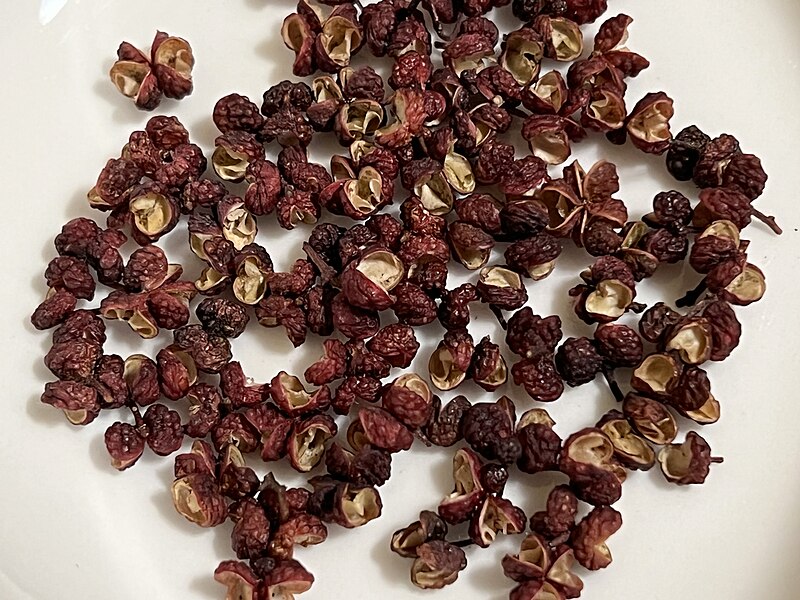
File:Sichuan_pepper.jpg · Wikimedia Commons · See Wikimedia Commons
Key facts
- Chinese
- 花椒
- Hanyu pinyin
- huājiāo
- Wade giles
- hua -chiao
- Ipa
- [xwa ́ .tɕja ́ ʊ]
- Yale romanization
- fāa-jīu
- Jyutping
- faa -ziu
- Hokkien poj
- hoa-chio
- T i l
- hua-tsio
via Wikipedia infobox
Wikidata facts
- Instance of
- food ingredient
- Subclass of
- peppercorn
- Image
- Poivre fond blanc.jpg
Show 3 more facts
- Commons category
- Sichuan pepper
- natural product of taxon
- Zanthoxylum piperitum
- cuisine
- Japanese cuisine
via Wikidata · CC0
~8 min read
Encyclopedic overview
Sichuan pepper (Chinese: 花椒; pinyin: huājiāo) is a spice made from the dried pericarp (outer shell of the fruit) of a plant of the genus Zanthoxylum in the family Rutaceae. It is commonly used in Sichuan cuisine of China and in the cuisines of the Himalayas. Despite its name, Sichuan pepper is not closely related to black pepper or chili pepper. Instead, Zanthoxylum plants are in the same family as citrus and rue.
When eaten, Sichuan pepper produces a tingling, numbing effect due to the presence of hydroxy-alpha sanshool. It is used in Sichuan dishes such as mapo doufu and Chongqing hot pot, and is often added to chili peppers to create a flavor known as málà (Chinese: 麻辣; 'numb-spiciness').
Excerpted from Wikipedia’s “Sichuan pepper” article, available under the CC BY-SA 4.0 licence.