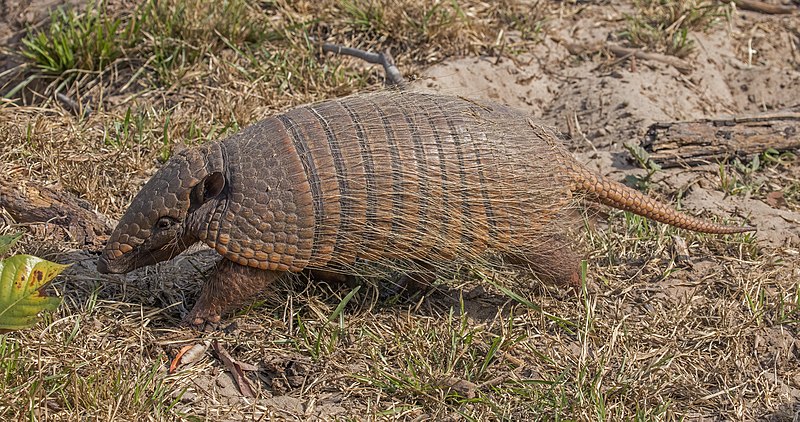
File:Six-banded_armadillo_(Euphractus_sexcinctus).JPG · Wikimedia Commons · See Wikimedia Commons
OverviewAI-generated
The six-banded armadillo, scientifically named *Euphractus sexcinctus*, is a species within the genus *Euphractus*. It is also referred to as the Gualacate, Yellow Armadillo, or Six-banded Armadillo. This mammal has a mass of 105 and a gestation period of 62. Its litter size is 2, and the longest observed lifespan is 22.1.
The species is distributed across South America, with records from Bolivia, Brazil, Uruguay, and Paraguay. Its taxon range is also noted as Bacabal. The IUCN Red List assessed its conservation status as Least Concern in 2025.
Synthesized by Vinony from 23 facts across 5 sources: Wikidata, iNaturalist, IUCN Red List, Encyclopedia of Life, Vinony graph. Generated from structured data (not the Wikipedia text) and checked against those facts — may still contain errors.
Species
Least ConcernSix-banded Armadillo
species
六帶犰狳(學名Euphractus sexcinctus),也叫黃犰狳,是生活在南美的一種犰狳,分布於玻利維亞、巴西、烏拉圭、巴拉圭等地區,體色為黃色或紅褐色。
via IUCN
Wikidata facts
- Instance of
- taxon
- Parent taxon
- Euphractus
- Mass
- 4.68
- Image
- Euphractus sexcinctus2.jpg
Show 11 more facts
- taxon rank
- species
- IUCN conservation status
- Least Concern
- taxon name
- Euphractus sexcinctus
- Commons category
- Euphractus sexcinctus
- Commons gallery
- Euphractus sexcinctus
- taxon common name
- armadillu / tatú de seis bandes
- gestation period
- 62
- litter size
- 2
- longest observed lifespan
- 22.1
- short name
- E. sexcinctus
- taxon range
- Bacabal
via Wikidata · CC0
~10 min read
Encyclopedic overview
The six-banded armadillo (Euphractus sexcinctus), also known as the yellow armadillo, is an armadillo found in South America. The sole extant member of its genus, it was first described by Swedish zoologist Carl Linnaeus in 1758. The six-banded armadillo is typically between 40 and 50 centimeters (16 and 20 in) in head-and-body length, and weighs 3.2 to 6.5 kilograms (7.1 to 14.3 lb). The carapace (hard shell on the back) is pale yellow to reddish brown, marked by scales of equal length, and scantily covered by buff to white bristle-like hairs. The forefeet have five distinct toes, each with moderately developed claws.
Six-banded armadillos are efficient diggers and form burrows to live in and search for prey. The armadillo is alert and primarily solitary. An omnivore, it feeds on insects, ants, carrion, and plant material. Due to their poor eyesight, armadillos rely on their sense of smell to detect prey and predators. Births take place throughout the year; gestation is 60 to 64 days long, after which a litter of one to three is born. Weaning occurs at one month, and juveniles mature by nine months. The six-banded armadillo inhabits savannas, primary and secondary forests, cerrados, shrublands, and deciduous forests. Fairly common, its range spans from Brazil and southern Suriname in the northeast through Bolivia, Paraguay, and Uruguay into northern Argentina in the southeast. The International Union for the Conservation of Nature and Natural Resources (IUCN) classifies it as least concern, and there are no major threats to its survival.
Excerpted from Wikipedia’s “six-banded armadillo” article, available under the CC BY-SA 4.0 licence.