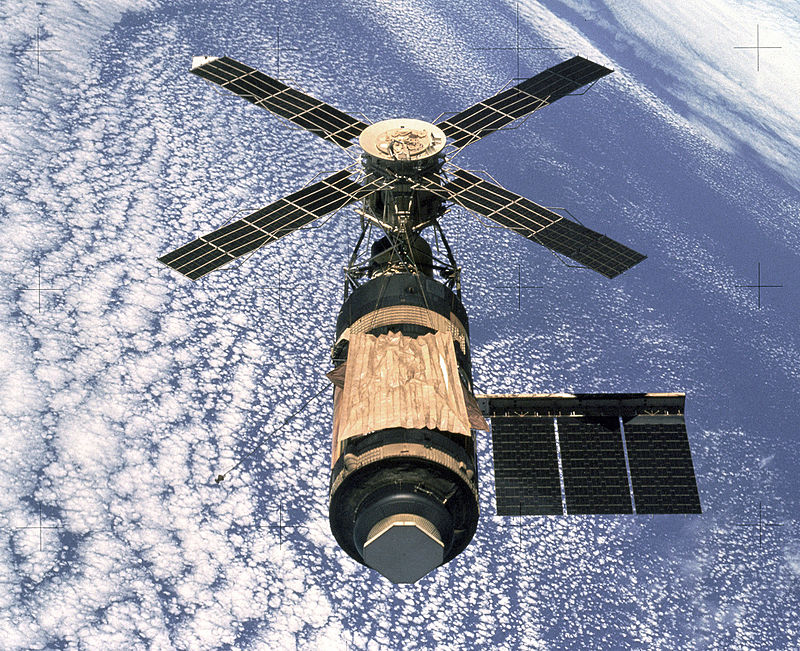
File:Skylab_(SL-4).jpg · Wikimedia Commons · See Wikimedia Commons
Skylab
Sign in to saveStation spatiale orbitale américaine, 1973-1974
Skylab was America's first space station, launched by NASA in 1973 and occupied by three rotating crews of astronauts for about six months while conducting hundreds of experiments, solar observations, and Earth studies. The station was built from a repurposed rocket stage and eventually fell back to Earth in 1979, ending its operational life.
AI-generated from the Wikipedia summary — may contain errors.
Key facts
- Space station.COSPAR_ID
- 1973-027A
- Space station.SATCAT
- 6633
- Space station.station
- Skylab
- Space station.station_image
- Skylab (SL-4).jpg
- Space station.station_image_caption
- Skylab as photographed by its departing final crew (Skylab 4).
- Space station.insignia
- Skylab Program Patch.png
- Space station.insignia_caption
- Skylab program insignia
- Space station.sign
- Skylab
- Space station.crew
- 3 per mission (9 total)
- Space station.launch
- May 14, 1973 17:30:00 UTC ( years ago)
- Space station.carrier_rocket
- Saturn VAS-513
- Space station.launch_pad
- Kennedy LC-39A
- Space station.status
- Deorbited
- Space station.reentry
- July 11, 1979 16:37:00 UTC
- Space station.mass
- w/o Apollo CSM
- Space station.length
- w/o Apollo CSM
- Space station.width
- w/ one solar panel
- Space station.height
- w/ telescope mount
via Wikipedia infobox
Wikidata facts
- Instance of
- space station
- Country
- United States
- Operator
- NASA
- Country of origin
- United States
- Parent body
- Earth
- Diameter
- 6.6
- Mass
- 76295
- Orbital period
- 93.4
- Image
- Skylab (SL-4).jpg
- Height
- 11.1
- Width
- 17
- Length
- 25.1
Show 15 more facts
- Commons category
- Skylab (space station)
- time of object orbit decay
- 1979-07-11
- UTC date of spacecraft launch
- 1973-05-14
- space launch vehicle
- Saturn V
- Commons gallery
- Skylab
- type of orbit
- low Earth orbit
- orbits completed
- 34981
- crew members
- William R. Pogue
- start point
- Kennedy Space Center Launch Complex 39A
- maximum capacity
- 3
- call sign
- Skylab
- orbital inclination
- 50
- apoapsis
- 442
- periapsis
- 434
- volume as quantity
- 351.6
Sources (6)
via Wikidata · CC0
Article · Français
Skylab (abréviation de Sky Laboratory, « Laboratoire du ciel » en français) est la première station spatiale lancée par l'agence spatiale américaine, la NASA. Elle est développée dans le cadre du Programme des applications Apollo mis en place en 1965 pour donner une suite au programme Apollo. Le projet est lancé dans un contexte de réduction budgétaire des dépenses spatiales américaines et l'architecture retenue repose essentiellement sur la réutilisation de composants existants. La station spatiale est un ensemble long de 35 mètres et d'une masse de 90 tonnes dont le module principal est réalisé à partir du troisième étage de la fusée lunaire géante Saturn V. Skylab est mise en orbite le 14 mai 1973. Au cours de son lancement, la station perd une partie de son et un de ses panneaux solaires. Le premier équipage, qui la rejoint quelques jours plus tard, doit d'abord restaurer son habitabilité. Trois équipages y séjournent entre 1973 et 1974, dont le dernier, durant près de 84 jours, établit un nouveau record. Les astronautes réalisent à bord de nombreuses observations scientifiques, en particulier l'observation du Soleil grâce à une batterie d'instruments et l'étude de l'adaptation de l'homme à l'espace. À l'issue de ces missions et faute de lanceurs disponibles et de budget, la station est mise en sommeil en attendant la mise au point de la Navette spatiale américaine en cours de développement. Mais le planning de ce projet prend du retard et l'intensité inattendue de l'activité solaire dégrade plus rapidement que prévu l'orbite de la station spatiale, qui se désintègre en rentrant dans l'atmosphère le 11 juillet 1979.
Abstract from DBpedia / Wikipedia · CC BY-SA
Gallery (52)
Available in 68 languages
- Español
- Français
- Deutsch
- 中文
- 日本語
- Русский
- Português
- Italiano
- العربية
- Afrikaans
- Aragonese
- Armenian
- Asturian
- Azerbaijani
- Bahasa Indonesia
- Bangla
- Basque
- Bosnian
Show 49 more
- Bulgarian
- Catalan
- Central Kurdish
- Croatian
- Czech
- Danish
- Egyptian Arabic
- Esperanto
- Estonian
- Finnish
- Galician
- Greek
- Hebrew
- Hungarian
- Ido
- Irish
- Kazakh
- Latvian
- Lithuanian
- Luxembourgish
- Macedonian
- Malay
- Malayalam
- Nederlands
- Norwegian
- Norwegian Nynorsk
- Pashto
- Polski
- Romanian
- Serbian
- Serbian (Latin)
- simple
- Sindhi
- Sinhala
- Slovak
- Slovenian
- Svenska
- Tamil
- Telugu
- Tiếng Việt
- Türkçe
- Ukrainian
- Urdu
- Uzbek
- Welsh
- Wu Chinese
- فارسی
- ไทย
- 한국어
via Wikidata sitelinks · CC0