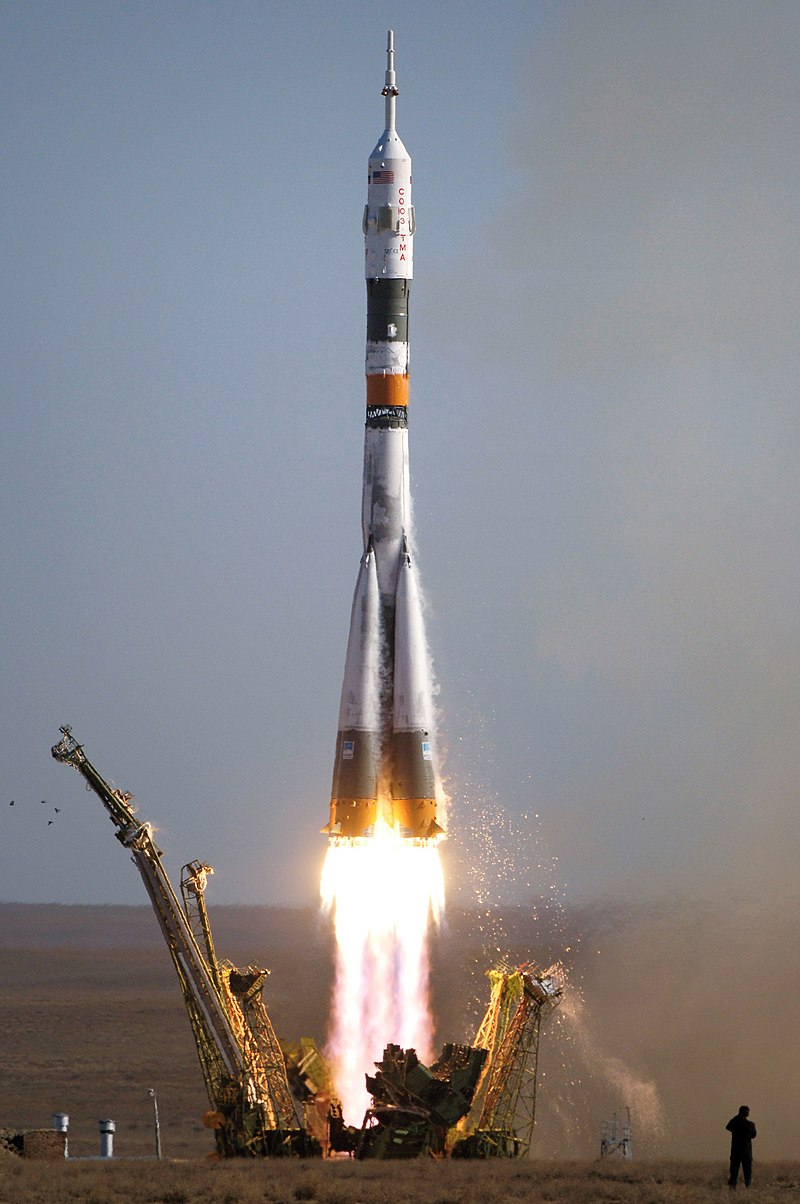
File:Soyuz_TMA-9_launch.jpg · Wikimedia Commons · See Wikimedia Commons
rocket
Sign in to saveAlso known as rockets
alt=|thumb|upright|A Soyuz-FG rocket launches from "[[Gagarin's Start" (Site 1/5), Baikonur Cosmodrome ]] A rocket (from , and so named for its shape) is an elongated flying vehicle that uses a rocket engine to accelerate without using any surrounding air. A rocket engine produces thrust by reaction to exhaust expelled at high speed. Unlike jet engines, rockets are fuelled entirely by propellant which they carry, without the need for oxygen from air; consequently a rocket can fly in the vacuum of space, indeed rocket engines operate more efficiently outside the atmosphere.
A rocket is an elongated vehicle powered by a rocket engine that expels exhaust at high speed to create thrust, allowing it to fly even in the vacuum of space where there is no air. Rockets matter because they carry all their own fuel and don't need oxygen from the air to operate, making them uniquely capable of reaching space and beyond, unlike jet engines that depend on atmospheric air.
AI-generated from the Wikipedia summary — may contain errors.
Wikidata facts
- Subclass of
- vehicle
- Part of
- spacecraft propulsion
- Image
- Chinese rocket.png
- Has use
- propulsion
Show 9 more facts
- Unicode character
- 🙮
- Commons category
- Rockets
- equivalent class
- dbpedia.org/ontology/Rocket
- topic's main category
- Category:Rockets
- Commons gallery
- Rocket
- different from
- rocket
- model item
- launch vehicle
- described by source
- Brockhaus and Efron Encyclopedic Dictionary
- on focus list of Wikimedia project
- Wikipedia:Vital articles/Level/4
via Wikidata · CC0
~55 min read
Encyclopedic overview
36 sectionsContents
- History
- Types
- Design
- Components
- Engines
- Propellant
- Pendulum rocket fallacy
- Uses
- Military
- Science and research
- Spaceflight
- Rescue
- Hobby, sport, and entertainment
- Flight
- Noise
- Physics
- Operation
- Forces on a rocket in flight
- Drag
- Net thrust
- Total impulse
- Specific impulse
- Delta-v (rocket equation)
- Mass ratios
- Staging
- Acceleration and thrust-to-weight ratio
- Energy
- Energy efficiency
- Oberth effect
- Safety, reliability and accidents
- Costs and economics
- 2010s emerging private competition
- See also
- Notes
- References
- External links
alt=|thumb|upright|A Soyuz-FG rocket launches from "[[Gagarin's Start" (Site 1/5), Baikonur Cosmodrome ]] A rocket (from , and so named for its shape) is an elongated flying vehicle that uses a rocket engine to accelerate without using any surrounding air. A rocket engine produces thrust by reaction to exhaust expelled at high speed. Unlike jet engines, rockets are fuelled entirely by propellant which they carry, without the need for oxygen from air; consequently a rocket can fly in the vacuum of space, indeed rocket engines operate more efficiently outside the atmosphere.
Multistage rockets are capable of attaining escape velocity from Earth and therefore can achieve unlimited maximum altitude. Compared with airbreathing engines, rockets are lightweight and powerful and capable of generating large accelerations. To control their flight, rockets may use momentum, airfoils, auxiliary reaction engines, gimballed thrust, momentum wheels, deflection of the exhaust stream, propellant flow, and spin, or may simply fly in a ballistic trajectory under the influence of gravity.
Excerpted from Wikipedia’s “rocket” article, available under the CC BY-SA 4.0 licence.
Gallery (52)
Available in 117 languages
- Español
- Français
- Deutsch
- 中文
- 日本語
- Русский
- Português
- Italiano
- العربية
- हिन्दी
- Afrikaans
- Albanian
- Albanian
- Aragonese
- Armenian
- Asturian
- azb
- Azerbaijani
Show 98 more
- Bahasa Indonesia
- Bangla
- Bashkir
- Basque
- be_x_old
- Belarusian
- blk
- Bosnian
- Breton
- Bulgarian
- Burmese
- Catalan
- Central Kurdish
- Croatian
- Czech
- Danish
- Egyptian Arabic
- Esperanto
- Estonian
- Filipino
- Finnish
- Galician
- Gan Chinese
- gcr
- Georgian
- Greek
- Haitian Creole
- Hausa
- Hebrew
- Hungarian
- Ido
- Irish
- Jamaican Creole English
- Javanese
- Kannada
- Kara-Kalpak
- Kazakh
- Kurdish
- Kyrgyz
- Latin
- Latvian
- Lithuanian
- Luxembourgish
- Macedonian
- Malay
- Malayalam
- Marathi
- Minangkabau
- Mirandese
- Moroccan Arabic
- Nederlands
- Nepali
- Newari
- Norwegian
- Norwegian Nynorsk
- Occitan
- Oromo
- Papiamento
- Piedmontese
- Polski
- Punjabi
- Quechua
- Romanian
- Serbian
- Serbian (Latin)
- Sicilian
- simple
- Sindhi
- Sinhala
- Slovak
- Slovenian
- Sundanese
- Svenska
- Swahili
- Tamil
- Taroko
- Tatar
- Telugu
- Tiếng Việt
- Tulu
- Türkçe
- Turkmen
- Tyap
- Ukrainian
- Urdu
- Uyghur
- Uzbek
- Waray
- Welsh
- Western Panjabi
- Wolof
- Wu Chinese
- zh_min_nan
- zh_yue
- Zulu
- فارسی
- ไทย
- 한국어
via Wikidata sitelinks · CC0