File:Euler_diagram_of_solar_system_bodies.svg · Wikimedia Commons · See Wikimedia Commons
small Solar System body
Sign in to saveobject in the Solar System that is neither a planet, nor a dwarf planet, nor a satellite
A small Solar System body is any object in our Solar System that isn't a planet, dwarf planet, or moon—which includes asteroids, comets, and other rocky or icy fragments. Understanding these bodies matters because they help scientists learn about the early history of our Solar System and can pose potential risks or opportunities if their orbits bring them near Earth.
AI-generated from the Wikipedia summary — may contain errors.
Wikidata facts
- Subclass of
- substellar object
- Part of
- Solar System
Show 3 more facts
- Commons category
- Small Solar System bodies
- topic's main category
- Category:Small Solar System bodies
- topic has template
- Template:Small Solar System bodies
via Wikidata · CC0
~4 min read
Encyclopedic overview
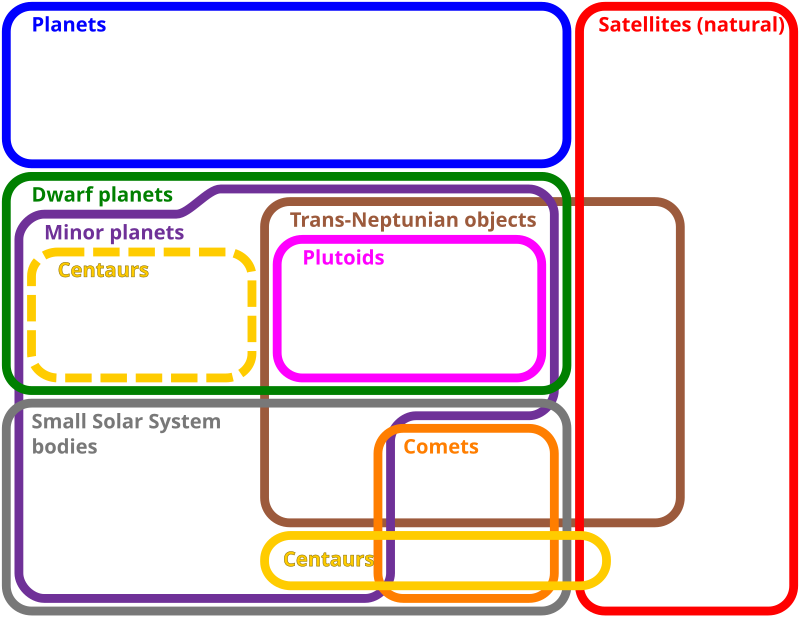
Euler diagram showing the types of bodies in the Solar System A small Solar System body (SSSB) is an object in the Solar System that is neither a planet, a dwarf planet, nor a natural satellite. The term was first defined in 2006 by the International Astronomical Union (IAU) as follows: "All other objects, except satellites, orbiting the Sun shall be referred to collectively as 'Small Solar System Bodies'".
This encompasses all comets and all minor planets other than those that are dwarf planets. Thus SSSBs are: the comets; the classical asteroids, with the exception of the dwarf planet Ceres; the trojans; and the centaurs and trans-Neptunian objects, with the exception of the dwarf planets Pluto, Haumea, Makemake, Quaoar, Orcus, Sedna, Gonggong and Eris and others that may turn out to be dwarf planets.
Excerpted from Wikipedia’s “small Solar System body” article, available under the CC BY-SA 4.0 licence.
Gallery (2)
Available in 61 languages
- Español
- Français
- Deutsch
- 中文
- 日本語
- Русский
- Português
- Italiano
- العربية
- हिन्दी
- Afrikaans
- Armenian
- Bahasa Indonesia
- Bangla
- Basque
- be_x_old
- Belarusian
- Bosnian
Show 42 more
- Breton
- Catalan
- Central Kurdish
- Chuvash
- Croatian
- Czech
- Danish
- Estonian
- Finnish
- Galician
- Hebrew
- Ido
- Irish
- Kabyle
- Kazakh
- Latvian
- Lithuanian
- Low German
- Luxembourgish
- Macedonian
- Malay
- Marathi
- Mingrelian
- Nederlands
- Norwegian
- Norwegian Nynorsk
- Oromo
- Polski
- Romanian
- Serbian
- Serbian (Latin)
- simple
- Slovak
- Slovenian
- Svenska
- Tiếng Việt
- Türkçe
- Ukrainian
- Urdu
- فارسی
- ไทย
- 한국어
via Wikidata sitelinks · CC0