
File:Wikipedia_homepage_on_a_large_Android_phone,_2015-04-16.jpg · Wikimedia Commons · See Wikimedia Commons
smartphone
Sign in to saveAlso known as smart phone, smartphones
thumb|A Nexus 6, an Android smartphone, displaying the [[Main Page of the English Wikipedia]]
OverviewAI-generated
A smartphone is a subject described by the Unicode characters "📱" and "📲". It is associated with the hashtag "smartphone" and categorized under the Commons category "Smartphones" and gallery "Smartphone". The term appears in a PubMed query with a count of 38,414.
The subject is referenced by 5,793 other encyclopedia articles. It is detailed in a BBC Bitesize article titled "A history of mobile phones and smartphones - BBC Bitesize," which describes the evolution of a communications revolution. This content has a character count of 7,693 and is grounded. Additional descriptions are available at URLs from BBC Bitesize, The Guardian, and Springer Link.
Synthesized by Vinony from 13 facts across 4 sources: Wikidata, Firecrawl, PubMed, Vinony graph. Generated from structured data (not the Wikipedia text) and checked against those facts — may still contain errors.
Research
38,414 papers- Is smartphone addiction really an addiction?ReviewJournal of behavioral addictions · 2018Panova T, Carbonell XDOI: 10.1556/2006.7.2018.49
- Smartphone-Based Hand Function Assessment: Systematic Review.Journal of medical Internet research · 2024Fu Y, Zhang Y, Ye B et al.DOI: 10.2196/51564
- Smartphone based lateral flow immunoassay quantifications.ReviewJournal of immunological methods · 2024Park JDOI: 10.1016/j.jim.2024.113745
- Smartphone technology and its applications in urology: a review of the literature.ReviewWorld journal of urology · 2020Tapiero S, Yoon R, Jefferson F et al.DOI: 10.1007/s00345-019-02960-y
- Clinically useful smartphone ophthalmic imaging techniques.ReviewGraefe's archive for clinical and experimental ophthalmology = Albrecht von Graefes Archiv fur klinische und experimentelle Ophthalmologie · 2021Pujari A, Saluja G, Agarwal D et al.DOI: 10.1007/s00417-020-04917-z
- Review of smartphone funduscopy for diabetic retinopathy screening.ReviewSurvey of ophthalmology · 2024Vaughan NDOI: 10.1016/j.survophthal.2023.10.006
- Smartphone-Based Tracking of Sleep in Depression, Anxiety, and Psychotic Disorders.ReviewCurrent psychiatry reports · 2019Aledavood T, Torous J, Triana Hoyos AM et al.DOI: 10.1007/s11920-019-1043-y
- Smartphone and Mobile App Use Among Physicians in Clinical Practice: Scoping Review.JMIR mHealth and uHealth · 2023Lee M, Bin Mahmood ABS, Lee ES et al.DOI: 10.2196/44765
via PubMed
Described at
A history of mobile phones and smartphones - BBC Bitesize
The evolution of a communications revolution
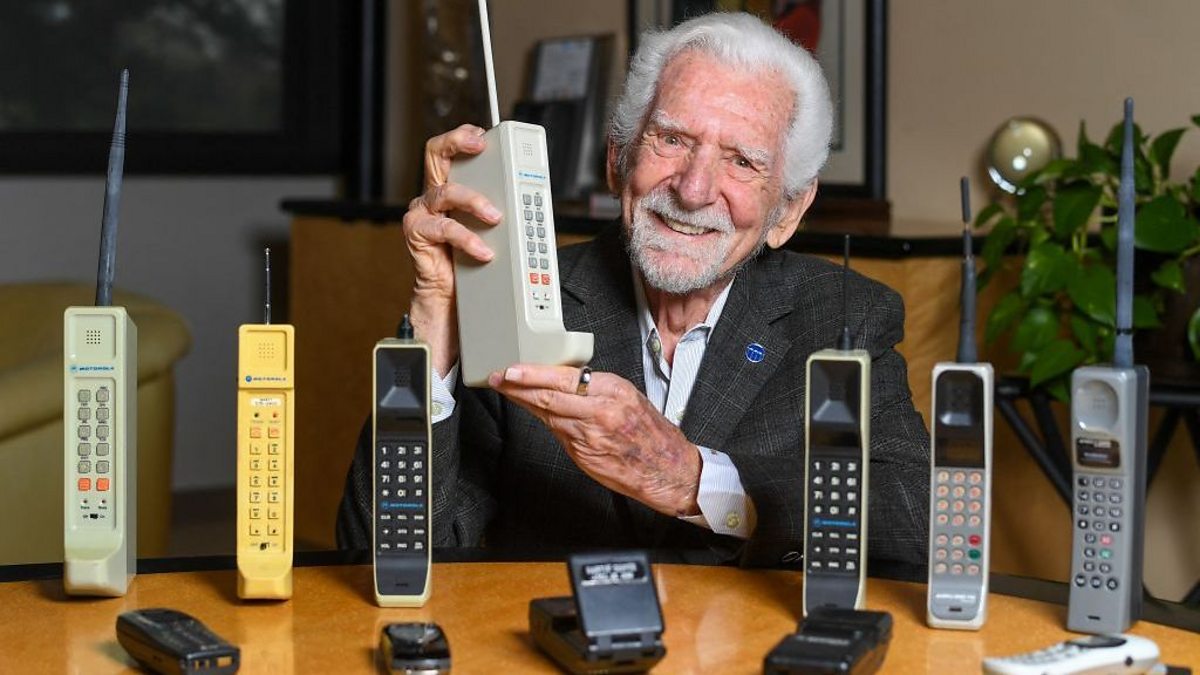
bbc.co.uk →Events such as the Mobile World Congress where the most remarkable advances in technology are on display, from phones we can wrap around our wrist to transparent laptop screens - show just how big a deal the industry is. Compared to other popular products, such as TVs and bicycles, mobile phones and smartphones are still so young; their story only began in the final part of the 20th Century. But it’s definitely a history worth calling up, as BBC Bitesize discovers. The first call made from a mobile phone happened on 3 April 1973 in New York City. It was made by the engineer Marty Cooper, who worked at the telecommunications firm Motorola and the call was to a rival at his company’s competitor, Bell Laboratories. For that price tag, mobile phone owners could telephone other people - but that was it. Texting, social media and camera capabilities would come (much) later. Its battery took 10 hours to charge, providing 30 minutes of use and a 15cm (6in) antenna had to be extended before making a call. It also weighed 790g (1.7lbs) - around four times as heavy as an iPhone. In the beginning, mobile phones were largely used by businesspeople who were on the go, needed to be in contact with clients and colleagues throughout the day and - perhaps most significantly - could afford them. They used what are seen as the first generation of mobile phone, affectionately referred to as 'bricks' today due to their large size in comparison to today's models. The second generation of mobile phone became a more regular sight in the street. These phones used the new 2G signal (which also means ‘second generation’) and when they arrived in the 1990s, more teenagers became mobile phone users. The ability to text was available for the first time, on handsets which were now a lot smaller and easier to handle than the Dynatac 8000X. From 1997, some mobile phones included games (Snake was very popular!) and it was in 1999 that cameras appeared on mobiles for the first time. The 1990s saw many developments in mobile phone technology and it was in 1996 that the internet appeared on a handset for the first time. This particular device, the 9000 Communicator, was made by the Finnish firm Nokia. Regarded as revolutionary, the Communicator could be opened up to reveal a keyboard and screen. It even featured prominently in the 1997 film The Saint. Val Kilmer played the title hero - using his phone to get him out of a pickle whenever necessary. One device that is often seen as the first smartphone is the IBM Simon from 1994. It had a touchscreen, ability to send a fax, and also an email and calendar function. The BlackBerry, launched in 1999, is also seen as as having smartphone capabilities. It had a keyboard instead of the traditional telephone buttons on its casing and was useful for sending and receiving emails. The smartphone as we are more likely to know it today first appeared in January 2007, when Steve Jobs of Apple announced the iPhone to an excited crowd in San Francisco. It combined the music player, the iPod, with internet capabilities and a touch screen mobile phone. In its second version, the iPhone 3G, users were also able to download apps of their choice from an online store. 1984: Motorola's Dynatac 8000x is the world's first commercially available mobile phone. 1992: First SMS (Short Message Service) - also known as a text - is sent. 1994: First mobile game appears on the Hagenuk MT-2000 - a version of the ever popular Tetris. 1997: Nokia introduces the popular Snake game. 1999: BlackBerry phones appear for the first time. Popular for their messaging service. 1999/2000: Mobile phones are on the market with a back-facing camera, perfect for taking a family photo. 2001: The 3G (third generation) phone network launches. 2003: Phones with a front-facing camera become popular, enabling us to take a selfie. They first appeared in Japan in 1999. 2007: The first Apple iPhone is launched. 2008: The first Android smartphone is launched. 2013:
Excerpt from a page describing this subject · 7,693 chars · not written by Vinony
Wikidata facts
- Subclass of
- electronic device
- Material used
- semiconductor
- Image
- 手机续航大横评!到底谁的电池最耐用?-00.00.26.845.png
Show 8 more facts
- Unicode character
- 📲
- hashtag
- smartphone
- Commons category
- Smartphones
- topic's main category
- Category:Smartphones
- Commons gallery
- Smartphone
- different from
- personal digital assistant
- has effect
- disruptive innovation
- described at URL
- link.springer.com/chapter/10.1007/978-3-319-94319-0_2
Sources (9)
via Wikidata · CC0
~54 min read
Encyclopedic overview
69 sectionsContents
- History
- Hardware
- Central processing unit
- Buttons
- Display
- Screen sizes
- Panel types
- Alternative input methods
- Notification light
- Sensors
- Common sensors
- Rare sensors
- Storage
- Memory cards
- File transfer
- Sound
- Audio connector
- Battery
- Charging
- Power management
- Cameras
- Space constraints
- Dedicated camera button
- Back cover materials
- Accessories
- Software
- Mobile operating systems
- Android
- iOS
- Sailfish OS
- Tizen
- Ubuntu Touch
- Discontinued operating systems
- Bada
- BlackBerry 10
- Firefox OS
- MeeGo/Maemo/Moblin
- Palm OS
- Symbian
- webOS
- Windows 10 Mobile
- Mobile apps
- Application stores
- List of current smartphone brands
- Sales
- By manufacturer
- By operating system
- Use
- Contemporary use and convergence
- Mobile banking and payment
- Facsimile
- Films
- Criticism and issues
- Social impacts
- Manufacture
- Use
- While driving
- Legal
- Medical
- Impacts on cognition and mental health
- Security
- Sleep
- Restrictions and bans
- Replacement of dedicated digital cameras
- Lifespan
- See also
- Notes
- References
- External links
thumb|A Nexus 6, an Android smartphone, displaying the [[Main Page of the English Wikipedia]]
A smartphone is a mobile device that combines the functionality of a traditional mobile phone with advanced computing capabilities. It typically has a touchscreen interface, allowing users to access a wide range of applications and services, such as web browsing, email, and social media, as well as multimedia playback and streaming. Smartphones have built-in cameras, GPS navigation, and support for various communication methods, including voice calls, text messaging, and internet-based messaging apps. Smartphones are distinguished from older-design feature phones by their more advanced hardware capabilities and extensive mobile operating systems, access to the internet, business applications, mobile payments, and multimedia functionality, including music, video, gaming, radio, and television.
Excerpted from Wikipedia’s “smartphone” article, available under the CC BY-SA 4.0 licence.
Gallery (52)
Available in 123 languages
- Español
- Français
- Deutsch
- 中文
- 日本語
- Русский
- Português
- Italiano
- العربية
- हिन्दी
- Afrikaans
- Albanian
- Albanian
- Angika
- Armenian
- Arpitan
- Assamese
- Asturian
Show 104 more
- Azerbaijani
- Bahasa Indonesia
- Bangla
- Basque
- Bavarian
- be_x_old
- Belarusian
- Bhojpuri
- Bikol
- Bosnian
- Breton
- Bulgarian
- Catalan
- Central Kurdish
- Croatian
- Czech
- Danish
- Esperanto
- Estonian
- Filipino
- Finnish
- Galician
- gcr
- Georgian
- Greek
- Haitian Creole
- Hakka Chinese
- Hebrew
- Hungarian
- Icelandic
- Ido
- Interlingua
- Interlingue
- Irish
- Kannada
- Kara-Kalpak
- Kashmiri
- Kazakh
- Lao
- Latgalian
- Latin
- Latvian
- Lithuanian
- Lombard
- Luxembourgish
- Macedonian
- Malagasy
- Malay
- Malayalam
- Marathi
- Mingrelian
- Mongolian
- nds_nl
- Nederlands
- Newari
- Northern Frisian
- Norwegian
- nup
- Occitan
- Old English
- Ossetic
- Palatine German
- Polski
- Punjabi
- Quechua
- Romanian
- Romansh
- Sango
- Scots
- Serbian
- Serbian (Latin)
- Sicilian
- simple
- Sindhi
- Sinhala
- Slovak
- Slovenian
- Somali
- Svenska
- Swahili
- Tajik
- Tamil
- Tatar
- Telugu
- Tiếng Việt
- Toki Pona
- Türkçe
- Ukrainian
- Urdu
- Uzbek
- Venetian
- Walloon
- Waray
- Wayuu
- Welsh
- Western Frisian
- Western Panjabi
- Wu Chinese
- zh_min_nan
- zh_yue
- Zulu
- فارسی
- ไทย
- 한국어
via Wikidata sitelinks · CC0