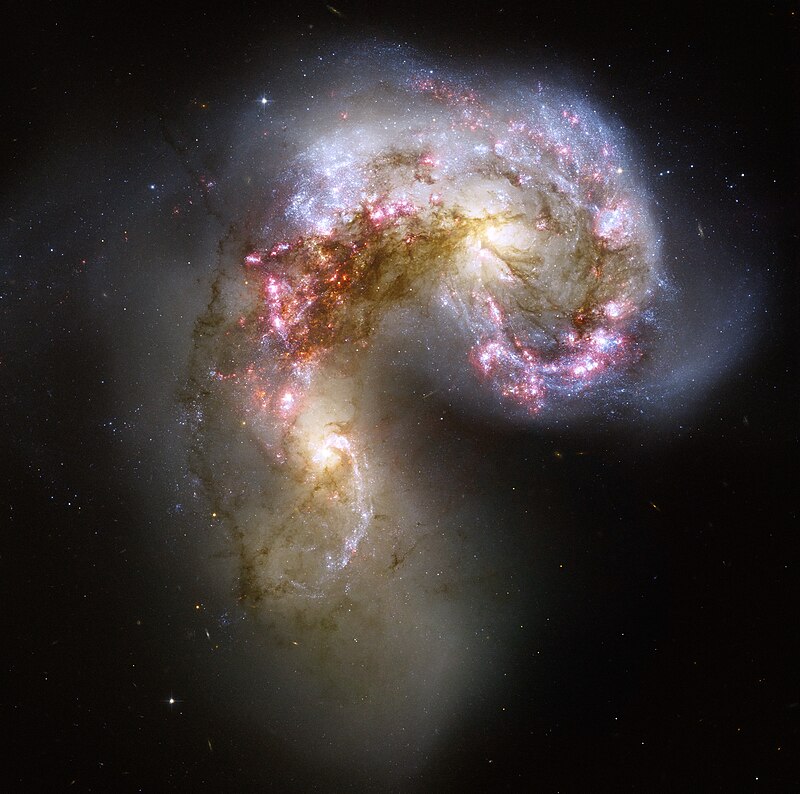
File:Antennae_galaxies_xl.jpg · Wikimedia Commons · See Wikimedia Commons
starburst galaxy
Sign in to savegalaxy undergoing an exceptionally high rate of star formation
Wikidata facts
- Subclass of
- galaxy
- Image
- NGC 1569.jpg
Show 3 more facts
- Commons category
- Starburst galaxies
- topic's main category
- Category:Starburst galaxies
- on focus list of Wikimedia project
- Wikipedia:Vital articles/Level/4
Sources (1)
via Wikidata · CC0
~14 min read
Encyclopedic overview
The Antennae Galaxies are an example of a starburst galaxy occurring from the collision of NGC 4038/NGC 4039. Credit: NASA/ESA. A starburst galaxy is one undergoing an exceptionally high rate of star formation, as compared to the long-term average rate of star formation in the galaxy, or the star formation rate observed in most other galaxies.
For example, the star formation rate of the Milky Way galaxy is approximately 3 M☉/yr, while starburst galaxies can experience star formation rates of 100 M☉/yr or more. While many main-sequence galaxies use up their molecular gas reservoir in 1-2 Gyr, the high rate of star formation in starbursts can deplete all of their star-forming material in scales of 0.1 Gyr - much shorter than the age of the galaxy. As such, the starburst nature of a galaxy is a phase, and one that typically occupies a brief period of a galaxy's evolution. The majority of starburst galaxies are in the midst of a merger or close encounter with another galaxy. Starburst galaxies include M82, NGC 4038/NGC 4039 (the Antennae Galaxies), and IC 10.
Excerpted from Wikipedia’s “starburst galaxy” article, available under the CC BY-SA 4.0 licence.