File:Isomerism.svg · Wikimedia Commons · See Wikimedia Commons
stereochemistry
Sign in to saveAlso known as 3D chemistry, three-dimensional chemistry, stereoanalysis
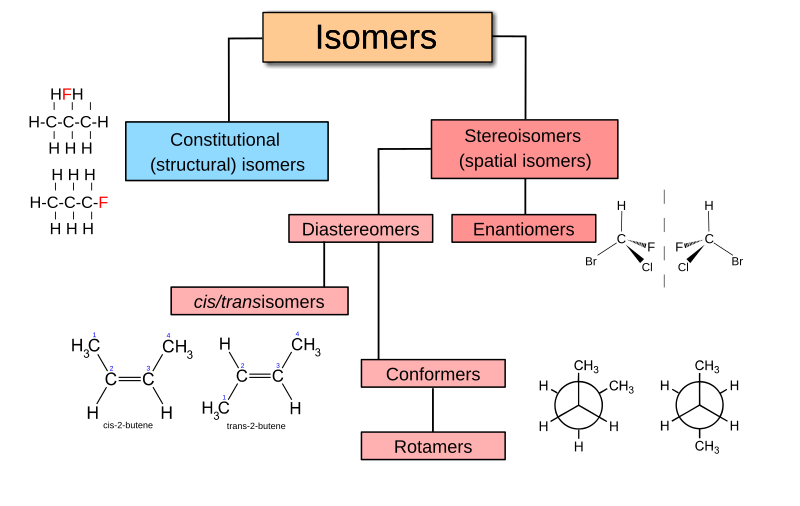
thumb|right|400px|The different types of isomers. Stereochemistry focuses on [[stereoisomers.]]
Stereochemistry is the branch of chemistry that studies stereoisomers—molecules with the same atoms connected in the same order, but arranged differently in three-dimensional space. It matters because these different spatial arrangements can lead to dramatically different properties and biological effects, such as why one version of a drug might be beneficial while another is harmful.
AI-generated from the Wikipedia summary — may contain errors.
Wikidata facts
- Instance of
- field of study
- Part of
- chemistry
- Image
- Chirality with hands.svg
Show 5 more facts
- is the study of
- absolute configuration
- topic has template
- Template:Navbox stereochemistry
- topic's main category
- Category:Stereochemistry
- Commons category
- Stereochemistry
- described by source
- New International Encyclopedia
Sources (5)
via Wikidata · CC0
~8 min read
Encyclopedic overview
9 sectionsContents
- <span class="anchor" id="Visual notation"></span> Visual representations
- Thalidomide example
- Diastereomers
- Epimers
- Cis-Trans isomers
- Atropisomers
- History
- See also
- References
thumb|right|400px|The different types of isomers. Stereochemistry focuses on [[stereoisomers.]]
Stereochemistry, a subdiscipline of chemistry, studies the spatial arrangement of atoms that form the structure of molecules and their manipulation. The study of stereochemistry focuses on the relationships between stereoisomers, which are defined as having the same molecular formula and sequence of bonded atoms (constitution) but differing in the geometric positioning of the atoms in space. For this reason, it is also known as 3D chemistry—the prefix "stereo-" means "three-dimensionality" because many of the types of stereochemistry are based on 3D geometric relationships. Stereochemistry applies to all kinds of compounds and ions, organic and inorganic species alike. Stereochemistry affects biological, physical, and supramolecular chemistry.
Excerpted from Wikipedia’s “stereochemistry” article, available under the CC BY-SA 4.0 licence.