File:Faraday_and_Daniell.jpg · Wikimedia Commons · See Wikimedia Commons
electrochemistry
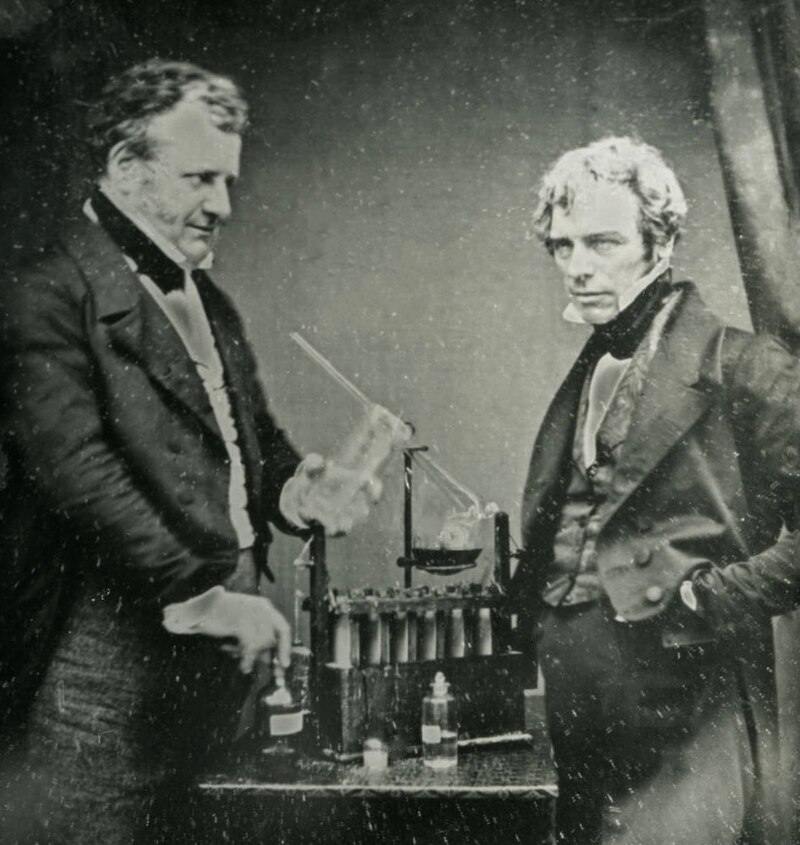
Sign in to savethumb|English chemist John Frederic Daniell|John Daniell (left) and physicist [[Michael Faraday (right), both credited as founders of electrochemistry]] Electrochemistry is the branch of physical chemistry concerned with the relationship between electrical potential difference and identifiable chemical change. These reactions involve electrons moving via an electronically conducting phase (typically an external electric circuit, but not necessarily, as in electroless plating) between electrodes separated by an ionically conducting and electronically insulating electrolyte (or ionic species in
Electrochemistry is the branch of chemistry that studies how electrical energy and chemical reactions relate to each other, involving the movement of electrons between electrodes through circuits or other pathways. It matters because it helps explain and control important processes like batteries, corrosion, and metal plating that affect everyday technology and industry.
AI-generated from the Wikipedia summary — may contain errors.
Research
57,572 papers- Electrochemistry under confinement.ReviewChemical Society reviews · 2022Jaugstetter M, Blanc N, Kratz M et al.DOI: 10.1039/d1cs00789k
- Graphdiyne Electrochemistry: Progress and Perspectives.ReviewSmall (Weinheim an der Bergstrasse, Germany) · 2022Chen X, Jiang X, Yang NDOI: 10.1002/smll.202201135
- Advances in microbial electrochemistry-enhanced constructed wetlands.ReviewWorld journal of microbiology & biotechnology · 2022Li X, Cheng M, Jiao X et al.DOI: 10.1007/s11274-022-03413-2
- Dynamic Chemistry Interactions: Controlled Single-Entity Electrochemistry.ReviewThe journal of physical chemistry letters · 2022Lu SM, Li MY, Long YTDOI: 10.1021/acs.jpclett.2c00960
- Electrochemistry of nucleic acids.ReviewChemical reviews · 2012Paleček E, Bartošík MDOI: 10.1021/cr200303p
- Electrochemistry/Photoelectrochemistry-Based Immunosensing and Aptasensing of Carcinoembryonic Antigen.ReviewSensors (Basel, Switzerland) · 2021Jiang J, Xia J, Zang Y et al.DOI: 10.3390/s21227742
- Combinatorial electrochemistry.ReviewCurrent opinion in chemical biology · 2001Yudin AK, Siu TDOI: 10.1016/s1367-5931(00)00202-7
- Electrochemistry.Proceedings of the National Academy of Sciences of the United States of America · 2012Bard AJ, Murray RWDOI: 10.1073/pnas.1209943109
via PubMed
Wikidata facts
- Subclass of
- physical chemistry
- Part of
- physical chemistry
- Image
- Schemas electrolyse h2o.svg
Show 5 more facts
- Commons category
- Electrochemistry
- topic's main category
- Category:Electrochemistry
- Stack Exchange tag
- chemistry.stackexchange.com/tags/electrochemistry
- on focus list of Wikimedia project
- Wikipedia:Vital articles/Level/4
- history of topic
- history of electrochemistry
Sources (6)
via Wikidata · CC0
~46 min read
Encyclopedic overview
36 sectionsContents
- History
- 16th–18th century
- 19th century
- 20th century
- Principles
- Oxidation and reduction
- Balancing redox reactions
- Acidic medium
- Basic medium
- Neutral medium
- Electrochemical cells
- Standard electrode potential
- Spontaneity of redox reaction
- Cell EMF dependency on changes in concentration
- Nernst equation
- Concentration cells
- Battery
- Corrosion
- Iron corrosion
- Corrosion of common metals
- Prevention of corrosion
- Coating
- Sacrificial anodes
- Electrolysis
- Electrolysis of molten sodium chloride
- Electrolysis of water
- Electrolysis of aqueous solutions
- Electrolysis of a solution of sodium chloride
- Quantitative electrolysis and Faraday's laws
- First law
- Second law
- Applications
- See also
- References
- Bibliography
- External links
thumb|English chemist John Frederic Daniell|John Daniell (left) and physicist [[Michael Faraday (right), both credited as founders of electrochemistry]] Electrochemistry is the branch of physical chemistry concerned with the relationship between electrical potential difference and identifiable chemical change. These reactions involve electrons moving via an electronically conducting phase (typically an external electric circuit, but not necessarily, as in electroless plating) between electrodes separated by an ionically conducting and electronically insulating electrolyte (or ionic species in a solution).
When a chemical reaction is driven by an electrical potential difference, as in electrolysis, or if a potential difference results from a chemical reaction as in an electric battery or fuel cell, it is called an electrochemical reaction. In electrochemical reactions, unlike in other chemical reactions, electrons are not transferred directly between atoms, ions, or molecules, but via the aforementioned electric circuit. This phenomenon is what distinguishes an electrochemical reaction from a conventional chemical reaction.
Excerpted from Wikipedia’s “electrochemistry” article, available under the CC BY-SA 4.0 licence.
Gallery (24)
Available in 78 languages
- Español
- Français
- Deutsch
- 中文
- 日本語
- Русский
- Português
- Italiano
- العربية
- हिन्दी
- Afrikaans
- Albanian
- Armenian
- Asturian
- azb
- Azerbaijani
- Bahasa Indonesia
- Bangla
Show 59 more
- Basque
- be_x_old
- Belarusian
- Bikol
- Bosnian
- Bulgarian
- Burmese
- Catalan
- Central Kurdish
- Croatian
- Czech
- Danish
- Esperanto
- Estonian
- Finnish
- Galician
- Gorontalo
- Greek
- Hebrew
- Hungarian
- Kazakh
- Latin
- Latvian
- Lithuanian
- Lombard
- Luxembourgish
- Macedonian
- Malay
- Mongolian
- Nederlands
- Norwegian
- Occitan
- Polski
- Romanian
- Scots
- Serbian
- Serbian (Latin)
- Sicilian
- simple
- Sindhi
- Slovak
- Slovenian
- Sundanese
- Svenska
- Tamil
- Tiếng Việt
- Türkçe
- Ukrainian
- Urdu
- Uzbek
- Waray
- Welsh
- Western Frisian
- Wu Chinese
- zh_min_nan
- zh_yue
- فارسی
- ไทย
- 한국어
via Wikidata sitelinks · CC0