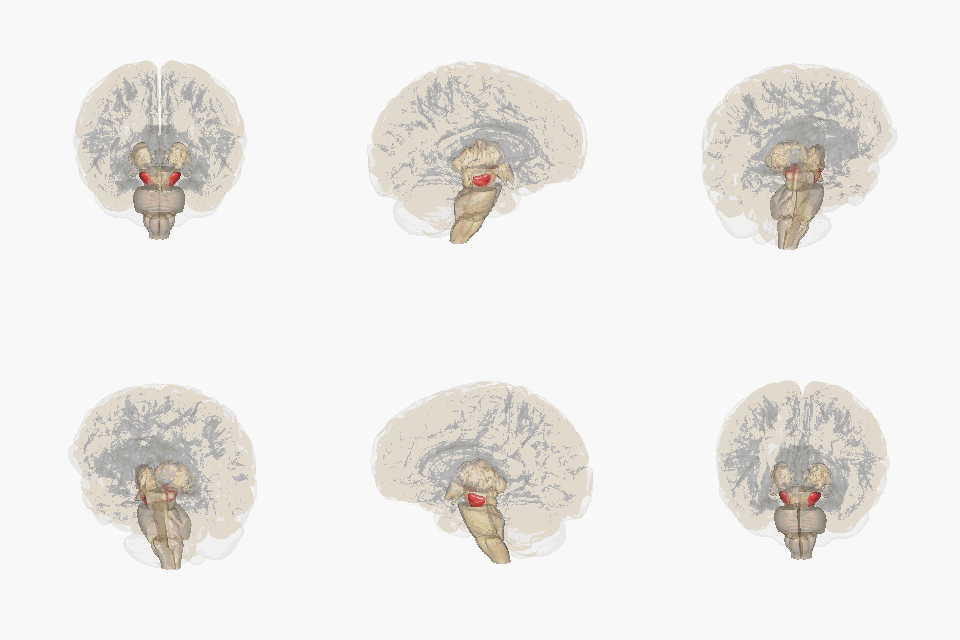
File:Substantia_nigra.gif · Wikimedia Commons · See Wikimedia Commons
Key facts
- Part of
- Midbrain , basal ganglia
- Latin
- substantia nigra
- Acronym
- SN
- Mesh
- D013378
- Neurolex id
- birnlex_789
- Ta98
- A14.1.06.111
via Wikipedia infobox
Research
33,225 papers- Substantia nigra control of basal ganglia nuclei.Journal of neural transmission. Supplementum · 2009
- Spatiotemporal changes in substantia nigra neuromelanin content in Parkinson's disease.Brain : a journal of neurology · 2020
- Substantia Nigra Free Water Increases Longitudinally in Parkinson Disease.AJNR. American journal of neuroradiology · 2018
- Neuromelanin of the human substantia nigra: an update.Neurotoxicity research · 2014
- Anatomy of the substantia nigra and subthalamic nucleus on MR imaging.Neuroimaging clinics of North America · 2010
via PubMed
Wikidata facts
- Part of
- cerebral peduncle
- Image
- Substantia nigra.gif
Show 2 more facts
- Commons category
- Substantia nigra
- NCI Thesaurus ID
- C12453
via Wikidata · CC0
~21 min read
Encyclopedic overview
The substantia nigra (SN) is a basal ganglia structure located in the midbrain that plays an important role in reward and movement. Substantia nigra is Latin for "black substance", reflecting the fact that parts of the substantia nigra appear darker than neighboring areas due to high levels of neuromelanin in dopaminergic neurons. Parkinson's disease is characterized by the loss of dopaminergic neurons in the substantia nigra pars compacta.
Although the substantia nigra appears as a continuous band in brain sections, anatomical studies have found that it actually consists of two parts with very different connections and functions: the pars compacta (SNpc) and the pars reticulata (SNpr). The pars compacta serves mainly as a projection to the basal ganglia circuit, supplying the striatum with dopamine. The pars reticulata conveys signals from the basal ganglia to numerous other brain structures.
Excerpted from Wikipedia’s “substantia nigra” article, available under the CC BY-SA 4.0 licence.