
Suriname
Sign in to saveAlso known as sr, Surrinam, Surinam, Republic of Suriname, Republic of Surinam, Dutch Guiana
Suriname, officially the Republic of Suriname, is a country in northern South America, also considered as part of the Caribbean and the West Indies. Situated slightly north of the equator, over 90% of its territory is covered by rainforest, the highest proportion of forest cover in the world. Suriname is bordered by the Atlantic Ocean to the north, French Guiana to the east, Brazil to the south, and Guyana to the west. It is the smallest country in South America by both population and territory, with around inhabitants in 2021 in an area of approximately . The capital and largest city is Param
OverviewAI-generated
Suriname, officially the Republic of Suriname, is a sovereign state in South America. It shares borders with France, Guyana, and Brazil, as well as the European Union. The capital city is Paramaribo. The country’s official language is Dutch, and its anthem is God zij met ons Suriname. Suriname is a member of the United Nations, the Union of South American Nations, the World Trade Organization, and the Dutch Language Union.
The population is recorded at 616,500 or 634,431, with 65.7641857200885 percent living in urban areas. The area covers 163,820 square kilometers, and 94.44758351333 percent of the land is forested. The highest point is Julianatop. The currency includes the Surinamese dollar and the Surinamese guilder. The top-level Internet domain is .sr, and the telephone country code is 597. The head of state is Jennifer Geerlings-Simons.
Synthesized by Vinony from 71 facts across 10 sources: Wikidata, REST Countries, Openweathermap, Open Meteo, World Bank, OpenStreetMap, Firecrawl, PubMed, Vinony graph, Geo. Generated from structured data (not the Wikipedia text) and checked against those facts — may still contain errors.
In the Vinony graph
Suriname is indexed among the 215 entries in Vinony's Countries collection.
Within Vinony's link graph, Suriname is referenced by 9,556 other articles, and connects out to Central Suriname Nature Reserve, history of Suriname and indentured servant.
The entry is geolocated on the map in city, across 6 mapped points.
It sits within the topics 1975 establishments in South America, Countries and territories where Dutch is an official language and Countries in South America.
Weather now
cached 20h ago7-day forecast
via Open-Meteo
Country
- Capital
- Paramaribo
- Population
- 616,500
- Region
- Americas · South America
- Demonym
- Surinamer
- Currencies
- SRD ($)
- Languages
- Dutch
- Calling code
- +597
- Drives on
- Left
- Gini
- 57.9 (1999)
- FIFA code
- SUR
- TLD
- .sr
- Timezones
- UTC-03:00
- Borders
- BRA, GUF, GUY
via REST Countries
Indicators · World Bank
- GDP
- $4.4B(2024)
- Population
- 634,431(2024)
- Life expectancy
- 73.8 yrs(2024)
- Unemployment
- 7.8 %(2025)
- Urban population
- 65.8 %(2024)
- Internet users
- 87.4 %(2023)
- Forest area
- 94.4 %(2023)
- Renewable energy
- 14.5 %(2021)
via World Bank Open Data · CC BY 4.0
Wikipedia views (30d)
123,777 totalvia Wikimedia Pageviews API
Key facts
- Country.conventional_long_name
- Republic of Suriname
- Country.common_name
- Suriname
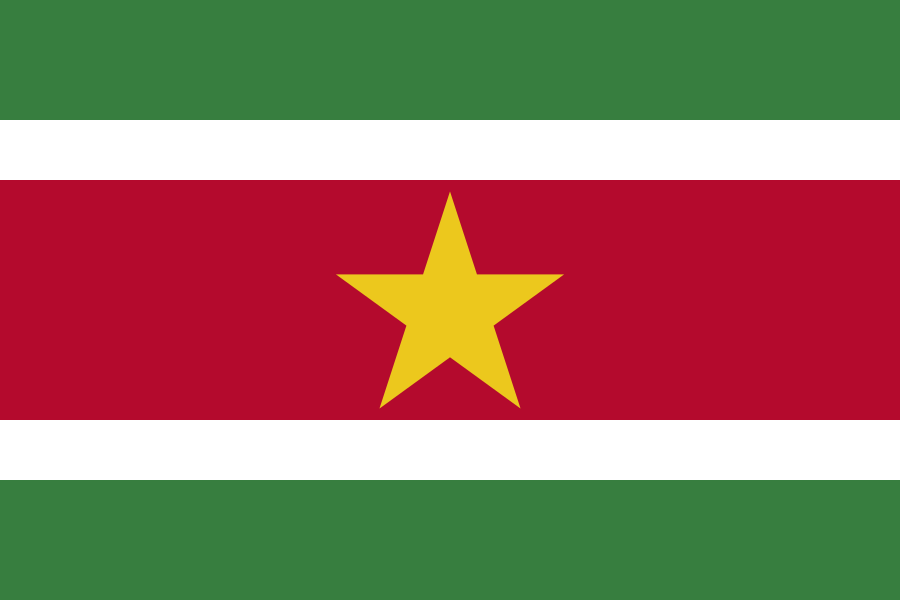
- Country.image_flag
- Flag of Suriname.svg
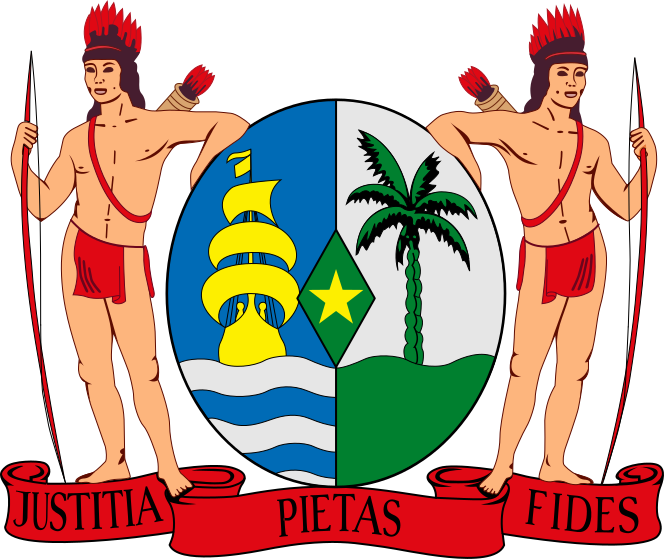
- Country.image_coat
- Coat of arms of Suriname.svg
- Country.national_motto
- "Justice – Piety – Trust"
- Country.national_anthem
- "God be with our Suriname"
- Country.image_map
- SURINAME orthographic.svg
- Country.map_caption
- Land controlled by Suriname shown in dark green; claimed land shown in light green.
- Country.capital
- Paramaribo
- Country.largest_city
- Paramaribo
- Country.official_languages
- Dutch
- Country.languages_type
- Lingua franca
- Country.languages
- Sranan Tongo
- Country.ethnic_groups_year
- 2012
- Country.religion_year
- 2012
- Country.religion
- 21.65% Roman Catholicism
- Country.demonym
- Surinamese
- Country.government_type
- Unitary assembly-independent presidential republic
via Wikipedia infobox
Research
1,988 papers- Blood banking services in Suriname.ReviewTransfusion and apheresis science : official journal of the World Apheresis Association : official journal of the European Society for Haemapheresis · 2023Fat MTS, Elliot U, Sjong LTJ et al.DOI: 10.1016/j.transci.2023.103806
- Suriname.Department of State publication. Background notes series · 1984United States. Department of State. Bureau of Public Affairs
- From Passive Surveillance to Response: Suriname's Efforts to Implement Maternal Death Surveillance and Response.ReviewGlobal health, science and practice · 2021Kodan LR, Verschueren KJC, Boerstra G et al.DOI: 10.9745/GHSP-D-20-00594
- Health literacy in Suriname.Social work in health care · 2017Diemer FS, Haan YC, Nannan Panday RV et al.DOI: 10.1080/00981389.2016.1277823
- Challenges and opportunities for TB elimination in Suriname.The international journal of tuberculosis and lung disease : the official journal of the International Union against Tuberculosis and Lung Disease · 2023Commiesie E, Stijnberg D, van den Boogaard J et al.DOI: 10.5588/ijtld.23.0309
- Non-tuberculous mycobacteria in sputum cultures in Suriname.The international journal of tuberculosis and lung disease : the official journal of the International Union against Tuberculosis and Lung Disease · 2020Gopie FA, Hassankhan A, Zijlmans W et al.DOI: 10.5588/ijtld.20.0249
- Suriname: country profile.New internationalist · 1988Thorndike T
- Hospital-based surveillance of children with cerebral palsy in Suriname: The Suriname cerebral palsy register.Developmental medicine and child neurology · 2024Declerck MHP, Jahan I, Lissone NPA et al.DOI: 10.1111/dmcn.15897
via PubMed
Wikidata facts
- Official name
- la République du Suriname
- Demonym
- Suranamach
- Country
- Suriname
- Contains
- Paramaribo District
- Continent
- South America
- Capital
- Paramaribo
- Official language
- Dutch
- Currency
- Surinamese guilder
- Population
- 563402
- Area
- 163270
- Head of government
- Jennifer Geerlings-Simons
- Head of state
- Jennifer Geerlings-Simons
- Form of government
- republic
- Legislature
- National Assembly
- Anthem
- God zij met ons Suriname
- Shares border with
- French Guiana
- Highest point
- Julianatop
- Official website
- gov.sr
- Life expectancy
- 70
- Nominal GDP
- 3620655116
- Unemployment rate
- 6
- Calling code
- +597
- Licence plate code
- SME
- Electrical plug type
- Schuko
Show 54 more facts
- Mains voltage
- 127
- Motto
- Cyfiawnder – Ffyddlondeb – Ymddiriedolaeth
- Flag
- flag of Suriname
- Coat of arms
- coat of arms of Suriname
- Significant event
- Surinamese Interior War
- topic's main Wikimedia portal
- Portal:Suriname
- top-level Internet domain
- .sr
- Commons category
- Suriname
- topic's main category
- Category:Suriname
- category for people born here
- Category:Births in Suriname
- category of associated people
- Category:Surinamese people
- diplomatic relation
- North Korea
- history of topic
- history of Suriname
- lowest point
- Atlantic Ocean
- mobile country code
- 746
- driving side
- left
- geography of topic
- Geography of Suriname
- category for people who died here
- Category:Deaths in Suriname
- trunk prefix
- 0
- marriageable age
- 21
- office held by head of government
- President of Suriname
- language used
- Surinamese Javanese
- central bank
- Centrale Bank van Suriname
- office held by head of state
- President of Suriname
- number of out-of-school children
- 21283
- has characteristic
- free country
- total fertility rate
- 2.36
- maritime identification digits
- 765
- on focus list of Wikimedia project
- Wikipedia:Vital articles/Level/4
- exact match
- zbw.eu/stw/descriptor/17932-1
- replaces
- Suriname
- inception
- 1975-11-25
- Unicode character
- 🇸🇷
- native label
- Ripoliku Sranan
- culture
- culture of Suriname
- economy of topic
- economy of Suriname
- demographics of topic
- demographics of Suriname
- different from
- Suriname
- Democracy Index
- 6.82
- Human Development Index
- 0.730
- P11012
- Llanfairpwllgwyngyll
- hashtag
- Suriname
- Gini coefficient
- 57.9
- Inequality-adjusted Human Development Index
- 0.532
- P12749
- ISO 0070
- birth rate
- 17.983
- male population
- 307625
- death rate
- 8.637
- rural population
- 208236
- female population
- 310416
- urban population
- 409804
- P8168
- Sevadybashevo
- located in/on physical feature
- Caribbean
Sources (15)
via Wikidata · CC0
Travel guide
Get in
thumb|375px|Countries marked in green enjoy visa free travel, while those marked in red get a visa on arrival
Get around
Since not many tourists visit Suriname yet and the inner-land is not within easy reach, the expenses of travel are higher than you might expect. Tourist attractions can be more expensive than in Europe or the United States. It is expected that this will change in the near future since there is an annual increase visible in foreign tourists, creating the necessity of working on better roads as well as other ways of cheaper transportation.
See
thumb|Wooden houses in one of the jungle villages along the Marowine river thumb|Lake Brokopondo With almost a third of the country being declared national reserves, Suriname's main tourist attraction are its vast natural lands and the diversity of flora and fauna in them. Head to the beaches of Galibi and Albina to witness the impressive breeding process of large Leatherback sea turtles, or book a helicopter ride to one of the more remote beaches to see the same, with fewer people around. Spot river dolphins on the way and see the typical mangrove forests between the ocean and the rain forests. The Amazon rain forests cover most of the Surinam surface and is home to thousands of birds, reptiles, monkeys and even a handful of jaguars. As tourism develops, guided tours and resorts in the heart of the jungle are popping up and make a comfortable option if you want to spend a few days spotting wildlife or plants, including the rubber tree, spike-footed palms, plenty of orchids and cacti. Day trips are an option too. The Central Suriname Nature Reserve is the most popular of the reserves and is home to the Raleigh waterfalls and mount Voltzberg. Brownsberg Nature Park is home to one of the largest man-made lakes in the world: the Brokopondo Reservoir. Visit Tonka Island to see the ecotourism project that Saramaccaner Maroons have set up there.
Maroon and Amerindian villages are found deep in the forests, but many of them also lie on the riverbanks. A boat trip down the Marowijne…
Do
thumb|Waterfall in Brownsberg Although most if not all visitors will probably visit Paramaribo it is well worth getting out to explore other regions that are all in great contrast with the capital.
Most people travel beyond the capital as part of package tours, including many tailored to Dutch backpacker budgets, which as of 2025 means around 100-200 euro per day, cheaper than Guyana and comparable to many other South American countries, though not among the world's cheapest. These can get you to spectacularly remote places in the Surinamese interior, though unlike in Guyana, they tend not to be geared heavily towards wildlife watching (with Bigi Pan and the Paramaribo dolphinwatching being the exceptions). Be aware that tour operators in Suriname often have a bit of a fast-and-loose approach, for example selling you a package tour without truly knowing the itinerary or which activities will be provided. In some cases you might be able to get around this by getting directly in contact with the lodges where the participants are accommodated during the tours, who usually are the ones providing the guides. But a more typical approach is just to set your expectations a little low and go with the flow.
For the more adventurous, Suriname is challenging to travel around independently, but certainly not with impossible. In many cases there are lesser-known public or shared transportation options if you're willing to ask around and rough it a bit.
Buy
right|thumb|315px|$20 Surinamese banknote Accommodation and food is relatively cheap. Retail prices for clothing, gifts, etc, are similar to Western Euurope and the US.
Things which are well worth buying are: Handcrafted jewellery handcrafted woodcarvings art Tropical flowers Perfumes
Eat
thumb|The regional version of chicken masala, served with roti, is one of the most popular dishes in the country. Because of the ethnic diversity there is a variety of exotic food available. Indian (specially roti with chicken), Chinese, Javanese (Indonesian), Creole.
Drink
Suriname wouldn't be the tropical paradise it is without its wide variety of great fruit juices. Even the well-known orange juice is a sensational taste, but do not hesitate to try great tropical fruits like passion fruit (known locally as 'markoesa') or soursop, better known as guanábana (locally known as 'zuurzak'). Since locals have an appetite for sweetness, sugar is added to most juices you buy in bottles. For pure juice it is best to ask for freshly made juice.
In the city it's also possible to get shaved ice in different flavours from the local vendors, which is very refreshing in the tropical climate.
The Javanese have a pink (and occasionally green) coloured drink called dawet, which consists of coconut milk.
Try to get a local 'east-Indian' to make you a glass of lassi if you have the chance.
Sleep
thumb|Street scene in Nickerie There are several good hostels and guest-houses available in Paramaribo and Nickerie. See the appropriate page for more information. When going into the rainforest it is best to buy a hammock in Paramaribo. Some guest houses in the forest provide hammocks, but these tend to be less hygienic, since washing machines are not that available in the forest. Bring mosquito repellent and sunblock when going into the forest.
Stay safe
If you are concerned about safety try to avoid venturing at night alone. Try using a bike when possible. When in Paramaribo at night, avoid the Palm Garden as this is a well known crime site where much drug trade is done. The police force is only so large and can only protect you to a certain extent. Therefore, stay where you know police protection is offered. So please, use common sense when venturing outside downtown, which in itself can have problems. Do not venture to the bush (binnenland) alone.
Stay healthy
To enter Suriname there's no need for any special kind of vaccination, though some are recommended (see below).
If you plan a jungle-trip, which is highly recommended, it is possible that you may want to take precautions against malaria, depending on the area you are planning to visit (although since 2005 there have not been any cases of malaria reported in Suriname).
Be sure to check with BOG, or your local pharmacist or health clinic what prophylactic you should take. The bigger threat nowadays comes from dengue, also spread by mosquitoes, for which there is no prophylactic, nor any cure. Traveller's diarrhoea can also potentially be a problem.
Tap water is drinkable in Paramaribo but not elsewhere.
Yellow fever vaccination is recommended (and is required to get into Brazil afterwards!) Tetanus-diphtheria vaccination is recommended. Hepatitis A vaccination is recommended.
The adult HIV/AIDS prevalence is reaching 2% or 1 in 50 adults, which is 3 times higher than the US and 9 times higher than the Netherlands. Be sure to practice safe sex.
The CDC has listed Suriname as a country affected by the Zika pandemic. Men and women planning to become pregnant, and pregnant women are advised to take extra caution.
If you are near French Guyana, you can move to the French side, where you can get treatment with a European Health Insurance Card (EHIC).
Travel guide from Wikivoyage (CC BY-SA 4.0)
~40 min read
Encyclopedic overview
42 sectionsContents
- Etymology
- History
- Pre-colonial
- Colonial period
- Abolition of slavery
- Decolonization
- Independence
- 1980 military coup
- Civil war, elections, and constitution
- 21st century
- Geography
- Borders
- Climate
- Biodiversity and conservation
- Government and politics
- Foreign relations
- Military
- Administrative divisions
- Economy
- Tourism
- Landmarks
- Transportation
- Road
- Air
- Demographics
- Largest cities
- Ethnicity
- Emigration
- Languages
- Religion
- Health
- Education
- Culture
- National holidays
- New Year's Eve
- Media
- Sports
- See also
- Notes
- References
- Further reading
- External links
Suriname, officially the Republic of Suriname, is a country in northern South America, also considered as part of the Caribbean and the West Indies. Situated slightly north of the equator, over 90% of its territory is covered by rainforest, the second-highest proportion of forest cover in the world. Suriname is bordered by the Atlantic Ocean to the north, French Guiana to the east, Brazil to the south, and Guyana to the west. It is the smallest country in South America by both population and territory, with around 612,985 inhabitants in 2021 in an area of approximately 165,940 square kilometers (64,070 square miles). The capital and largest city is Paramaribo, which is home to roughly half the population.
Suriname was inhabited as early as the fourth millennium BC by various Indigenous peoples, including the Lokono, Kalina, and Wayana. Europeans arrived and contested the area in the 16th century, with the Dutch controlling much of the country's current territory by the late 17th century. Under Dutch rule, Suriname was a lucrative plantation colony focused mostly on sugar; its economy was driven by African slave labour until the abolition of slavery in 1863. Approximately 300,000 enslaved Africans were taken to Suriname during the transatlantic slave trade, from the mid-1600s to the early 1800s. After 1863, indentured servants were recruited mostly from British India and the Dutch East Indies. In 1954, Suriname became a constituent country of the Kingdom of the Netherlands. On 25 November 1975, it became independent following negotiations with the Dutch government. Suriname continues to maintain close diplomatic, economic, and cultural ties with the Netherlands.
Excerpted from Wikipedia’s “Suriname” article, available under the CC BY-SA 4.0 licence.
Gallery (60)
On the map
6 mapped locations
Available in 238 languages
- Español
- Français
- Deutsch
- 中文
- 日本語
- Русский
- Português
- Italiano
- العربية
- हिन्दी
- Achinese
- Afrikaans
- Albanian
- Albanian
- Amharic
- ami
- Angika
- Aragonese
Show 219 more
- Armenian
- Arpitan
- Asturian
- Awadhi
- Aymara
- azb
- Azerbaijani
- Bahasa Indonesia
- Balinese
- Bangla
- Bashkir
- Basque
- bat_smg
- Bavarian
- be_x_old
- Belarusian
- Betawi
- Bhojpuri
- Bikol
- Bishnupriya
- Bislama
- Bosnian
- Breton
- Bulgarian
- Buriat
- Burmese
- Catalan
- cbk_zam
- cdo
- Cebuano
- Central Kurdish
- Chechen
- Chuvash
- Cornish
- Corsican
- Crimean Tatar
- Croatian
- Czech
- dag
- Danish
- Divehi
- dty
- Egyptian Arabic
- Esperanto
- Estonian
- Ewe
- Extremaduran
- Faroese
- Fiji Hindi
- Filipino
- Finnish
- fiu_vro
- Gagauz
- Galician
- gcr
- Georgian
- Gilaki
- Goan Konkani
- Gothic
- Greek
- Guarani
- Gujarati
- Haitian Creole
- Hakka Chinese
- Hausa
- Hawaiian
- Hebrew
- Hungarian
- Iban
- Icelandic
- Ido
- Igbo
- Iloko
- Inari Sami
- Interlingua
- Interlingue
- Irish
- Jamaican Creole English
- Javanese
- Kabyle
- Kannada
- Kara-Kalpak
- Karachay-Balkar
- Kazakh
- Kinyarwanda
- Kurdish
- Kyrgyz
- Ladino
- Lao
- Latgalian
- Latin
- Latvian
- Ligurian
- Limburgish
- Lingala
- Lingua Franca Nova
- Lithuanian
- lld
- Lojban
- Lombard
- Low German
- Lower Sorbian
- Luxembourgish
- Macedonian
- Madurese
- Maithili
- Malagasy
- Malay
- Malayalam
- Maltese
- Manipuri
- Manx
- Māori
- map_bms
- Marathi
- Mari
- Mazanderani
- Minangkabau
- Mingrelian
- Moksha
- Mongolian
- Moroccan Arabic
- Navajo
- nds_nl
- Nederlands
- Nepali
- Newari
- Northern Frisian
- Northern Sami
- Norwegian
- Norwegian Nynorsk
- Novial
- Occitan
- Old English
- olo
- Oromo
- Ossetic
- Pampanga
- Papiamento
- Pashto
- Pennsylvania German
- Piedmontese
- Polski
- Punjabi
- Quechua
- rki
- Romanian
- Romansh
- Samoan
- Santali
- Sardinian
- Saterland Frisian
- Scots
- Scottish Gaelic
- Serbian
- Serbian (Latin)
- Shan
- Shona
- Sicilian
- Silesian
- simple
- Sindhi
- Sinhala
- Slovak
- Slovenian
- Somali
- Sranan Tongo
- Sundanese
- Svenska
- Swahili
- szy
- Tajik
- Talysh
- Tamil
- Taroko
- Tatar
- tay
- Telugu
- Tetum
- Tibetan
- Tiếng Việt
- Tigrinya
- Tok Pisin
- Toki Pona
- Tongan
- Tumbuka
- Türkçe
- Turkmen
- Udmurt
- Ukrainian
- Upper Sorbian
- Urdu
- Uyghur
- Uzbek
- Venetian
- Veps
- Volapük
- Walloon
- Waray
- Wayuu
- Welsh
- West Flemish
- Western Frisian
- Western Mari
- Western Panjabi
- Wolof
- Wu Chinese
- Yakut
- Yiddish
- Yoruba
- Zaza
- Zeelandic
- zh_classical
- zh_min_nan
- zh_yue
- Zhuang
- فارسی
- ไทย
- 한국어
via Wikidata sitelinks · CC0