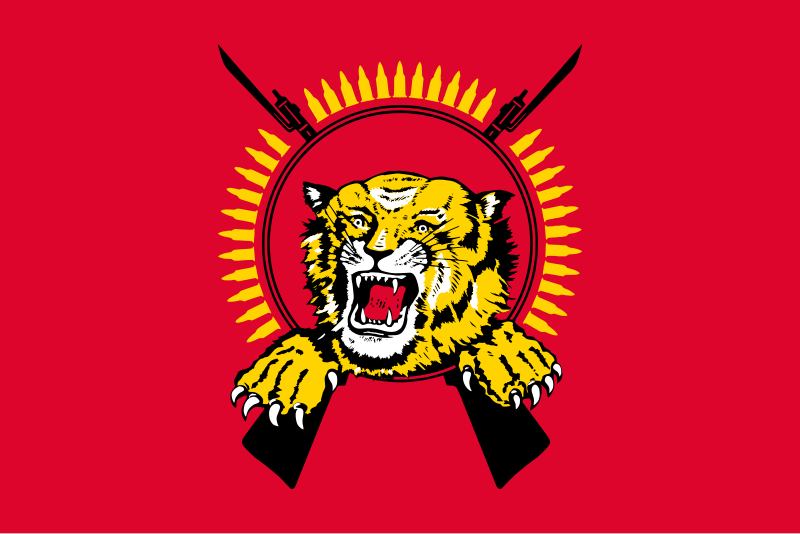
File:Tamil_Eelam_Flag.svg · Wikimedia Commons · See Wikimedia Commons
Key facts
- Capital
- Trincomalee
- Largest city
- Jaffna
- Districts
- List Amparai Batticaloa Jaffna Kilinochchi Mannar Mullaitivu Puttalam Trincomalee Vavuniya
- Total
- 21,952 km (8,476 sq mi)
- Land
- 20,533 km (7,928 sq mi)
- Water
- 1,419 km (548 sq mi) 6.46%
- Density
- 164.12/km (425.07/sq mi)
- Sri lankan tamils
- 1,644,799 (48.80%)
- Sinhalese
- 950,498 (28.20%)
- Moors
- 748,366 (22.20%)
- Indian tamils
- 16,263 (0.48%)
- Other
- 9,993 (0.29%)
- Hinduism
- 1,357,744 (40.29%)
- Buddhist
- 713,609 (21.18%)
- Muslim
- 762,256 (22.62%)
- Catholic
- 446,333 (13.24%)
- Other christian
- 87,479 (2.59%)
- Time zone
- UTC+5:30
via Wikipedia infobox
Wikidata facts
- Instance of
- project
- Country
- Sri Lanka
- Continent
- Asia
- Capital
- Kilinochchi
- Official language
- English language
- Population
- 3162254
- Area
- 21952.0
- Time zone
- UTC+05:30
Show 5 more facts
- Commons category
- Tamil Eelam
- topic's main category
- Category:Tamil Eelam
- dissolved, abolished or demolished date
- 2009-00-00
- inception
- 1983-00-00
- language used
- English language
via Wikidata · CC0
~40 min read
Encyclopedic overview
Tamil Eelam (/ˌtæmɪl ˈiːlæm/; Tamil: தமிழீழம், romanized: Tamiḻīḻam, IPA: [ˌtɐmɪɻ ˈiːɻɐm]) is a proposed independent state that many Sri Lankan Tamils and their diaspora aspire to create in the north and east of Sri Lanka. Large sections of the North-East were under de facto control of the Liberation Tigers of Tamil Eelam (LTTE) for most of the 1990s–2000s during the Sri Lankan civil war. Tamil Eelam, although encompassing the traditional homelands of Eelam Tamils, does not have official status or recognition by world states. The name is derived from the ancient Tamil name for Sri Lanka, Eelam.
In 1956, the Ilankai Tamil Arasu Kachchi (ITAK), the most dominant Tamil political party in Sri Lanka (then known as Ceylon), lobbied for a united state that would give the minority Tamils and majority Sinhalese equal rights, including recognition of two official languages—Tamil and Sinhala—and considerable autonomy for the Tamil regions of the country. However, the Official Language Act No. 33 of 1956, more simply known as the Sinhala Only Act, was passed in the Sri Lankan Parliament in 1956. The act replaced English as the official language of Sri Lanka with Sinhala; due to the lack of official recognition of the Tamil language, the act was widely viewed by Tamils as a sign of the Sri Lankan state's ambition of establishing a Sinhala–Buddhist nation state. Though both the Bandaranaike–Chelvanayakam Pact and the Senanayake-Chelvanayakam Pact were signed, they were not approved by the Sinhalese dominated Sri Lankan Parliament in 1957 and 1965, respectively. The failure of the Sri Lankan Parliament to implement these agreements caused further disillusionment and isolation among Tamils.
Excerpted from Wikipedia’s “Tamil Eelam” article, available under the CC BY-SA 4.0 licence.