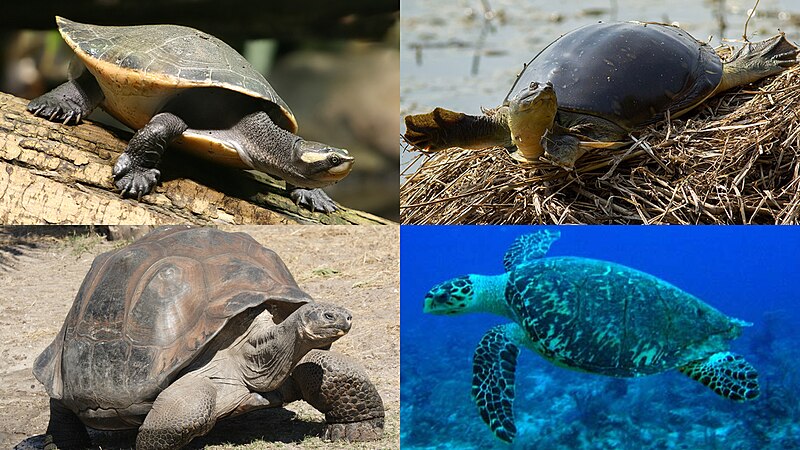
File:Turtle_diversity.jpg · Wikimedia Commons · See Wikimedia Commons
żółwie
Sign in to saveAlso known as turtles, tortoises, Chelonia, chelonians, chelonian
Turtles (order Testudines) are reptiles characterized by a special shell developed mainly from their ribs. Modern turtles are divided into two major groups, the Pleurodira (side necked turtles) and Cryptodira (hidden necked turtles), which differ in the way the head retracts. There are 360 living and recently extinct species of turtles, including land-dwelling tortoises and freshwater terrapins. They are found on most continents, some islands and, in the case of sea turtles, much of the ocean. Like other amniotes (reptiles, birds, and mammals) they breathe air and do not lay eggs underwater, a
OverviewAI-generated
Testudines is an order of reptiles within the phylum Chordata and kingdom Animalia. The taxon was established by Linnaeus in 1758 and is classified as an accepted order. It belongs to the subclass Reptilia and the parent taxa Perichelydia and Archosauromorpha. The group is distinct from Testudinata. Common names for this group include turtles, skilpadder, želve, and سُلحفاة.
Members of Testudines inhabit marine, brackish, and freshwater environments. Their temporal range begins in the Triassic period. The taxon is the source of tortoise shell. Records of Testudines are maintained by institutions including UCMP, NMMNHS, ALMNH, and UCM in the United States. The group is referenced by 3,244 other encyclopedia articles.
Synthesized by Vinony from 39 facts across 7 sources: Wikidata, GBIF, PubMed, Gbif Occ, WoRMS, iDigBio, Vinony graph. Generated from structured data (not the Wikipedia text) and checked against those facts — may still contain errors.
Species
turtles
Testudines
CLASS
- KingdomAnimalia
- PhylumChordata
- ClassTestudines
- OrderTestudines
Kura-kura dan penyu adalah hewan bersisik berkaki empat yang termasuk golongan reptil. Bangsa hewan yang disebut (ordo) Testudinata (atau Chelonians) ini khas dan mudah dikenali dengan adanya ‘rumah’ atau batok (bony shell) yang keras dan kaku. Batok kura-kura ini terdiri dari dua bagian. Bagian atas yang menutupi punggung disebut karapas (carapace) dan bagian bawah (ventral, perut) disebut plastron. Kemudian setiap bagiannya ini terdiri dari dua lapis. Lapis luar umumnya berupa sisik-sisik besar dan keras, dan tersusun seperti genting; sementara lapis bagian dalam berupa lempeng-lempeng tulang yang tersusun rapat seperti tempurung. Perkecualian terdapat pada kelompok labi-labi (Trionychoidea) dan jenis penyu belimbing, yang lapis luarnya tiada bersisik dan digantikan lapisan kulit di bagian luar tempurung tulangnya. Dalam bahasa Indonesia, kita mengenal tiga kelompok hewan yang termasuk bangsa ini, yalah penyu (bahasa Inggris: sea turtles), labi-labi atau bulus (freshwater turtles), dan kura-kura (tortoises). Dalam bahasa Inggris, dibedakan lagi antara kura-kura darat (land tortoises) dan kura-kura air tawar (freshwater tortoises atau terrapins).
via GBIF
Museum specimens
- Specimen records
- 1,641
- With media
- 26
- Collections
- UCMP, NMMNHS, ALMNH, UCM
- Recorded in
- United States
Research
640 papers- Freshwater aquatic reptiles (Testudines and Crocodylia) as biomonitor models in assessing environmental contamination by inorganic elements and the main analytical techniques used: a review.ReviewEnvironmental monitoring and assessment · 2021Dos Santos RL, de Sousa Correia JM, Dos Santos EMDOI: 10.1007/s10661-021-09212-w
- Comparison of the Single-Cell Immune Landscape of Testudines from Different Habitats.Cells · 2022Guo R, Ma G, Zhai X et al.DOI: 10.3390/cells11244023
- Slow and negligible senescence among testudines challenges evolutionary theories of senescence.Science (New York, N.Y.) · 2022da Silva R, Conde DA, Baudisch A et al.DOI: 10.1126/science.abl7811
- Chondrocranial anatomy of Testudo hermanni (Testudinidae, Testudines) with a comparison to other turtles.Journal of morphology · 2024Mauel C, Leicht L, Broshko Y et al.DOI: 10.1002/jmor.21747
- Gastrointestinal parasites of Peltocephalus dumerilianus (Testudines: Podocnemididae) from Jaú National Park, Brazilian Amazon.Revista brasileira de parasitologia veterinaria = Brazilian journal of veterinary parasitology : Orgao Oficial do Colegio Brasileiro de Parasitologia Veterinaria · 2024Menegaldo LR, Arias-Pacheco CA, Perin PP et al.DOI: 10.1590/S1984-29612024013
- Growth and life history of freshwater chelydrid turtles (Testudines: Cryptodira): A bone histological approach.Journal of anatomy · 2025Bhat MS, Cullen TMDOI: 10.1111/joa.14130
- The hooked element in the pes of turtles (Testudines): a global approach to exploring primary and secondary homology.ReviewJournal of anatomy · 2013Joyce WG, Werneburg I, Lyson TRDOI: 10.1111/joa.12103
- Heart morphology during the embryonic development of Podocnemis unifilis Trosquel 1948 (Testudines: Podocnemididae).Anatomical record (Hoboken, N.J. : 2007) · 2023Rocha LIQ, Oliveira MFDS, Dias LC et al.DOI: 10.1002/ar.25041
via PubMed
Wikidata facts
- Instance of
- taxon
- Subclass of
- Reptilia
- Parent taxon
- Archosauromorpha
- Image
- Hawaii turtle 2.JPG
Show 12 more facts
- Commons category
- Testudines
- taxon rank
- order
- taxon name
- Testudines
- topic's main category
- Category:Testudines
- different from
- Testudinata
- has list
- list of Testudines families
- taxon common name
- فكرون
- on focus list of Wikimedia project
- Wikipedia:Vital articles/Level/4
- hashtag
- turtle
- Commons gallery
- Turtle
- maintained by WikiProject
- WikiProject Tree of Life
- temporal range start
- Triassic
via Wikidata · CC0
Article · Polski
Żółwie (nazwa systematyczna nieustalona, zobacz ) – rząd owodniowców z gromady zauropsydów (Sauropsida) lub według linneuszowskiej klasyfikacji rząd z gromady gadów (Reptilia). Rząd żółwi dzieli się na 2 podrzędy, 14 rodzin i obejmuje 356 gatunków oraz 122 podgatunki żyjące w czasach nowożytnych, tj. od 1500 roku n.e. W tym czasie wyginęło 7 gatunków oraz 3 podgatunki. Charakteryzują się obecnością pancerza chroniącego cały tułów. Wśród żółwi spotyka się gatunki zarówno mięsożerne, jak i roślinożerne, wodne i lądowe. Wszystkie są jajorodne. Zapłodnienie wewnętrzne odbywa się za pomocą narządu kopulacyjnego. Żółwie, pomimo tego iż są mniej zróżnicowane morfologicznie od innych gadów, potrafiły opanować najróżnorodniejsze środowiska poczynając od mórz, a na terenach pustynnych kończąc. Występują na wszystkich kontynentach z wyjątkiem Antarktydy, lecz zdecydowana większość to mieszkańcy ciepłej i umiarkowanej strefy wszystkich kontynentów oraz wysp oceanicznych i oceanów. Istnieje kilka gatunków żółwi, które zamieszkują Amerykę Północną, Europę i Australię, gdzie występuje klimat umiarkowany (mroźna zima lub bardzo gorące lato). Gatunki te potrafią przetrwać w takim klimacie, ponieważ zapadają w sen zimowy (hibernacja) lub sen letni (estywacja). Jedynym żółwiem występującym na terenie Polski w granicach swojego naturalnego obszaru występowania jest żółw błotny. Czasem spotykane są gatunki obce polskiej faunie m.in.: żółw stepowy, żółwiak drapieżny, żółw jaszczurowaty, żółw ostrogrzbiety, żółw grecki, żółw czerwonolicy – zostały one introdukowane. Dział zoologii zajmujący się żółwiami to chelonologia. 23 maja obchodzony jest Światowy Dzień Żółwia.
Abstract from DBpedia / Wikipedia · CC BY-SA
Gallery (56)
Available in 158 languages
- Español
- Français
- Deutsch
- 中文
- 日本語
- Русский
- Português
- Italiano
- العربية
- हिन्दी
- Afrikaans
- Albanian
- Albanian
- Amharic
- Angika
- Aragonese
- Armenian
- Asturian
Show 139 more
- Atikamekw
- azb
- Azerbaijani
- Bahasa Indonesia
- Balinese
- Basque
- be_x_old
- Belarusian
- Bhojpuri
- Bosnian
- Breton
- btm
- Bulgarian
- Burmese
- Catalan
- cdo
- Cebuano
- Cherokee
- Cheyenne
- Church Slavic
- Chuvash
- Crimean Tatar
- Croatian
- Czech
- Danish
- Egyptian Arabic
- eml
- Esperanto
- Estonian
- Extremaduran
- Faroese
- Filipino
- Finnish
- fiu_vro
- Fon
- Galician
- Georgian
- Gilaki
- Gothic
- Greek
- Guarani
- Gujarati
- Haitian Creole
- Hakka Chinese
- Hausa
- Hebrew
- Hungarian
- hyw
- Icelandic
- Ido
- Iloko
- Interlingua
- Interlingue
- Irish
- Javanese
- Kabyle
- Kannada
- Kara-Kalpak
- Kashmiri
- Kazakh
- kge
- Kikuyu
- Kyrgyz
- Latin
- Latvian
- Ligurian
- Limburgish
- Lingala
- Lingua Franca Nova
- Lithuanian
- Luxembourgish
- Macedonian
- Malagasy
- Malay
- Malayalam
- Manipuri
- Marathi
- Mazanderani
- Moroccan Arabic
- Navajo
- Nederlands
- Newari
- Northern Frisian
- Norwegian
- Norwegian Nynorsk
- Novial
- Occitan
- Odia
- Ossetic
- Pashto
- Polski
- ppl
- Quechua
- roa_rup
- roa_tara
- Romanian
- Santali
- Sardinian
- Scots
- Scottish Gaelic
- Serbian
- Serbian (Latin)
- Sicilian
- simple
- Sindhi
- Sinhala
- Slovak
- Slovenian
- Somali
- Svenska
- Swahili
- szy
- Tajik
- Tamil
- Tibetan
- Tiếng Việt
- Toki Pona
- Türkçe
- Ukrainian
- Upper Sorbian
- Urdu
- Uyghur
- Uzbek
- Veps
- Waray
- Welsh
- Western Mari
- Western Panjabi
- Wu Chinese
- Yakut
- Yiddish
- Zaza
- zh_classical
- zh_min_nan
- zh_yue
- Zhuang
- فارسی
- ไทย
- 한국어
via Wikidata sitelinks · CC0