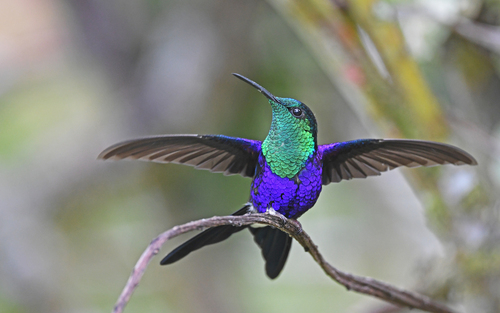
(c) Christoph Moning, some rights reserved (CC BY), uploaded by Christoph Moning · cc-by
Thalurania
Sign in to saveAlso known as woodnymphs, Woodnymph
Woodnymphs are hummingbirds in the genus Thalurania. Males are green and violet-blue, while females are green with white-tipped tails and at least partially whitish underparts. Both sexes have an almost straight, entirely black bill and little or no white post-ocular spot. They are found in forest (primarily humid) and tall second growth. The species in this genus are almost entirely allo- or parapatric, and a species is present virtually everywhere in the tropical humid Neotropics.
Species
Crowned Woodnymph
GENUS
- KingdomAnimalia
- PhylumChordata
- ClassAves
- OrderApodiformes
- FamilyTrochilidae
via GBIF
Museum specimens
- Specimen records
- 17
- With media
- 2
- Family
- Trochilidae
- Collections
- DMNH, RBINS-SCIENTIFIC HERITAGE, UCLA, UAM, LSUMZ, UMMZ
- Recorded in
- Guatemala, Ecuador, Costa Rica, Panama, Colombia, Peru, BréSil, Suriname
Wikidata facts
- Instance of
- taxon
- Parent taxon
- Trochilinae
- Image
- ThaluraniaGlaucopis200805DarioSanches.jpg
Show 6 more facts
- Commons category
- Thalurania
- taxon rank
- genus
- taxon name
- Thalurania
- topic's main category
- Category:Thalurania
- Commons gallery
- Thalurania
- taxon range
- Brazil
Sources (1)
via Wikidata · CC0
~2 min read
Encyclopedic overview
2 sectionsContents
- Taxonomy
- References
Woodnymphs are hummingbirds in the genus Thalurania. Males are green and violet-blue, while females are green with white-tipped tails and at least partially whitish underparts. Both sexes have an almost straight, entirely black bill and little or no white post-ocular spot. They are found in forest (primarily humid) and tall second growth. The species in this genus are almost entirely allo- or parapatric, and a species is present virtually everywhere in the tropical humid Neotropics.
==Taxonomy== The genus Thalurania was introduced in 1848 by the English ornithologist John Gould. Gould did not specify a type species but this was designated as the fork-tailed woodnymph by George Robert Gray in 1855. The genus name combines the Ancient Greek thalos meaning "child" with ouranos meaning "heaven".
Excerpted from Wikipedia’s “Thalurania” article, available under the CC BY-SA 4.0 licence.
Gallery (2)
Available in 25 languages
- Español
- Français
- 中文
- Русский
- Português
- Italiano
- Bahasa Indonesia
- Breton
- Catalan
- Cebuano
- Egyptian Arabic
- Esperanto
- Finnish
- Hungarian
- Kotava
- Nederlands
- Norwegian Nynorsk
- Polski
via Wikidata sitelinks · CC0