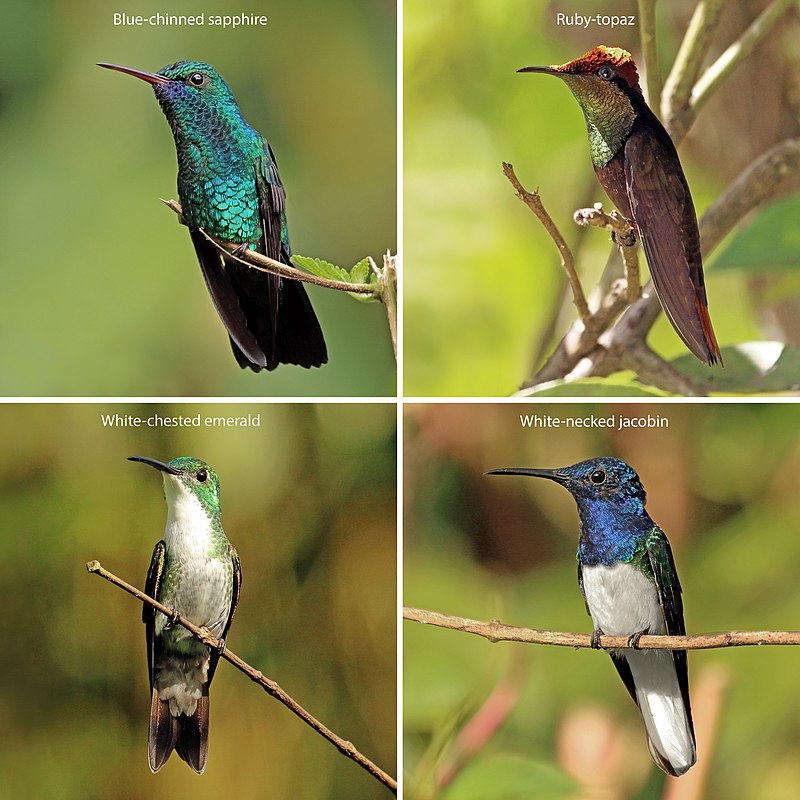
File:Trinidad_and_Tobago_hummingbirds_composite.jpg · Wikimedia Commons · See Wikimedia Commons
Trochilidae
Sign in to saveAlso known as hummers, hummer, hummingbirds, hummingbird
Hummingbirds are birds native to the Americas and comprise the biological family Trochilidae. With approximately 375 species and 113 genera, they occur from Alaska to Tierra del Fuego, but most species are found in Central and South America. As of 2026, 21 hummingbird species are listed as endangered or critically endangered, with about 255 species declining in population.
OverviewAI-generated
Trochilidae is a family of birds within the kingdom Animalia, phylum Chordata, and class Aves. It belongs to the order Apodiformes. The taxon was established by Vigors in 1825 and is recognized as an accepted family.
The group originated approximately 30 million years ago. Records of this family are held by institutions including USNM, UAZ, ROM, CUMV, and MSU. Specimens have been documented in the Bahamas, Colombia, Canada, the United States, and Mexico.
Scientific databases contain over 23 million occurrence records for the family. Additionally, 509 records with 68 media items are available. The subject is referenced by 1,569 other encyclopedia articles.
Synthesized by Vinony from 28 facts across 6 sources: Wikidata, GBIF, Gbif Occ, WoRMS, iDigBio, Vinony graph. Generated from structured data (not the Wikipedia text) and checked against those facts — may still contain errors.
Species
Trochilidae
FAMILY
- KingdomAnimalia
- PhylumChordata
- ClassAves
- OrderApodiformes
- FamilyTrochilidae
本条目部分链接不符合格式手冊規範。跨語言链接及章節標題等處的链接可能需要清理。(2015年12月11日) 請協助改善此條目。參見WP:LINKSTYLE、WP:MOSIW以了解細節。突出显示跨语言链接可以便于检查。 亞科 隐蜂鸟亚科(Phaethornithinae) 蜂鸟亚科(Trochilinae) 蜂鸟(學名:Trochilidae)是屬於雨燕目的蜂鸟科,体型小,能够以快速拍打翅膀(每秒70次,取决於鸟的大小)的方式而悬停在空中,也是唯一可以向后飞的鸟。蜂鸟的飞行本领高超,也被人们称为「神鸟」、「彗星」、「森林女神」和「花冠」等[1]。 吸蜜蜂鸟(學名:Mellisuga helenae)僅重1.8公克,是世界上最小的鸟。还有一种典型的北美蜂鸟红喉北蜂鸟(Archilochus colubris)重量约三公克左右,身长7.6公分。蜂鸟中体型最大的是巨蜂鸟(學名:Patagona gigas),其体重也僅20克。 目录 1 蜂鸟的起源 2 生态环境 3 分布地域 4 生理特征 5 食物 6 蜂鸟与人 6.1 蜂鸟的餵養 6.2 被困的蜂鸟 6.3 蜂鸟的神话 6.4 蜂鸟的故事 6.5 蜂鸟的保护 7 種類 8 参考文献 9 参见 10 延伸閱覽 11 外部链接 蜂鸟的起源 蜂鸟的体型小,骨架不易保存成为化石,因此其演化史至今仍未解。现今的蜂鸟大多生活在中南美洲,在南美洲曾发现100万年前的蜂鸟化石,因此动物学家认为蜂鸟是源自更新世;然而在歐洲,动物学家发现了歐洲蜂鳥的化石,是迄今已知最早的蜂鳥化石,距今有3000多万年的历史,如此可知蜂鸟的祖先远在渐新世的时候便出现。 生态环境 蜂鸟居住的范围十分广阔,範圍从高达4,000米的安第斯山直到赤道區域的亚马逊河热带雨林,有的蜂鸟生活在干旱的灌木丛林,也有蜂鸟生活在潮湿的沼泽地区。 分布地域 蜂鸟仅分布于美洲,从南加拿大和阿拉斯加到火地岛,包括西印度群岛都有牠们的踪迹。黑颏北蜂鸟是美国和加拿大西部最常见的种类。只有红喉北蜂鸟在北美洲东部繁衍,但是其他种类的蜂鸟个别成员也可以在北美洲东部見到,有时是来自古巴或巴哈马群岛的游民。 蜂鸟在歐亞非全境均没有分布,但有些天蛾(如長喙天蛾)在白天活动取食花蜜时会被误认为是蜂鸟。太陽鳥科物種同樣會吃花蜜,但分佈於東亞及東南亞。兩者在外型上的近似是基於趨同演化,而不是在分類學上相關。 生理特征 绿紫耳蜂鸟 形态特征 蜂鸟的羽毛一般为蓝色或绿色,下体较淡,有的雄鸟具有羽冠或修长的尾羽。雄鸟中,绝大多数为蓝绿色,也有的为紫色、红色或黄色。雌鸟体羽较为暗淡。 新陈代谢 为适应翅膀的快速拍打,蜂鸟的代谢率是所有动物是最快的,它们的心跳能达到每分钟100到1000下,依體型不同。蜂鸟每天消耗的食品远超过他们自身的体重,为了获取巨量的食物,它们每天必须采食数百朵花。有时候蜂鸟必须忍受好几
via GBIF
Museum specimens
- Specimen records
- 509
- With media
- 68
- Family
- Trochilidae
- Collections
- USNM, UAZ, ROM, CUMV, MSU, MVZ
- Recorded in
- Bahamas, Colombia, Canada, United States, Mexico, Ecuador, Brazil, Panama
Wikidata facts
- Instance of
- taxon
- Image
- Golden-tailed sapphire (Chrysuronia oenone oenone) male in flight Sumaco.jpg
Show 12 more facts
- topic has template
- Template:Taxonomy/Trochilidae
- taxon range
- Brazil
- exact match
- wordnet-rdf.princeton.edu/wn30/01833805-n
- start time
- 30000000-0
- maintained by WikiProject
- WikiProject Birds
- taxon rank
- family
- taxon name
- Trochilidae
- Commons category
- Trochilidae
- Commons gallery
- Trochilidae
- taxon common name
- kolibriji
- on focus list of Wikimedia project
- Wikipedia:Vital articles/Level/4
- described by source
- Encyclopædia Britannica 11th edition
via Wikidata · CC0
~63 min read
Encyclopedic overview
52 sectionsContents
- Description
- Morphology
- Life cycle
- Population estimates and threatened species
- Superficially similar species
- Range
- Taxonomy and systematics
- Evolution
- Phylogeny
- Geographic diversification
- Coevolution with ornithophilous flowers
- Coevolution "syndrome"
- Sexual dimorphisms
- Feather colors
- Specialized characteristics and metabolism
- Humming
- Visual system
- Anatomy
- Adaptations
- Song, vocal learning, and hearing
- Metabolism
- Heat dissipation
- Kidney function
- Hemoglobin adaptation to altitude
- Adaptation to winter
- Torpor
- Lifespan
- Natural enemies
- Predators
- Parasites
- Reproduction
- Flight
- Wingbeats and flight stability
- Feather sounds
- Courtship dives
- Wing feather trill
- Migration
- South America
- North America
- Feeding
- Beak specializations
- Perception of sweet nectar
- Tongue as a micropump
- Feeders and artificial nectar
- Visual cues of foraging
- Olfaction
- In myth and culture
- Gallery
- See also
- Notes
- References
- External links
Hummingbirds are birds native to the Americas and comprise the biological family Trochilidae. With approximately 375 species and 113 genera, they occur from Alaska to Tierra del Fuego, but most species are found in Central and South America. As of 2026, 21 hummingbird species are listed as endangered or critically endangered, with about 255 species declining in population.
Hummingbirds have varied specialized characteristics to enable rapid, maneuverable flight: exceptional metabolic capacity, adaptations to high altitude, sensitive visual and communication abilities, and long-distance migration in some species. Among all birds, male hummingbirds have the widest diversity of plumage color, particularly in blues, greens, and purples. Hummingbirds are the smallest mature birds, measuring in length. The smallest is the bee hummingbird, which weighs less than , and the largest is the giant hummingbird, weighing . Noted for long beaks, hummingbirds are specialized for feeding on flower nectar, but all species also consume small insects.
Excerpted from Wikipedia’s “Trochilidae” article, available under the CC BY-SA 4.0 licence.
Gallery (54)
Available in 105 languages
- Español
- Français
- Deutsch
- 中文
- 日本語
- Русский
- Português
- Italiano
- العربية
- हिन्दी
- Afrikaans
- Albanian
- Aragonese
- Armenian
- Asturian
- Atikamekw
- Aymara
- azb
Show 86 more
- Azerbaijani
- Bahasa Indonesia
- Balinese
- Bangla
- Basque
- Belarusian
- Bosnian
- Breton
- Bulgarian
- Burmese
- Catalan
- Cebuano
- Cheyenne
- Croatian
- Czech
- Danish
- Egyptian Arabic
- Esperanto
- Estonian
- Filipino
- Finnish
- Galician
- Georgian
- Greek
- Guarani
- Haitian Creole
- Hebrew
- Hungarian
- Icelandic
- Ido
- Irish
- Javanese
- Kannada
- Kashubian
- Kazakh
- Kotava
- Kyrgyz
- Latin
- Latvian
- Lezghian
- Lingua Franca Nova
- Lithuanian
- Macedonian
- Malay
- Malayalam
- Mongolian
- Navajo
- Nederlands
- Northern Frisian
- Norwegian
- Norwegian Nynorsk
- Ossetic
- Pashto
- Pennsylvania German
- Polski
- Punjabi
- Quechua
- Romanian
- Rundi
- Scottish Gaelic
- Serbian
- Serbian (Latin)
- simple
- Slovak
- Slovenian
- Sundanese
- Svenska
- Swahili
- Tamil
- Telugu
- Tiếng Việt
- Tulu
- Türkçe
- Ukrainian
- Urdu
- Uzbek
- Waray
- Welsh
- Western Frisian
- Western Mari
- Western Panjabi
- Wu Chinese
- zh_yue
- فارسی
- ไทย
- 한국어
via Wikidata sitelinks · CC0