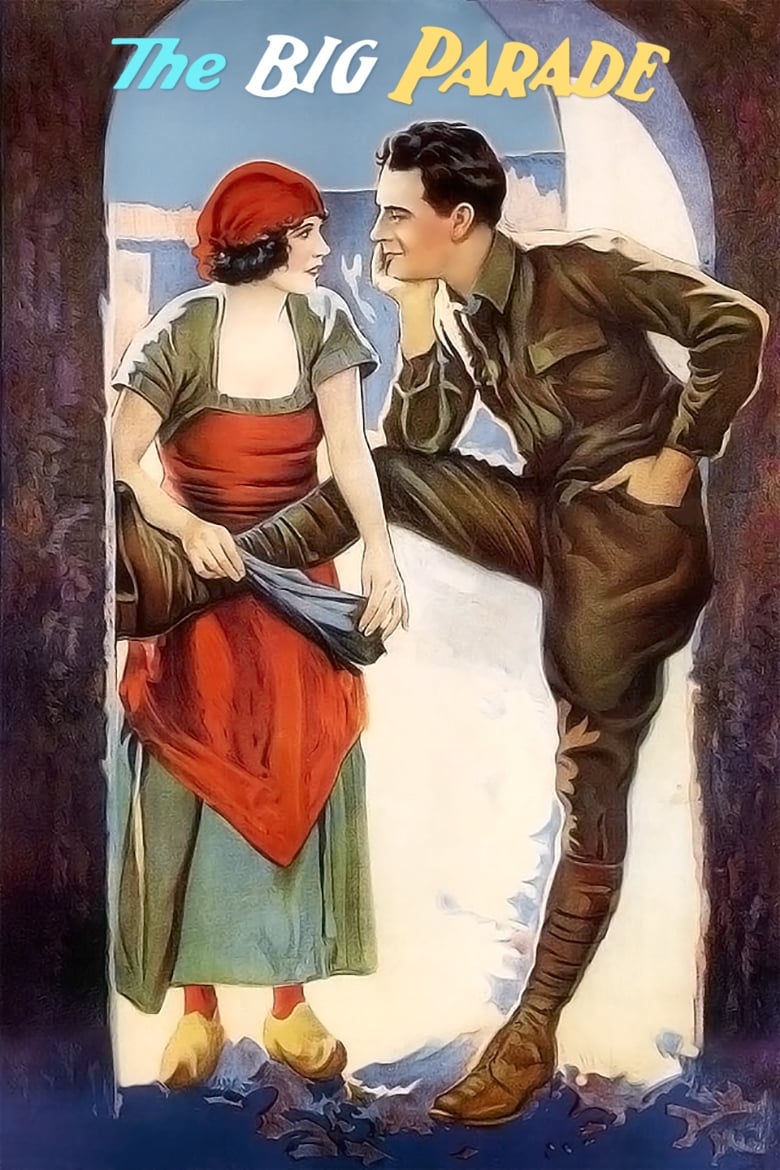
Poster from TMDB
OverviewAI-generated
The Big Parade is a 1925 American silent war drama and romance film directed by King Vidor and George W. Hill, and produced by Irving Thalberg and King Vidor for Metro-Goldwyn-Mayer. Its cast includes John Gilbert, Renée Adorée, Hobart Bosworth and Claire McDowell, with a screenplay by Joseph Farnham, cinematography by John Arnold, a score by William Axt and production design by James Basevi. Shot in black-and-white at an aspect ratio of 4:3, its story is set in France.
The film is part of the National Film Registry and was distributed by Metro-Goldwyn-Mayer and Fandango at Home. It was made on a budget of $382,000 and earned $20,000,000 at the box office.
Synthesized by Vinony from 38 facts across 3 sources: Wikidata, TMDb, IMDb. Generated from structured data (not the Wikipedia text) and checked against those facts — may still contain errors.
Film · TMDB
7.6The story of an idle rich boy who joins the US Army's Rainbow Division and is sent to France to fight in World War I, becomes friends with two working class men, experiences the horrors of trench warfare, and finds love with a French girl.
Cast
- John Gilbert as James 'Jim' Apperson
- Renée Adorée as Melisande
- Hobart Bosworth as Mr. Apperson
- Claire McDowell as Mrs. Apperson
- Claire Adams as Justyn Reed
- Robert Ober as Harry Apperson
Themes
- france
- world war i
- patriotism
- battlefield
- combat
- silent film
- french girl
- spitting
- 1910s
- american g.i.
This product uses the TMDB API but is not endorsed or certified by TMDB.
Key facts
- Directed by
- King Vidor
- Screenplay by
- Harry Behn (scenario), Joseph W. Farnham (titles)
- Story by
- Laurence Stallings
- Produced by
- King Vidor (presented by) , Irving Thalberg (uncredited)
- Starring
- John Gilbert Renée Adorée Hobart Bosworth Tom O'Brien Karl Dane
- Cinematography
- John Arnold
- Edited by
- Hugh Wynn
- Music by
- William Axt , David Mendoza
- Production company
- Metro-Goldwyn-Mayer
- Distributed by
- Loew's Incorporated
- Release date
- November 5, 1925 ( 1925-11-05 ) (USA)
- Running time
- 151 minutes
- Country
- United States
- Languages
- Silent film , English intertitles
- Budget
- $382,000
- Box office
- $18–22 million (theatrical rental)
via Wikipedia infobox
Wikidata facts
- Instance of
- film
- Part of
- National Film Registry
- Genre
- romance film
- Country of origin
- United States
- Director
- George W. Hill
- Screenwriter
- Joseph Farnham
- Composer
- William Axt
- Producer
- King Vidor
- Production company
- Metro-Goldwyn-Mayer
- Cinematographer
- John Arnold
- Narrative location
- France
- Duration
- 141
- FilmAffinity ID
- 509427
- Distribution format
- video on demand
- Image
- The Big Parade poster.jpg
Show 9 more facts
- publication date
- 2007-06-16
- title
- The Big Parade
- production designer
- James Basevi
- aspect ratio (W:H)
- 4:3
- color
- black-and-white
- distributed by
- Fandango at Home
- Commons category
- The Big Parade
- assessment
- Bechdel test
- review score
- 100%
via Wikidata · CC0
~9 min read
Encyclopedic overview
The Big Parade is a 1925 American silent war drama film directed by King Vidor, starring John Gilbert, Renée Adorée, Hobart Bosworth, Tom O'Brien, and Karl Dane. Written by World War I veteran Laurence Stallings, the film is about an idle rich boy who joins the U.S. Army's Rainbow Division, is sent to France to fight in World War I, becomes a friend of two working-class men, experiences the horrors of trench warfare, and finds love with a French girl. A sound version of the film was released in 1930. While the sound version of the film has no audible dialog, it featured a synchronized musical score with sound effects using both the sound-on-disc and sound-on-film process.
The film has been praised for its realistic depiction of warfare, and it heavily influenced a great many subsequent war films, especially All Quiet on the Western Front (1930). The Big Parade is regarded as one of the greatest films made about World War I, and, in 1992, was selected for preservation in the United States National Film Registry by the Library of Congress.
Excerpted from Wikipedia’s “The Big Parade” article, available under the CC BY-SA 4.0 licence.