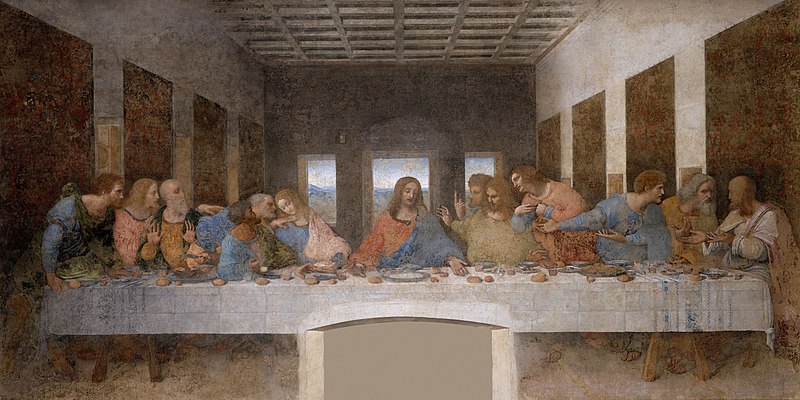
File:The_Last_Supper_-_Leonardo_Da_Vinci_-_High_Resolution_32x16.jpg · Wikimedia Commons · See Wikimedia Commons
The Last Supper
Sign in to saveAlso known as Il Cenacolo, L'Ultima Cena, Cenacolo vinciano, L'ultima cena, Last Supper
mural painting by Leonardo da Vinci
"The Last Supper" is a mural painting created by Leonardo da Vinci that depicts Jesus's final meal with his apostles before his crucifixion. It is considered one of the most important works of Renaissance art and has profoundly influenced how this biblical scene is understood and represented in Western culture.
AI-generated from the Wikipedia summary — may contain errors.
Official website
Ultima Cena Leonardo Da Vinci | Cenacolo Vinciano Sito Ufficiale
Benvenuto Nel Sito Web Ufficiale Del Museo Cenacolo Vinciano, Milano. Orari, Acquisto Biglietti E Approfondimenti Sull'Ultima Cena Di Leonardo Da Vinci.
cenacolovinciano.org →The Last Supper occupies the whole north wall of the refectory of the Dominican monastery of Santa Maria delle Grazie. This was the chamber where the friars met to eat, pray and meditate during their meals. Since the 14th century, in the Tuscan tradition on which Leonardo drew, this room has also been referred to by the term “Cenacolo”. And since the early 16th century, the term has also been used in Italian to designate the paintings of the Last Supper that generally adorn refectories. On the left, Saint Maria delle Grazie, Milan. On the right, the whole north wall of the refectory with the Last Supper History has separated from its original context a space that was closely embedded in the monastery’s everyday life. The route we follow to reach it today enables us only in part to understand its ties with the rest of the building. Along the route that leads to the refectory, in the first corridor, there remain large fragments of frescoes dating from the mid-17th century, depicting a scene of martyrdom, perhaps the episode of 49 Dominicans slain at Sandomierz. The second section overlooks the Cloister of the Dead, so called because it once contained the graves of the friars. Ludovico Sforza, known as Ludovico il Moro, had created a flourishing court in Milan, attracting artists, intellectuals and musicians. Between 1478 and 1482 Donato Bramante and Leonardo da Vinci moved to Milan from Florence. The two artists, among the most important figures in the Italian Renaissance, both worked on the monastery of Santa Maria delle Grazie, giving rise to one of the most extraordinary monumental complexes in the history of Italian art. Leonardo arrived in Milan in 1482, after introducing himself to the ruler of the city with a long letter in which he listed his abilities as painter, musician, military engineer and architect. He remained at Ludovico’s court until 1499. He was employed as an artist, the inventor of marvelous spectacles and set designs, as well as an engineer and sculptor. From this period date his studies of the systems of Lombard canals, the portrait of Ludovico’s favorite, Cecilia Gallerani, known as The Lady with the Ermine (now in Krakow), and the project for the Equestrian Monument to Francesco Sforza, Ludovico il Moro’s father, which Leonardo was unable to complete. The decoration of the Sala delle Asse in the Castello Sforzesco also remained unfinished. At the end of the century Ludovico Sforza wished to make Santa Maria delle Grazie a place to celebrate his power and his family mausoleum. He financed important commissions in the complex, such as the restructuring of the tribune of the church, which he entrusted to Donato Bramante. The decoration of the refectory was entrusted to Leonardo da Vinci, from whom Ludovico commissioned a painting of Christ at the Last Supper with the twelve apostles. Please note that reservation is always mandatory for all types of tickets. The Last Supper Museum is open from Tuesday to Sunday, from 8.15 am to 7.00 pm. Last entry is at 6.45 pm. The preservation of Leonardo’s masterpiece requires optimal environmental conditions, ensured by air treatment and controlled visitor access. To check ticket release dates and book your visit, see the dedicated page . From December 3rd, the “Leonardo’s Last Supper’s Museum” will no longer be part of the state museums that belong to Direzione regionale Musei nazionali Lombardia, which has managed it from 2014 until today. As a matter of fact, in implementation of the Ministerial Decree n° 299 dated to 09/25/2024, “The Leonardo’s Last Supper Museum” will be managed by the Pinacoteca di Brera. This is related to the realisation of a Milanese museum centre which will be characterised by the Pinacoteca itself, The Last Supper Museum, the Biblioteca Braidense and Citterio Palace. The experimentation to gradually increase the number of visitors allowed inside the Museo del Cenacolo Vinciano continues: starting on Friday, March 1, in conjunction wi
Read more on their site →Excerpt from the official site · 14,901 chars · not written by Vinony
Described at
Ultima Cena Leonardo Da Vinci | Cenacolo Vinciano Sito Ufficiale
Benvenuto Nel Sito Web Ufficiale Del Museo Cenacolo Vinciano, Milano. Orari, Acquisto Biglietti E Approfondimenti Sull'Ultima Cena Di Leonardo Da Vinci.
cenacolovinciano.org →Link to a page describing this subject · 14,901 chars · not written by Vinony
Wikidata facts
- Instance of
- work of art
- Religion
- Christianity
- Country
- Italy
- Located in
- Milan
- Genre
- religious art
- Country of origin
- Republic of Florence
- Based on
- John 13
- Main subject
- Last Supper
- Depicts
- tunic
- Movement
- High Renaissance
- Material used
- gesso
- Creator
- Leonardo da Vinci
- Collection
- Snta Maria delle Grazie
- Location
- Snta Maria delle Grazie
- Official website
- cenacolovinciano.org
- Image
- Leonardo da Vinci (1452-1519) - The Last Supper (1495-1498).jpg
- Height
- 700
- Width
- 880
Show 12 more facts
- commissioned by
- Ludovico Sforza
- Commons category
- Last Supper by Leonardo da Vinci
- inception
- 1490-00-00
- fabrication method
- fresco-secco
- catalog code
- XVII
- time period
- High Renaissance
- copyright status
- public domain
- depicts Iconclass notation
- 73D2
- different from
- The Last Supper
- name
- العشاء الأخير
- on focus list of Wikimedia project
- Wikipedia:Vital articles/Level/4
- described at URL
- www.katholisch.de/artikel/9775-das-sind-die-boten-des-herrn
Sources (7)
via Wikidata · CC0
~27 min read
Encyclopedic overview
The Last Supper (Italian: Il Cenacolo [il tʃeˈnaːkolo] or L'Ultima Cena [ˈlultima ˈtʃeːna]) is a mural painting by the Italian High Renaissance artist Leonardo da Vinci, dated to c. 1495–1498, housed in the refectory of the Convent of Santa Maria delle Grazie in Milan, Italy. The painting represents the scene of the Last Supper of Jesus with the Twelve Apostles, as it is told in the Gospel of John – specifically the moment after Jesus announces that one of his apostles will betray him. Its handling of space, mastery of perspective, treatment of motion and complex display of human emotion has made it one of the Western world's most recognizable paintings and among Leonardo's most celebrated works. Some commentators consider it pivotal in inaugurating the transition into what is now termed the High Renaissance.
The work was commissioned as part of a plan of renovations to the church and its convent buildings by Leonardo's patron Ludovico Sforza, Duke of Milan. In order to permit his inconsistent painting schedule and frequent revisions, it is painted with materials that allowed for regular alterations: tempera on gesso, pitch, and mastic. Due to the methods used, a variety of environmental factors, and intentional damage, little of the original painting remains today despite numerous restoration attempts, the last being completed in 1999. The Last Supper is Leonardo's largest work, aside from the Sala delle Asse.
Excerpted from Wikipedia’s “The Last Supper” article, available under the CC BY-SA 4.0 licence.
Gallery (14)
On the map
Available in 84 languages
- Español
- Français
- Deutsch
- 中文
- 日本語
- Русский
- Português
- Italiano
- العربية
- हिन्दी
- abstract
- Afrikaans
- Albanian
- Armenian
- Azerbaijani
- Bahasa Indonesia
- Bangla
- Basque
Show 65 more
- Belarusian
- Bosnian
- Breton
- Bulgarian
- Burmese
- Catalan
- Croatian
- Czech
- Danish
- Egyptian Arabic
- Esperanto
- Estonian
- Finnish
- Galician
- Georgian
- Greek
- Hebrew
- Hungarian
- Ido
- Iloko
- Irish
- Kannada
- Kazakh
- Latin
- Latvian
- Limburgish
- Lithuanian
- Lombard
- Macedonian
- Malayalam
- Maltese
- Marathi
- Mazanderani
- Nederlands
- Norwegian
- Odia
- Polski
- Punjabi
- Romanian
- Serbian
- Serbian (Latin)
- Sicilian
- simple
- Sinhala
- Slovak
- Slovenian
- Svenska
- szy
- Tamil
- Tatar
- Tiếng Việt
- Türkçe
- Ukrainian
- Urdu
- Venetian
- Waray
- Welsh
- Western Panjabi
- Wu Chinese
- zh_min_nan
- zh_yue
- Zulu
- فارسی
- ไทย
- 한국어
via Wikidata sitelinks · CC0