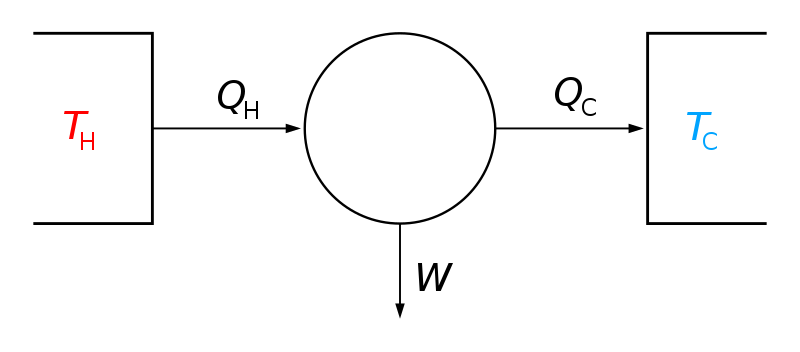
File:Carnot_heat_engine_2.svg · Wikimedia Commons · See Wikimedia Commons
thermodynamics
Sign in to saveAlso known as thermo-dynamics, thermal science, pyro-dynamics
Thermodynamics is a branch of physics that deals with heat, work, and temperature, and their relation to energy, entropy, and the physical properties of matter and radiation. The behavior of these quantities is governed by the four laws of thermodynamics, which convey a quantitative description using measurable macroscopic physical quantities but may be explained in terms of microscopic constituents by statistical mechanics. Thermodynamics applies to various topics in science and engineering, especially physical chemistry, biochemistry, chemical engineering, and mechanical engineering, as well
Thermodynamics is the branch of physics that studies how heat, work, and temperature relate to energy and matter, governed by four fundamental laws that describe how these quantities behave. It matters because it applies across science and engineering—from chemistry and biochemistry to designing engines and industrial processes—helping us understand and predict how energy transforms in physical systems.
AI-generated from the Wikipedia summary — may contain errors.
Research
650,519 papers- The Thermodynamics of Development in Bioartificial Tissue Design.ReviewTrends in biotechnology · 2018Lenas PDOI: 10.1016/j.tibtech.2018.06.006
- The Thermodynamics of Trichocyte Keratins.ReviewAdvances in experimental medicine and biology · 2018Popescu CDOI: 10.1007/978-981-10-8195-8_13
- Thermodynamics guided lead discovery and optimization.ReviewDrug discovery today · 2010Ferenczy GG, Keserũ GMDOI: 10.1016/j.drudis.2010.08.013
- Receptor binding thermodynamics at the neuronal nicotinic receptor.ReviewCurrent topics in medicinal chemistry · 2004Borea PA, Varani K, Gessi S et al.DOI: 10.2174/1568026043451410
- Connecting thermodynamics and economics: well-lit roads and burned bridges.ReviewAnnals of the New York Academy of Sciences · 2010Glucina MD, Mayumi KDOI: 10.1111/j.1749-6632.2009.05166.x
- Thermodynamics of amyloid fibril formation from non-equilibrium experiments of growth and dissociation.Biophysical chemistry · 2021Norrild RK, Vettore N, Coden A et al.DOI: 10.1016/j.bpc.2021.106549
- Thermodynamics insights of lignin dissolution in deep eutectic solvents.International journal of biological macromolecules · 2025Wang Y, Wang H, Yan C et al.DOI: 10.1016/j.ijbiomac.2025.140224
- Thermodynamics shapes the in vivo enzyme burden of glycolytic pathways.mBio · 2025Khana DB, Jen A, Shishkova E et al.DOI: 10.1128/mbio.01837-25
via PubMed
Wikidata facts
- Instance of
- academic discipline
- Subclass of
- physical science
- Part of
- physics
- Image
- Heat engine summary.png
Show 10 more facts
- hashtag
- Thermodynamics
- significant person
- Walther Nernst
- topic's main category
- Category:Thermodynamics
- Commons category
- Thermodynamics
- Commons gallery
- Thermodynamics
- is the study of
- work
- topic has template
- Template:Thermodynamics sidebar
- on focus list of Wikimedia project
- Wikipedia:Vital articles/Level/4
- described by source
- Encyclopædia Britannica 11th edition
- Stack Exchange tag
- physics.stackexchange.com/tags/thermodynamics
via Wikidata · CC0
~30 min read
Encyclopedic overview
27 sectionsContents
- Introduction
- History
- Etymology
- Branches of thermodynamics
- Classical thermodynamics
- Statistical mechanics
- Chemical thermodynamics
- Equilibrium thermodynamics
- Non-equilibrium thermodynamics
- Laws of thermodynamics
- Zeroth law
- First law
- Second law
- Third law
- System models
- States and processes
- Instrumentation
- Conjugate variables
- Potentials
- Axiomatic thermodynamics
- Applied fields
- See also
- Lists and timelines
- Notes
- References
- Further reading
- External links
Thermodynamics is a branch of physics that deals with heat, work, and temperature, and their relation to energy, entropy, and the physical properties of matter and radiation. The behavior of these quantities is governed by the four laws of thermodynamics, which convey a quantitative description using measurable macroscopic physical quantities but may be explained in terms of microscopic constituents by statistical mechanics. Thermodynamics applies to various topics in science and engineering, especially physical chemistry, biochemistry, chemical engineering, and mechanical engineering, as well as other complex fields such as meteorology.
Historically, thermodynamics developed out of a desire to increase the efficiency of early steam engines, particularly through the work of French physicist Sadi Carnot (1824). Scots-Irish physicist Lord Kelvin was the first to formulate a concise definition of thermodynamics in 1854 which stated, "Thermo-dynamics is the subject of the relation of heat to forces acting between contiguous parts of bodies, and the relation of heat to electrical agency." German physicist and mathematician Rudolf Clausius restated Carnot's principle known as the Carnot cycle and gave the theory of heat a more accurate and sounder basis. His most important paper, "On the Moving Force of Heat", published in 1850, first stated the second law of thermodynamics. In 1865 he named the concept of entropy. In 1870 he introduced the virial theorem, which applied to heat.
Excerpted from Wikipedia’s “thermodynamics” article, available under the CC BY-SA 4.0 licence.
Gallery (13)
Available in 129 languages
- Español
- Français
- Deutsch
- 中文
- 日本語
- Русский
- Português
- Italiano
- العربية
- हिन्दी
- abstract
- Afrikaans
- Albanian
- Albanian
- Angika
- Aragonese
- Armenian
- Assamese
Show 110 more
- Asturian
- azb
- Azerbaijani
- Bahasa Indonesia
- Bangla
- Bashkir
- Basque
- bat_smg
- Bavarian
- be_x_old
- Belarusian
- Bikol
- Bosnian
- Bulgarian
- Burmese
- Catalan
- Central Kurdish
- Chuvash
- Croatian
- Czech
- Danish
- Esperanto
- Estonian
- Extremaduran
- Fiji Hindi
- Filipino
- Finnish
- fiu_vro
- Galician
- gcr
- Georgian
- Greek
- Guarani
- Haitian Creole
- Hebrew
- Hungarian
- Icelandic
- Ido
- Iloko
- Interlingua
- Irish
- Jamaican Creole English
- Kazakh
- kbp
- Kurdish
- Kyrgyz
- Latin
- Latvian
- Lithuanian
- Lombard
- Low German
- Luxembourgish
- Macedonian
- Malay
- Malayalam
- Marathi
- Mingrelian
- Mongolian
- Moroccan Arabic
- Nederlands
- Nepali
- Northern Frisian
- Norwegian
- Norwegian Nynorsk
- Occitan
- Oromo
- Pashto
- Piedmontese
- Polski
- Punjabi
- rki
- Romanian
- Rusyn
- Sardinian
- Scots
- Serbian
- Serbian (Latin)
- Sicilian
- simple
- Sindhi
- Sinhala
- Slovak
- Slovenian
- Standard Moroccan Tamazight
- Svenska
- Swahili
- Tachelhit
- Tajik
- Tamil
- Tatar
- Telugu
- Tiếng Việt
- Türkçe
- Ukrainian
- Urdu
- Uzbek
- Veps
- Waray
- Welsh
- Western Frisian
- Western Panjabi
- Wu Chinese
- Yakut
- Yiddish
- zh_classical
- zh_min_nan
- zh_yue
- فارسی
- ไทย
- 한국어
via Wikidata sitelinks · CC0