File:Kammmolchmaennchen.jpg · Wikimedia Commons · See Wikimedia Commons
Triturus cristatus
Sign in to saveAlso known as Great Crested Newt, Turanomolge mensbieri, GCN, northern crested newt, warty newt
species of amphibian
Species
Least Concernnorthern crested newt
SPECIES
- KingdomAnimalia
- PhylumChordata
- ClassAmphibia
- OrderCaudata
- FamilySalamandridae
via GBIF · IUCN
Museum specimens
- Specimen records
- 2,950
- With media
- 20
- Family
- Salamandridae
- Collections
- MVZ, UCM
- Recorded in
- Italy, Luxembourg, Germany
Wikidata facts
Show 7 more facts
- taxon rank
- species
- IUCN conservation status
- Least Concern
- taxon name
- Triturus cristatus
- Commons category
- Triturus cristatus
- Commons gallery
- Triturus cristatus
- taxon common name
- tritone crestato
- short name
- T. cristatus
Sources (8)
via Wikidata · CC0
~16 min read
Encyclopedic overview
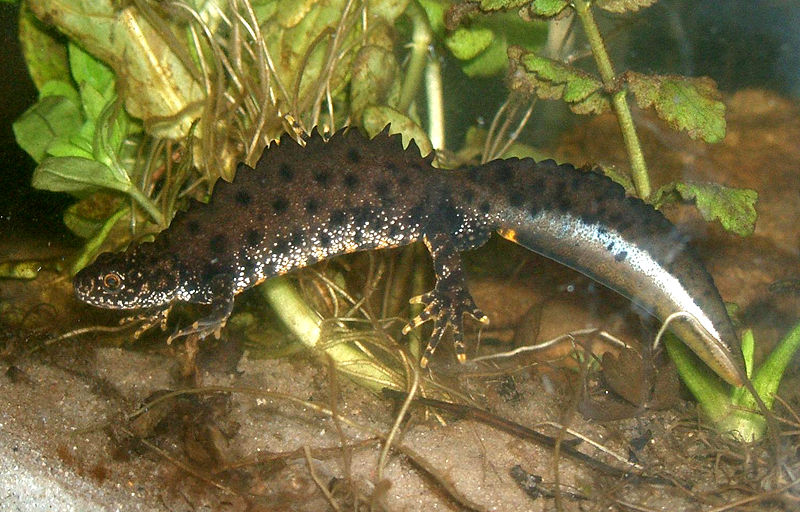
The northern crested newt, great crested newt or warty newt (Triturus cristatus) is a newt species native to Great Britain, northern and central continental Europe and parts of Western Siberia. It is a large newt, with females growing up to 16 cm (6.3 in) long. Its back and sides are dark brown, while the belly is yellow to orange with dark blotches. During the breeding season, males develop a conspicuous jagged crest on their back and tail.
The northern crested newt spends most of the year on land, primarily in wooded areas of the lowlands. In spring, it moves to aquatic breeding sites, mainly larger fish-free ponds. Males court females with a ritualised display and deposit a spermatophore on the ground, which the female then picks up with her cloaca. After fertilisation, a female lays around 200 eggs, folding them into water plants. The larvae develop over two to four months before metamorphosing into terrestrial juveniles (efts). Both larvae and land-dwelling newts mainly feed on different invertebrates.
Excerpted from Wikipedia’s “Triturus cristatus” article, available under the CC BY-SA 4.0 licence.