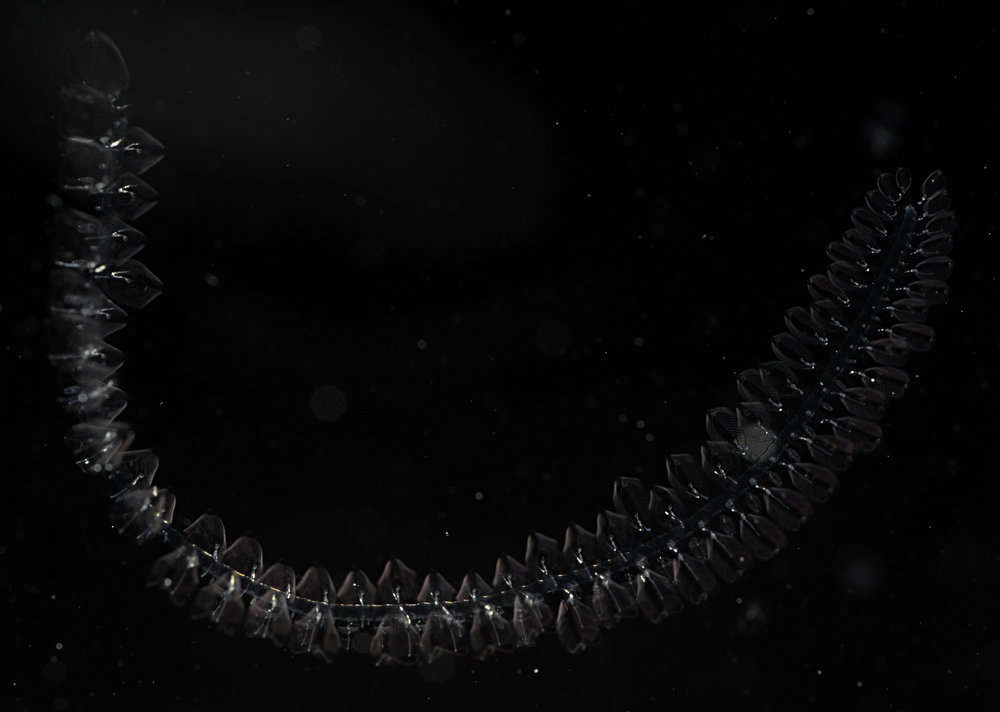
Encyclopedia of Life · EOL (see source)
Thaliacea
Sign in to saveThaliacea is a class of marine chordates within the subphylum Tunicata, comprising the salps, pyrosomes and doliolids. Unlike their benthic relatives the ascidians, from which they are believed to have emerged, thaliaceans are free-floating (pelagic) for their entire lifespan. The group includes species with complex life cycles, with both solitary and colonial forms. Because of their pelagic and gelatinous nature they are extremely rare in the fossil record, with the first unambiguous thaliacean fossil only being reported in 2026 from the mid-Cambrian Huayuan biota.
OverviewAI-generated
Thaliacea is a class within the phylum Chordata and the kingdom Animalia. The taxon was described by Van der Hoeven in 1850 and is currently accepted. Members of this class are commonly known as salps and inhabit marine environments.
Records for Thaliacea have been documented in the United States, Mexico, Japan, and India. These records are held by institutions including SIO, CAS, and YPM. The class has 109,927 occurrences and 133 records, with 17 associated media files.
Synthesized by Vinony from 20 facts across 6 sources: Wikidata, GBIF, Gbif Occ, WoRMS, iDigBio, Vinony graph. Generated from structured data (not the Wikipedia text) and checked against those facts — may still contain errors.
Species
salps
CLASS
- KingdomAnimalia
- PhylumChordata
- ClassThaliacea
樽海鞘纲(學名:Thaliacea),又名海樽纲,是被囊动物亚门的一个海洋生物的纲。 與他們的底棲親戚海鞘不同的是:樽海鞘纲物種的整個生命週期都是自由浮動的(中上層)。該組包括具有複雜生命週期的物種,具有孤立和群居形式。 现存65种。体成桶形,单体或群体营飘浮生活。被囊薄而透明,其上有环状肌肉带。例如樽海鞘。
via GBIF
Museum specimens
- Specimen records
- 133
- With media
- 17
- Collections
- SIO, CAS, YPM
- Recorded in
- United States, Mexico, Japan, India
Wikidata facts
Show 7 more facts
- taxon name
- Thaliacea
- Commons category
- Thaliacea
- taxon rank
- class
- Code of nomenclature
- International Code of Zoological Nomenclature
- topic's main category
- Category:Thaliacea
- described by source
- Brockhaus and Efron Encyclopedic Dictionary
- taxon common name
- salper
Sources (1)
via Wikidata · CC0
~5 min read
Encyclopedic overview
5 sectionsContents
- Anatomy
- The jelly pump and the carbon cycle
- Taxonomy
- References
- External links
Thaliacea is a class of marine chordates within the subphylum Tunicata, comprising the salps, pyrosomes and doliolids. Unlike their benthic relatives the ascidians, from which they are believed to have emerged, thaliaceans are free-floating (pelagic) for their entire lifespan. The group includes species with complex life cycles, with both solitary and colonial forms. Because of their pelagic and gelatinous nature they are extremely rare in the fossil record, with the first unambiguous thaliacean fossil only being reported in 2026 from the mid-Cambrian Huayuan biota.
==Anatomy== The three orders of thaliaceans are filter feeders. Pyrosomes are colonial animals, with multiple tiny ascidian-like zooids arranged in a cylinder closed at one end. All of the atrial siphons point inwards, emptying into a single, common cloaca in the centre of the cylinder. As the water exhaled by the zooids exits through a common opening, the water movement slowly propels the pyrosome through the sea. Salps and doliolids have a transparent barrel-shaped body through which they pump water, propelling them through the sea, and from which they extract food. The bulk of the body consists of the large pharynx. Water enters the pharynx through the large buccal siphon at the front end of the animal, and is forced through a number of slits in the pharyngeal wall into an atrium lying just behind it. From here, the water is expelled through an atrial siphon at the posterior end. The pharynx is both a respiratory organ and a digestive one, filtering food from the water with the aid of a net of mucus slowly pulled across the slits by cilia.
Excerpted from Wikipedia’s “Thaliacea” article, available under the CC BY-SA 4.0 licence.