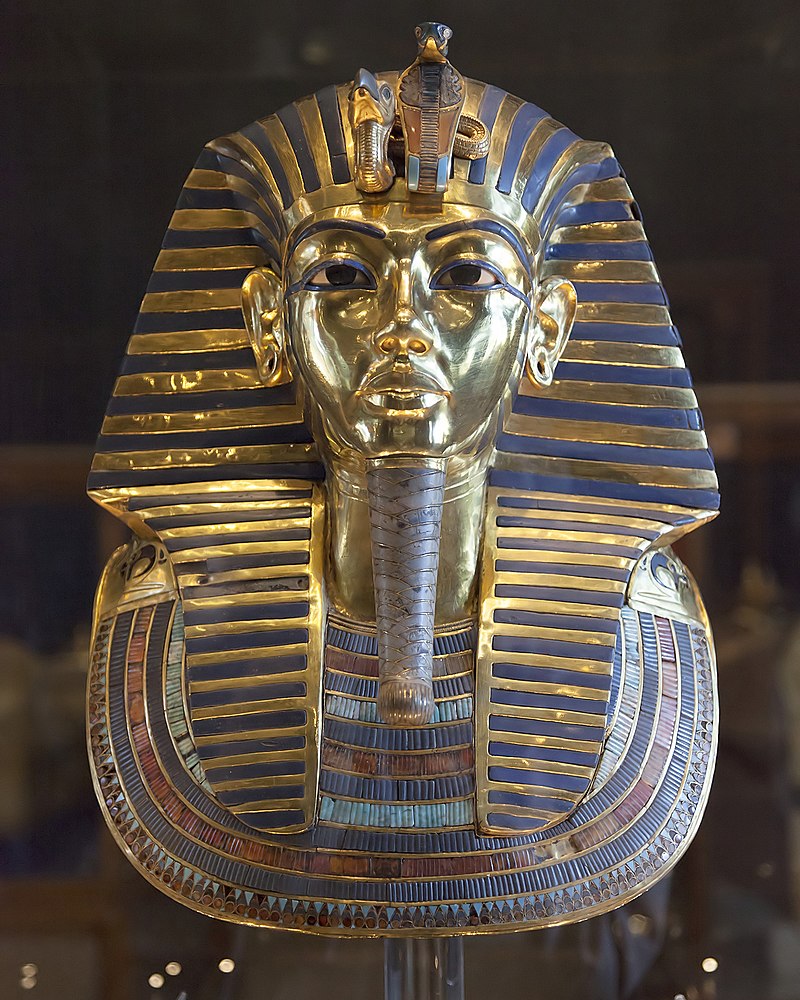
File:CairoEgMuseumTaaMaskMostlyPhotographed.jpg · Wikimedia Commons · See Wikimedia Commons
TutanKhamun
Sign in to saveAlso known as King Tut, Tutenkhamon, Tutenkhamen, Tutankhaten, Tutankhamen
Tutankhamun or Tutankhamen (; ), was the thirteenth pharaoh of the Eighteenth Dynasty of ancient Egypt, who ruled . Born Tutankhaten, he instituted the restoration of the traditional polytheistic form of ancient Egyptian religion, undoing a previous shift to the religion known as Atenism. Tutankhamun's reign is considered one of the greatest restoration periods in ancient Egyptian history, and his tomb door proclaims his dedication to illustrative constructions of the ancient Egyptian gods.
Tutankhamun was a pharaoh of ancient Egypt who ruled during the Eighteenth Dynasty and is remembered for restoring traditional Egyptian religious practices after a period of religious change. His reign is considered one of the most important restoration periods in ancient Egyptian history, and his tomb reflects his commitment to honoring the traditional Egyptian gods.
AI-generated from the Wikipedia summary — may contain errors.
Key facts
- Pharaoh.name
- Tutankhamun
- Pharaoh.alt_name
- Tutankhaten, Tutankhamen, Tutankhamon
- Pharaoh.image
- CairoEgMuseumTaaMaskMostlyPhotographed.jpg
- Pharaoh.caption
- Tutankhamun's golden funerary mask at the Grand Egyptian Museum in Giza, Egypt
- Pharaoh.HorusHiero
- E1:D40-t-w-t-ms:O34-t-w-Z3
- Pharaoh.Horus
- Ka nakht tut mesut Victorious bull, the (very) image of (re)birth.
- Pharaoh.NebtyHiero
- nfr-h:p-Z2*w-s-g:r-H-a:N17:N17
- Pharaoh.Nebty
- Nefer hepu, segereh tawy Perfect of laws, who has quieted down the Two Lands.
- Pharaoh.GoldenHiero
- U39-xa:Y1:Z2-S29-Htp:t*p-nTrw
- Pharaoh.Golden
- Wetjes khau, sehetep netjeru Elevated of appearances, who has satisfied the gods.
- Pharaoh.PrenomenHiero
- ra-xpr-Z2:nb
- Pharaoh.Prenomen
- Neb-kheperu-re The possessor of the manifestation of Re.
- Pharaoh.NomenHiero
- i-mn:n-t-w-t-anx-S38-O28-M26
- Pharaoh.Nomen
- Tut-ankh-imen, heqa iunu-shemau The living image of Amun, ruler of the Heliopolis of Upper Egypt.
- Pharaoh.reign
- , New Kingdom
- Pharaoh.dynasty
- 18th Dynasty
- Pharaoh.predecessor
- Uncertain:Neferneferuaten (most likely), Akhenaten or Smenkhkare
- Pharaoh.successor
- Ay
via Wikipedia infobox
Wikidata facts
- Instance of
- human
- Official name
- Neb-Jeperu-Ra
- Gender
- male
- Citizenship
- Ancient Egypt
- Place of birth
- Amarna
- Place of death
- Thebes
- Spouse
- Ankhesenamun
- Father
- Akhenaten
- Mother
- The Younger Lady
- Sibling
- Meritaten
- Occupation
- ruler
- Position held
- pharaoh
- Languages spoken
- Middle Egyptian
- Noble title
- pharaoh
- Platform
- Commodore 64
- Image
- Tutanchamun Maske.jpg
- Residence
- Thebes
Show 17 more facts
- described by source
- National Geographic
- Commons category
- Tutankhamun
- place of burial
- tomb of Tutankhamun
- date of birth
- 1343-00-00
- date of death
- 1324-00-00
- topic's main category
- Category:Tutankhamun
- manner of death
- natural causes
- cause of death
- malaria
- different from
- Tutankamon 44
- name in hiero markup
- E1:D40-t-w-t-ms:O34-t-w-Z3
- time period
- Eighteenth Dynasty of Egypt
- end of work period
- 1324-00-00
- start of work period
- 1333-00-00
- topic has template
- Template:Tutankhamun
- on focus list of Wikimedia project
- Wikipedia:Vital articles/Level/4
- birth name
- Tutankamon
Sources (7)
via Wikidata · CC0
~60 min read
Encyclopedic overview
39 sectionsContents
- Family
- Reign
- Religiopolitical countermand
- Architectural projects
- Military campaigns
- Battle participation
- During-life deification
- Nubian temples
- Stela of Huy
- Cult structure
- Genealogy
- Personal life
- Health
- Malaria
- Leg fracture
- Speculated podiatric diagnoses
- Misdiagnoses
- Other speculated diagnoses
- Physical appearance
- Facial appearance
- Full-body reconstruction
- Death
- Succession
- Huy Iry-pat unfulfillment
- Reign of vizier Ay
- Horemheb Iry-pat fulfillment
- Tomb
- Rediscovery
- Contents
- Rumoured curse
- Legacy
- International exhibitions
- Family tree
- See also
- Notes
- Citations
- References
- Further reading
- External links
Tutankhamun or Tutankhamen (; ), was the thirteenth pharaoh of the Eighteenth Dynasty of ancient Egypt, who ruled . Born Tutankhaten, he instituted the restoration of the traditional polytheistic form of ancient Egyptian religion, undoing a previous shift to the religion known as Atenism. Tutankhamun's reign is considered one of the greatest restoration periods in ancient Egyptian history, and his tomb door proclaims his dedication to illustrative constructions of the ancient Egyptian gods.
His endowments and restorations of cults were recorded on the Restoration Stela. The cult of the god Amun at Thebes was restored to prominence, and the royal couple changed their names to "Tutankhamun" and "Ankhesenamun", replacing the -aten suffix. He also moved the royal court from Akhenaten's capital, Amarna, back to Memphis almost immediately on his accession to the kingship. He reestablished diplomatic relations with the Mitanni and carried out military campaigns in Nubia and the Near East. Tutankhamun was one of only a few kings known to be worshipped as a deity during their lifetime. He likely began construction of a royal tomb in the Valley of the Kings and an accompanying mortuary temple, but both were unfinished at the time of his death.
Excerpted from Wikipedia’s “TutanKhamun” article, available under the CC BY-SA 4.0 licence.
Gallery (52)
Available in 113 languages
- Español
- Français
- Deutsch
- 中文
- 日本語
- Русский
- Português
- Italiano
- العربية
- हिन्दी
- Afrikaans
- Albanian
- Armenian
- Asturian
- azb
- Azerbaijani
- Bahasa Indonesia
- Bangla
Show 94 more
- Bashkir
- Basque
- be_x_old
- Belarusian
- Bhojpuri
- Bikol
- Bosnian
- Breton
- Bulgarian
- Catalan
- cdo
- Central Kurdish
- Chuvash
- Croatian
- Czech
- Danish
- Egyptian Arabic
- Esperanto
- Estonian
- Faroese
- Filipino
- Finnish
- fiu_vro
- Galician
- Georgian
- Greek
- Haitian Creole
- Hawaiian
- Hebrew
- Hungarian
- Icelandic
- Ido
- Igbo
- Irish
- Javanese
- Kannada
- Kashmiri
- Kazakh
- Kurdish
- Kyrgyz
- Lao
- Latin
- Latvian
- Lingua Franca Nova
- Lithuanian
- Luxembourgish
- Macedonian
- Malagasy
- Malay
- Malayalam
- Maltese
- Marathi
- Mingrelian
- Mongolian
- Nederlands
- Norwegian
- Norwegian Nynorsk
- Occitan
- Piedmontese
- Polski
- Punjabi
- Romanian
- Scots
- Scottish Gaelic
- Serbian
- Serbian (Latin)
- Sicilian
- simple
- Sinhala
- Slovak
- Slovenian
- Somali
- Svenska
- Swahili
- Tajik
- Tamil
- Tiếng Việt
- Toki Pona
- Türkçe
- Ukrainian
- Urdu
- Uzbek
- Waray
- Welsh
- Western Frisian
- Western Panjabi
- Wu Chinese
- Yiddish
- Yoruba
- zh_min_nan
- zh_yue
- فارسی
- ไทย
- 한국어
via Wikidata sitelinks · CC0