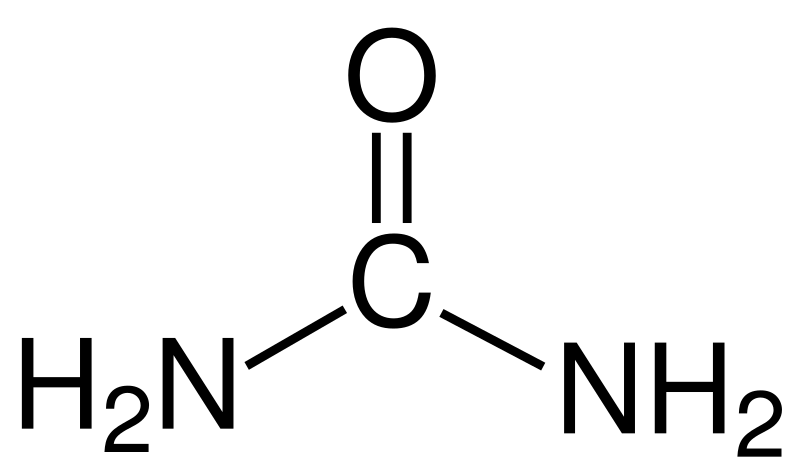
File:Urea_Structural_Formula_V2.svg · Wikimedia Commons · See Wikimedia Commons
اوره
Sign in to saveAlso known as carbamide, carbonic acid diamide
مادهٔ آلی نیتروژندار با فرمول شیمیایی CO(NH₂)₂
AI overview
Urea is an organic compound made up of two amino groups connected by a carbonyl group, making it the simplest type of amide derived from carbamic acid. It's commonly found in nature and has important applications in various industrial and biological processes.
AI-generated from the Wikipedia summary — may contain errors.
Chemical data
- Formula
- CH4N2O
- Molecular weight
- 60.056 g/mol
- IUPAC name
- urea
- SMILES
- C(=O)(N)N
- InChIKey
- XSQUKJJJFZCRTK-UHFFFAOYSA-N
- XLogP
- -1.4
- Polar surface area
- 69.1 Ų
- H-bond donors
- 2
- H-bond acceptors
- 1
- Formal charge
- 0
via PubChem
Drug data · ChEMBL
- Max clinical phase
- Approved
- Molecule type
- Small molecule
- First approval
- 1982
- Admin. routes
- oral, parenteral, topical
- Indications
- skin disease, atopic eczema, hepatocellular carcinoma, diabetes mellitus
via ChEMBL · EBI
Wikidata facts
- Subclass of
- organic compound
- Has part
- carbon
- Mass
- 60.032
- Image
- Sample of Urea.jpg
- Has use
- nitrogen fertilizer
Show 15 more facts
- Commons category
- Urea
- chemical formula
- CH₄N₂O
- canonical SMILES
- C(=O)(N)N
- medical condition treated
- epidermolytic hyperkeratosis
- pKa
- 0.18
- melting point
- 134
- crystal system
- tetragonal crystal system
- different from
- uric acid
- density
- 1.32
- boiling point
- 174
- standard enthalpy of formation
- -333.3
- has characteristic
- bitterness
- subject has role
- primary metabolite
- monomer of
- urea-formaldehyde
- ionization energy
- 9.70
Sources (7)
via Wikidata · CC0
Gallery (15)
Available in 85 languages
- Español
- Français
- Deutsch
- 中文
- 日本語
- Русский
- Português
- Italiano
- العربية
- हिन्दी
- Afrikaans
- Armenian
- azb
- Azerbaijani
- Bahasa Indonesia
- Bangla
- Basque
- Belarusian
Show 66 more
- Bosnian
- Bulgarian
- Catalan
- Croatian
- Czech
- Danish
- Esperanto
- Estonian
- Finnish
- Galician
- Georgian
- Greek
- Gujarati
- Hebrew
- Hungarian
- Icelandic
- Ido
- Irish
- Javanese
- Kannada
- Kazakh
- Kyrgyz
- Latin
- Latvian
- Lithuanian
- Lombard
- Low German
- Macedonian
- Malagasy
- Malay
- Malayalam
- Marathi
- Mongolian
- Nederlands
- Nepali
- Norwegian
- Norwegian Nynorsk
- Obolo
- Occitan
- Polski
- Punjabi
- Romanian
- Serbian
- Serbian (Latin)
- simple
- Slovak
- Slovenian
- Somali
- Svenska
- Tamil
- Telugu
- Tiếng Việt
- Türkçe
- Ukrainian
- Urdu
- Uzbek
- Waray
- Western Frisian
- Western Panjabi
- Wu Chinese
- zh_classical
- zh_min_nan
- zh_yue
- فارسی
- ไทย
- 한국어
via Wikidata sitelinks · CC0