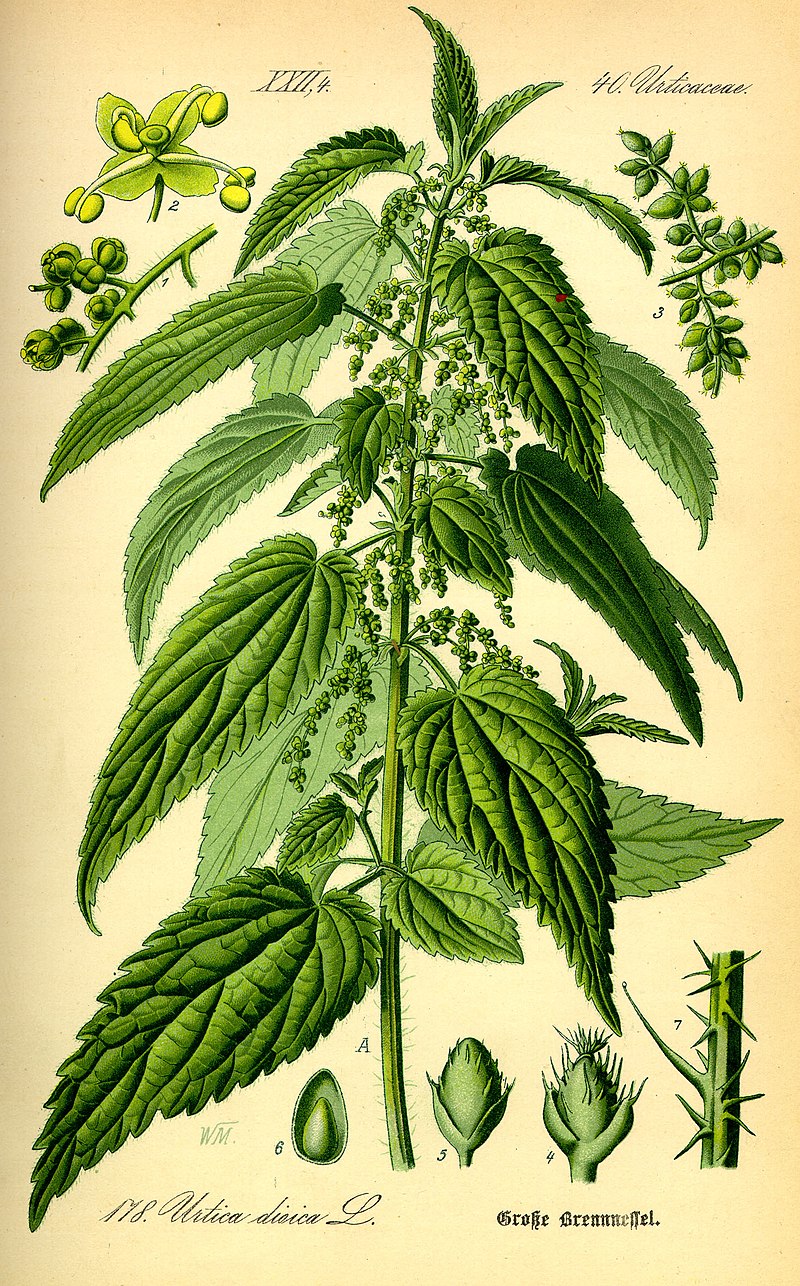
File:Illustration_Urtica_dioica0.jpg · Wikimedia Commons · See Wikimedia Commons
Urtica
Sign in to saveAlso known as nettle, nettles
Urtica is a genus of flowering plants in the family Urticaceae. Many species have stinging hairs and may be called nettles or stinging nettles (the latter name applying particularly to U. dioica). The generic name Urtica derives from the Latin for 'sting'.
OverviewAI-generated
Urtica is a genus within the family Urticaceae. Its taxonomic type is Urtica dioica. Common names for this group include nettle, ሳማ, chordica, and Chordiga. The taxon is described in the Bible Encyclopedia of Archimandrite Nicephorus. It produces nucule fruits and serves as a source for nettle soup.
Records indicate the presence of Urtica in Mexico, South Africa, China, the United States, and Brazil. Institutions including UACH, IIB-UV, INECOL, ECOSUR, and MEL hold specimens. There are 1300 records and 706 media items associated with the genus. It is referenced by 267 other encyclopedia articles.
A separate entry for Urtica exists within the phylum Cnidaria, class Hexacorallia, and order Actiniaria. This marine taxon is listed as unaccepted in the World Register of Marine Species.
Synthesized by Vinony from 28 facts across 5 sources: Wikidata, Plants of the World, WoRMS, iDigBio, Vinony graph. Generated from structured data (not the Wikipedia text) and checked against those facts — may still contain errors.
Species
Genus
- PhylumCnidaria
- ClassHexacorallia
- OrderActiniaria
Common Name: nettle
via · Kew POWO
Museum specimens
- Specimen records
- 1,300
- With media
- 706
- Family
- Urticaceae
- Collections
- UACH, IIB-UV, INECOL, ECOSUR, MEL, CAS
- Recorded in
- Mexico, South Africa, China, United States, Brazil, Spain, Philippines, India
Wikidata facts
- Instance of
- taxon
- Parent taxon
- Urticaceae
- Image
- Urtica.png
Show 9 more facts
- taxon name
- Urtica
- taxon rank
- genus
- topic's main category
- Category:Urtica
- Commons category
- Urtica
- taxon common name
- kopriva
- has fruit type
- nucule
- taxonomic type
- Urtica dioica
- this taxon is source of
- nettle soup
Sources (3)
via Wikidata · CC0
~8 min read
Encyclopedic overview
16 sectionsContents
- Description
- Taxonomy
- Phylogeny
- Species
- Etymology
- Ecology
- Toxicity
- Uses
- Culinary
- In folklore
- Asian
- Caribbean
- European
- In toponymy
- References
- External links
Urtica is a genus of flowering plants in the family Urticaceae. Many species have stinging hairs and may be called nettles or stinging nettles (the latter name applying particularly to U. dioica). The generic name Urtica derives from the Latin for 'sting'.
Due to the stinging hairs, Urtica are rarely eaten by herbivores, but provide shelter for insects. The fiber has historically been used by humans, and cooking preparations exist.
Excerpted from Wikipedia’s “Urtica” article, available under the CC BY-SA 4.0 licence.
Gallery (18)
Available in 94 languages
- Español
- Français
- Deutsch
- 中文
- 日本語
- Русский
- Português
- Italiano
- العربية
- Afrikaans
- Albanian
- Amharic
- Aragonese
- Armenian
- Asturian
- azb
- Azerbaijani
- Bahasa Indonesia
Show 75 more
- Basque
- bat_smg
- Belarusian
- Breton
- Bulgarian
- Catalan
- Cebuano
- Central Kurdish
- Chuvash
- Croatian
- Czech
- Danish
- Egyptian Arabic
- Erzya
- Esperanto
- Estonian
- Finnish
- Galician
- Georgian
- Greek
- Hebrew
- Icelandic
- Ido
- Ingush
- Irish
- Kabyle
- Kazakh
- Komi
- Komi-Permyak
- Kurdish
- Kyrgyz
- Latin
- Latvian
- lbe
- Limburgish
- Lithuanian
- Macedonian
- Mazanderani
- Mingrelian
- Moksha
- Mongolian
- Navajo
- nds_nl
- Nederlands
- Northern Frisian
- Norwegian
- Norwegian Nynorsk
- nrm
- Occitan
- Ossetic
- Polski
- Quechua
- Sardinian
- Serbian
- Sicilian
- simple
- Slovak
- Svenska
- Tamil
- Tatar
- Tiếng Việt
- Türkçe
- Tuvinian
- Ukrainian
- Upper Sorbian
- Uzbek
- Waray
- Western Mari
- Wu Chinese
- Yakut
- Zaza
- Zeelandic
- zh_yue
- فارسی
- 한국어
via Wikidata sitelinks · CC0