Encyclopedia of Life · EOL (see source)
OverviewAI-generated
Varroa destructor is a species of mite belonging to the family Varroidae. It is classified within the kingdom Animalia, phylum Arthropoda, class Arachnida, and order Mesostigmata. The species was described by Anderson & Trueman in 2001 and is distinct from Varroa jacobsoni. Its common names include 蜜蜂蟹蟎, kleštík zhoubný, and 꿀벌응애.
This organism has a length of 1.1 and a width of 1.6. It serves as a host for the Deformed wing virus and is a contributing factor to colony collapse disorder. The mite afflicts Apis, with specific hosts including Apis mellifera and Apis cerana. It causes the condition known as varroosis.
Records of Varroa destructor have been documented in the United States, Brazil, the United Kingdom, China, and Japan.
Synthesized by Vinony from 31 facts across 5 sources: Wikidata, GBIF, Gbif Occ, iDigBio, Vinony graph. Generated from structured data (not the Wikipedia text) and checked against those facts — may still contain errors.
Species
SPECIES
- KingdomAnimalia
- PhylumArthropoda
- ClassArachnida
- OrderMesostigmata
- FamilyVarroidae
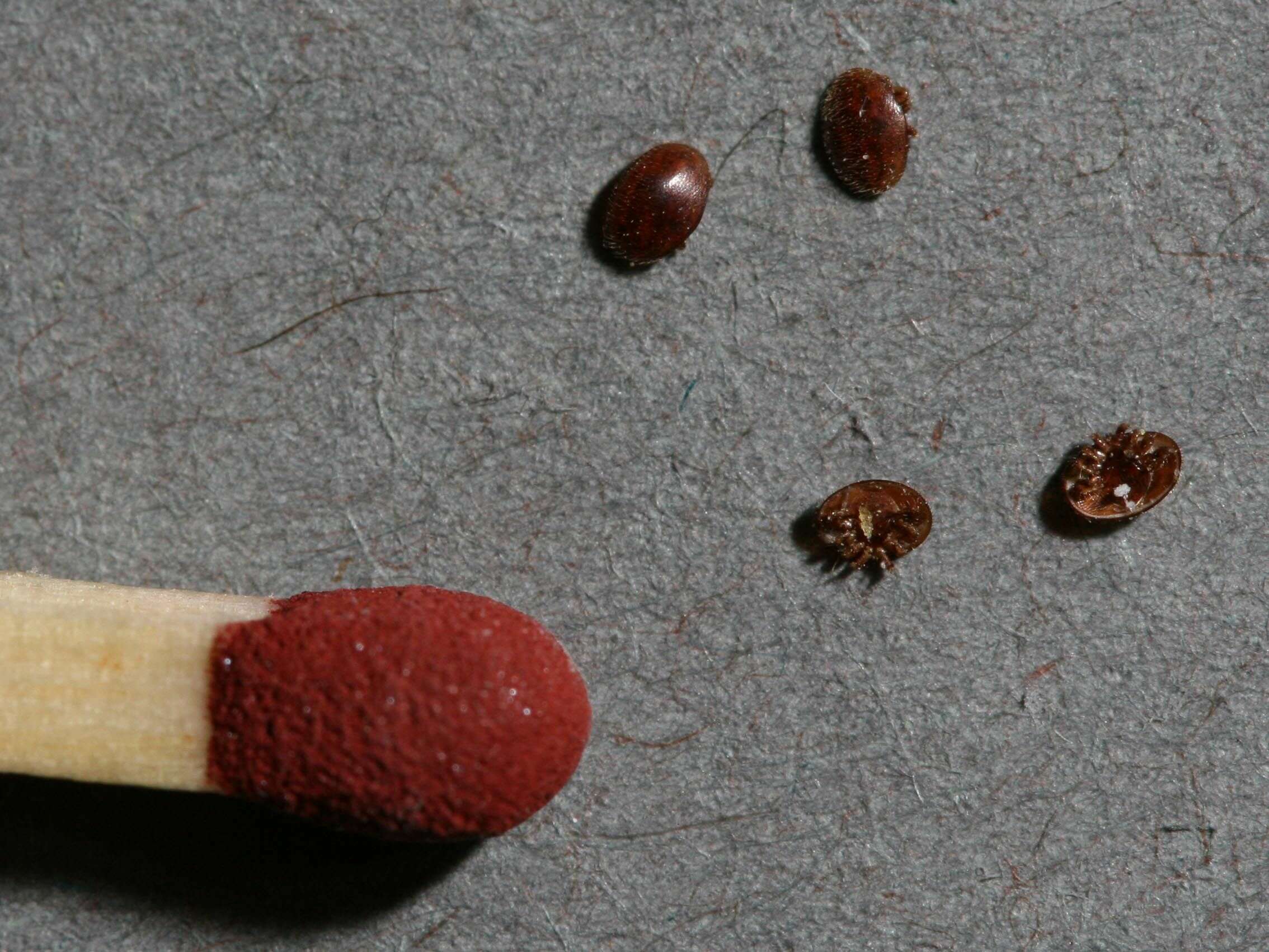
Die Varroamilbe (Varroa destructor) ist eine (als adultes Weibchen) ca. 1,1 Millimeter lange und 1,6 Millimeter breite Milbe aus der Familie Varroidae, die als Parasit an Honigbienen (Apis mellifera und Apis cerana) lebt. Die Milbe entwickelt und vermehrt sich in der verdeckelten Brut im Bienenstock. Der Befall von Bienenvölkern durch die Milbenart wird als Varroose (alter Name: Varroatose) bezeichnet. Varroa destructor gilt als der bedeutsamste Bienenschädling weltweit. In Österreich ist die Tierseuche Varroose anzeigepflichtig, in der Schweiz unter Gr. 4 Zu überwachende Seuchen (Meldepflicht) eingestuft. In Deutschland ist sie in der Bienenseuchen-Verordnung zwar geregelt, aufgrund ihrer Ubiquität wird aber von einer Anzeige- oder Meldepflicht abgesehen.
via GBIF
Museum specimens
- Specimen records
- 49
- With media
- 15
- Family
- Varroidae
- Collections
- UAM, DMNS, PSUC, OHIO STATE UNIVERSITY ACAROLOGY LABORATORY, COLUMBUS, OH (OSAL), SAMA
- Recorded in
- United States, Brazil, United Kingdom, China, Japan, South Africa, South Korea, Germany
Wikidata facts
Show 13 more facts
- Commons category
- Varroa destructor
- taxon rank
- species
- taxon name
- Varroa destructor
- taxon common name
- 꿀벌응애
- has effect
- varroosis
- sequenced genome URL
- metazoa.ensembl.org/Varroa_destructor_gca002443255
- short name
- V. destructor
- has host
- Apis
- natural reservoir of
- Deformed wing virus
- contributing factor of
- colony collapse disorder
- afflicts
- Apis
- different from
- Varroa jacobsoni
- taxon author citation
- Anderson & Trueman, 2001
via Wikidata · CC0
~19 min read
Encyclopedic overview
Varroa destructor, the Varroa mite, is an external parasitic mite that attacks and feeds on honey bees and is one of the most damaging honey bee pests in the world. A significant mite infestation leads to the death of a honey bee colony, usually in the late autumn through early spring. Without management for Varroa mite, honey bee colonies typically collapse within 2 to 3 years in temperate climates. These mites can infest Apis mellifera, the western honey bee, and Apis cerana, the Asian honey bee. Since it is very similar physically to the closely related Varroa jacobsoni, these species were thought to be one prior to 2000, but they were found to be two separate species by DNA analysis.
Parasitism of bees by mites in the genus Varroa is called varroosis. The Varroa mite can reproduce only in a honey bee colony. It attaches to the body of the bee and weakens the bee. The species is a vector for at least five debilitating bee viruses, including RNA viruses such as the deformed wing virus (DWV). The Varroa mite is the parasite with possibly the most pronounced economic impact on the beekeeping industry and is one of multiple stress factors contributing to the higher levels of bee losses around the world. Varroa mite has also been implicated as one of the multiple causes of colony collapse disorder.
Excerpted from Wikipedia’s “Varroa destructor” article, available under the CC BY-SA 4.0 licence.