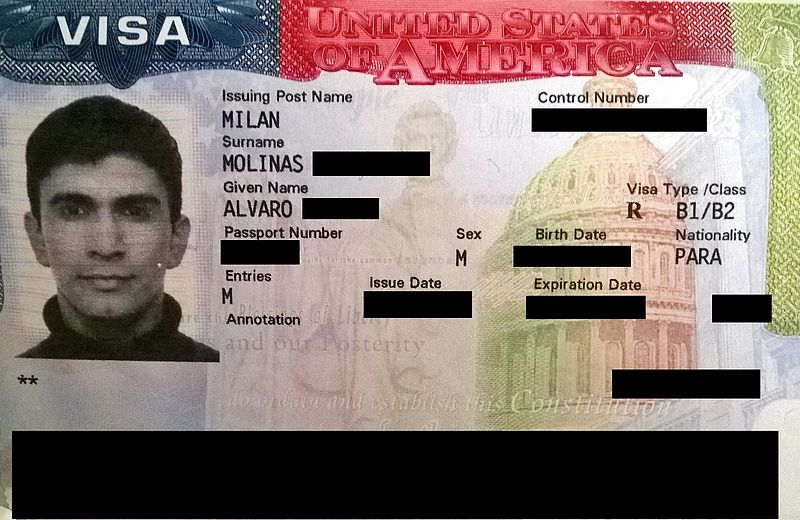
File:Visa_usa.jpg · Wikimedia Commons · See Wikimedia Commons
A visa is an official document or authorization that a country's government grants to allow a foreign person to enter, stay, or work within its borders. It matters because it helps countries control who comes in and out while giving travelers the permission they need to legally cross international borders.
AI-generated from the Wikipedia summary — may contain errors.
Wikidata facts
- Subclass of
- travel document
- Image
- Visa usa.jpg
Show 5 more facts
- Commons category
- Visas
- topic's main category
- Category:Visas
- Stack Exchange tag
- travel.stackexchange.com/tags/visas
- P8168
- Zoltán Dömötör
- facet of
- immigration law
Sources (2)
via Wikidata · CC0
~40 min read
Encyclopedic overview
A United States travel visa specimen A travel visa (from Latin charta visa 'paper that has been seen'; also known as visa stamp) is a conditional authorization granted by a polity to a foreigner that allows them to enter, remain within, or leave its territory. Visas typically include limits on the duration of the foreigner's stay, areas within the country they may enter, the dates they may enter, the number of permitted visits, or if the individual can work in the country in question. Visas are associated with the request for permission to enter a territory and thus are, in most countries, distinct from actual formal permission for an alien to enter and remain in the country. In each instance, a visa is subject to border control at the time of actual entry and can be revoked at any time. Visa evidence most commonly takes the form of a sticker endorsed in the applicant's passport or other travel document but may also exist electronically. Some countries no longer issue physical visa evidence, instead recording details only in border security databases.
Some countries require that their citizens, and sometimes foreign travelers, obtain an exit visa in order to be allowed to leave the country.
Excerpted from Wikipedia’s “visa” article, available under the CC BY-SA 4.0 licence.
Gallery (11)
Available in 80 languages
- Español
- Français
- Deutsch
- 中文
- 日本語
- Русский
- Português
- Italiano
- العربية
- हिन्दी
- Albanian
- Armenian
- Assamese
- Azerbaijani
- Bahasa Indonesia
- Bangla
- Basque
- be_x_old
Show 61 more
- Belarusian
- Bulgarian
- Buriat
- Burmese
- Catalan
- Central Kurdish
- Croatian
- Czech
- Danish
- Esperanto
- Estonian
- Filipino
- Finnish
- Galician
- Georgian
- Greek
- Hebrew
- Hungarian
- Icelandic
- Kazakh
- Kyrgyz
- Latin
- Latvian
- Limburgish
- Lithuanian
- Lombard
- Luxembourgish
- Malay
- Malayalam
- Marathi
- Mazanderani
- Minangkabau
- Nederlands
- Norwegian
- Norwegian Nynorsk
- olo
- Pampanga
- Pashto
- Polski
- Romanian
- Serbian
- Serbian (Latin)
- simple
- Slovak
- Svenska
- Swahili
- Tajik
- Tamil
- Tatar
- Tiếng Việt
- Türkçe
- Tuvinian
- Ukrainian
- Urdu
- Wu Chinese
- zh_classical
- zh_yue
- Zhuang
- فارسی
- ไทย
- 한국어
via Wikidata sitelinks · CC0