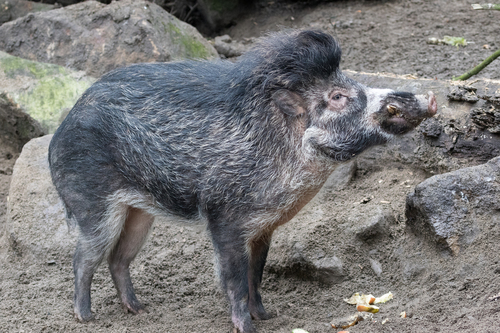
(c) Zweer de Bruin, some rights reserved (CC BY-NC-ND) · cc-by-nc-nd
Species
Visayan Warty Pig
species
卷毛野猪(学名:Sus cebifrons),猪科猪属,是一种生存在菲律宾米沙鄢群島的动物。 分布 卷毛野猪是米沙鄢的特有物种,现仅存于内格罗斯岛、班乃岛及马斯巴特岛,历史上曾分布于宿雾岛、吉马拉斯岛和蒂考岛[1]。 本种的栖息地包括原始森林及次生林,从沿海平地至海拔1600米的高地苔藓林均是其原生栖息地,但由于平地大都被人类开发,现有的种群大多只能在海拔800米以上的地区找到。一些已退化的次生草地也有其踪迹[1]。 雄性成体 幼仔 保护现状 本种目前受菲律宾当地立法保护,但由于执法不彰使保育效果不佳[1]。 人类对森林的开发是卷毛野猪所面临的主要威胁,包括伐木活动及建筑业发展,使其栖息地减少及被分割。此外,本种也常常被视为野味而受盗猎活动所威胁,这种野猪肉在当地市场的价格往往比家猪高一倍。在森林边缘地带,由于卷毛野猪常闯入农地啃食农作物,被农民视为害虫,因而成为合法猎杀的目标[1]。 此外,卷毛野猪也会与源自普通野猪(S. scrofa)的野化家猪杂交,形成“基因污染”,也是本种所面临的威胁之一[1]。 由于本种的整体种群数量呈下降趋势,国际自然保护联盟濒危物种红色名录将其评为极危[1]。 参考文献 ^ 1.0 1.1 1.2 1.3 1.4 1.5 1.6 Sus cebifrons. IUCN Red List of Threatened Species 2008. International Union for Conservation of Nature. 2008. 维基物种中的分类信息:卷毛野猪 维基共享资源中相关的多媒体资源:卷毛野猪 取自“https://zh.wikipedia.org/w/index.php?title=卷毛野猪&oldid=42037269” 分类: IUCN極危物種 豬屬 菲律賓動物 隐藏分类: CS1含有外文文本 物种微格式条目 含有拉丁語的條目
via
Wikidata facts
Show 6 more facts
- taxon common name
- cinghiale dalle verruche delle Visayas
- taxon rank
- species
- IUCN conservation status
- Critically Endangered
- taxon name
- Sus cebifrons
- Commons category
- Sus cebifrons
- short name
- S. cebifrons
Sources (2)
via Wikidata · CC0
~6 min read
Encyclopedic overview
The Visayan warty pig (Sus cebifrons) is a critically endangered species in the pig genus (Sus). It is endemic to six of the Visayan Islands (Cebu, Negros, Panay, Masbate, Guimaras, and Siquijor) in the central Philippines. It is known by many names in the region (depending on the island and linguistic group) with most translating into 'wild pig': baboy ilahas ('wild pig' in Hiligaynon, Cebuano and Waray), baboy talonon ('forest pig' in Hiligaynon), baboy sulop ('dark pig' in Cebuano), and baboy ramo ('wild boar' in Waray).
The Visayan warty pig is critically endangered due to habitat loss and hunting. It is believed to be extinct in four of the islands in its original native range, with only small surviving populations in Negros and Panay. Due to the small numbers of remaining Visayan warty pigs in the wild, little is known of their behaviors or characteristics outside of captivity. In 2012, the Negros Interior Biodiversity Expedition undertook camera trapping in the Northern Negros Natural Park and gained the first photos taken in the wild of the Visayan warty pig.
Excerpted from Wikipedia’s “Visayan warty pig” article, available under the CC BY-SA 4.0 licence.