File:Wankel_Cycle_anim_en.gif · Wikimedia Commons · See Wikimedia Commons
Wankel engine
Sign in to saveAlso known as rotary engine
internal combustion engine using an eccentric rotary design in place of pistons
Wikidata facts
- Instance of
- engine configuration
- Subclass of
- pistonless rotary engine
- Image
- Wankel-Airco.jpg
Show 4 more facts
- discoverer or inventor
- Felix Wankel
- Commons category
- Wankel engines
- Commons gallery
- Wankel engine
- topic's main category
- Category:Wankel engines
Sources (2)
via Wikidata · CC0
~40 min read
Encyclopedic overview
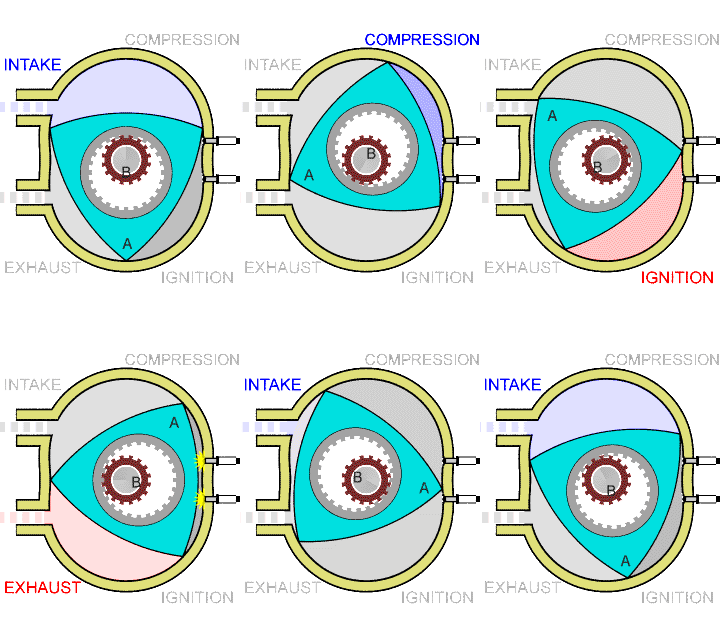
KKM Wankel combustion cycle. A is the apex of the rotor, and B is the eccentric shaft. The distance between A and B remains constant. Three power pulses are produced for each revolution of the rotor, and one power pulse is produced for each revolution of the output shaft.
The Wankel engine (/ˈvʌŋkəl/, VAHN-kəl) is a type of internal combustion engine using an eccentric rotary design to convert pressure into rotating motion. The concept was proven by German engineer Felix Wankel, followed by a commercially feasible engine designed by German engineer Hanns-Dieter Paschke. The Wankel engine's rotor is similar in shape to a Reuleaux triangle, with the sides having less curvature. The rotor spins inside a figure-eight-like epitrochoidal housing around a fixed gear. The midpoint of the rotor moves in a circle around the output shaft, rotating the shaft via a cam.
Excerpted from Wikipedia’s “Wankel engine” article, available under the CC BY-SA 4.0 licence.