
File:Western_Sahara_(orthographic_projection).svg · Wikimedia Commons · See Wikimedia Commons
Western Sahara
Sign in to saveAlso known as West Sahara, Spanish Sahara, Southern Provinces
territory in North and West Africa
OverviewAI-generated
Western Sahara is a disputed territory located in North Africa along the Atlantic Ocean. It shares borders with Mauritania, Algeria, and Morocco. The region is listed as a non-self-governing territory and an occupied territory. It has been part of the Spanish Empire, Spanish West Africa, and Spanish Sahara, and is currently claimed by the Sahrawi Arab Democratic Republic and Morocco.
The territory has a population of 612000 and covers an area of 266000. Its elevation above sea level is 237. The currency used includes the Moroccan dirham and the Sahrawi peseta. The region is situated in the UTC±00:00 and UTC+01:00 time zones. Its demonym is sahrāwī.
Synthesized by Vinony from 28 facts across 4 sources: Wikidata, Firecrawl, Vinony graph, Geo. Generated from structured data (not the Wikipedia text) and checked against those facts — may still contain errors.
Described at
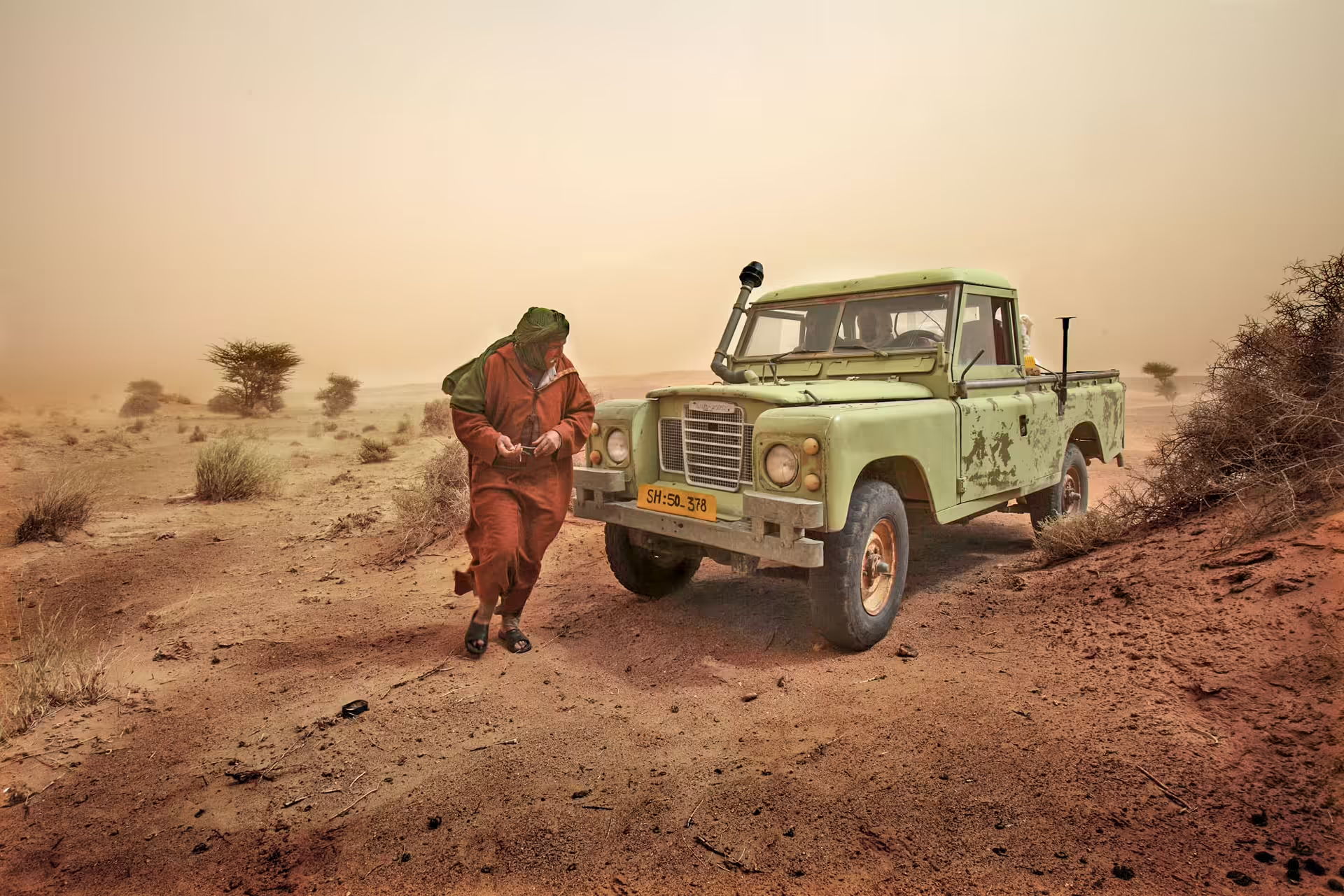
Západná Sahara - Západná Sahara - PlaceMania
Neuznaná krajina ktorá je väčšia ako Spojené kráľovstvo, no namiesto 65 miliónov ľudí ho nazýva svojim domovom menej ako 600 000.
placemania.sk →Tej gigantickej hradbe, ktorú v dĺžke prekonáva len Veľký čínsky múr, sa niekedy hovorí Múr hanby. V nekonečných pieskoch Západnej Sahary ju postavili Maročania, zriadili pozdĺž nej mínové polia a nechávajú ju strážiť po zuby ozbrojenými jednotkami. Niet divu – vďaka múru môžu nerušene čerpať z bohatých zdrojov, ktoré územia za ňou skrývajú. Nachádzajú sa tu ropné polia, ale taktiež polovica celosvetových zásob fosfátu na planéte (bez neho sa neobíde moderné poľnohospodárstvo). More pri pobreží je zase ideálne pre rybolov. Politická situácia na vyprahnutej Západnej Sahare je v skratke poriadne napätá a OSN hľadá mierové riešenia už od roku 1976, kedy odtiaľ odišli španielski kolonizátori.Lenže tých hneď vystriedala nová koloniálna mocnosť, tentokrát Maroko, a obyvatelia Saharskej arabskej demokratickej republiky alebo Sahrawi od tej doby bojujú o svoje právo na sebaurčenie. Ozbrojený boj trval pätnásť rokov, potom povstalci odložili zbrane a pokúsili sa presadiť svoje ciele politicky – vyhlásiť referendum, v ktorom by tunajší obyvatelia definitívne rozhodli, či chcú nezávislosť alebo naopak plné začlenenie do Maroka. Lenže k referendu nikdy nedošlo. Namiesto neho prišli dlhé roky zdĺhavých a všeobecne neúspešných vyjednávaní o to, kto by v referende mal mať hlasovacie právo. Obyvatelia Saharskej republiky žiadali vylúčenie marockých osadníkov, Maroko sa osadníkov zastávalo s tým, že ako riadni občania regiónu pochopiteľne hlasovať majú. Zato odmietlo k referendu pripustiť mnohých z pôvodoných obyvateľov, ktorí už dlhé roky žijú v stanových táboroch v susednom Alžírsku a pre marocké úrady už ide o cudzincov. Jeden z najdlhších konfliktov post-koloniálnej éry sa v skratke zmenil na vyčerpávajúcu právnickú bitku a niektorí z pôvodných obyvateľov Západnej Sahary živoria v nedôstojných podmienkach táborov už štyri desaťročia. Za celý život nepoznali nič iného ako provizórium, ktoré najskôr bude trvať večne. Ich jediným obzorom je vezenie z piesku. Nikdy nevstúpili na svoju rodnú pôdu, nikdy ju ani nevideli, ale ich sny o nezávislej a slobodnej Saharskej republike ich neopúšťajú. Ako prehlásil jeden miestny právnik: “Vzdáte sa viery v Boha len preto, že ste ho nevideli na vlastné oči?” Zakladateľ projektu PlaceMania.sk a zodpovedá za jeho obsah, technické fungovanie a dlhodobý rozvoj. Cestovné zápisky na webe vychádzajú z vlastnej skúsenosti z ciest; faktografické záznamy o miestach vznikajú kombináciou verejných zdrojov, automatizovaného spracovania dát a redakčného overovania. Zameriava sa na netradičné lokality, ich historický a geografický kontext a menej známe súvislosti. Things to do near Západná Sahara, Moroccan Sahara, Spanish Sahara, Spanish Western Sahara, Western Sahara, الصحراء الغربية, لصحراء الغربية, Krajina, Politická oblasť, EH, ESH. Find tours, guided tours, local activities, attractions, tickets, excursions, sightseeing, day trips and travel experiences nearby. Coordinates: 24.215527, -12.885834. V oáze Imlili v Západnej Sahare, len tisíce kilometrov od civilizácie, sa ukrýva jedinečný prírodný div. Sebkha, starobylé slané lagúny,… Hodnota nebola dostupná pre Západná Sahara, údaje boli doplnené z krajiny Maroko. Pozrite si ďalšie zaujímave miesta vo svete, ktoré stoja za naplánovanie ďalšej cesty. Samozvaný štát vyhlásený v roku 2019 na nenárokovanom území medzi Chorvátskom a Srbskom, v blízkosti Liberlandu. Podnestersko je taká unikátna neuznaná krajina v Európe, kde ešte "fičí" komunizmus. Chcete vidieť ďalšie úchvatné miesta ako Západná Sahara? Nájdeš ich u nás na mape. Objav s nami ďalšie úžasné miesta na zemi.
Excerpt from a page describing this subject · 17,218 chars · not written by Vinony
Wikidata facts
- Instance of
- occupied territory
- Part of
- North Africa
- Official name
- Sahara occidental
- Demonym
- Sahrawi
- Country
- Spanish Sahara
- Continent
- Africa
- Currency
- Sahrawi peseta
- Population
- 612000
- Area
- 266000
- Elevation
- 237
- Body of water
- Atlantic Ocean
- Shares border with
- Algeria
- Image
- Western Sahara desert 4.jpg
- Calling code
- +212
- Said to be same as
- Southern Provinces
Show 22 more facts
- Commons category
- Western Sahara
- topic's main category
- Category:Western Sahara
- topic's main Wikimedia portal
- Portal:Western Sahara
- Commons gallery
- صحراء غربية - Sahara Occidental
- geography of topic
- geography of Western Sahara
- short name
- EH
- territory claimed by
- Morocco
- category for people born here
- Category:Births in Western Sahara
- language used
- Saharan Spanish
- native label
- الصحراء الغربية
- Unicode character
- 🇪🇭
- economy of topic
- economy of Western Sahara
- demographics of topic
- demographics of Western Sahara
- different from
- Saharan Morocco
- related category
- Category:Western Sahara-related lists
- on focus list of Wikimedia project
- Wikipedia:Vital articles/Level/4
- culture
- culture of Western Sahara
- driving side
- right
- P12749
- Molina Aterno
- lowest point
- Sebkha Tah
- top-level Internet domain
- .eh
- described at URL
- www.placemania.sk/svetova-zaujimavost/zapadna-sahara
Sources (15)
via Wikidata · CC0
~40 min read
Encyclopedic overview
Western Sahara is a United Nations–designated non-self-governing territory in north-western Africa. It has a surface area of 272,000 square kilometres (105,000 sq mi). Western Sahara is the last African colonial state yet to achieve independence and has been dubbed "Africa's last colony". With an estimated population of around 600,000 inhabitants, it is the most sparsely populated territory in Africa and the second most sparsely populated territory in the world after Greenland, consisting mainly of desert flatlands.
Francoist Spain previously colonized the territory as the Spanish Sahara until 1975, when the Spanish transition to democracy took effect. In 1976, when Spain attempted to transfer its administration to Morocco and Mauritania while ignoring a verdict of the International Court of Justice that those countries had no sovereignty over Western Sahara, a war erupted and the Polisario Front—a national liberation movement recognized by the United Nations as the legitimate representative of the people of Western Sahara—proclaimed the Sahrawi Arab Democratic Republic (SADR) with a government-in-exile in Tindouf, Algeria. Mauritania withdrew its claims in 1979, and Morocco secured de facto control of most of the territory, including all major cities and most natural resources. A UN-sponsored ceasefire agreement was reached in 1991, though a planned referendum monitored by the UN's MINURSO mission has since stalled.
Excerpted from Wikipedia’s “Western Sahara” article, available under the CC BY-SA 4.0 licence.
Gallery (12)
On the map
2 mapped locations
Available in 172 languages
- Español
- Français
- Deutsch
- 中文
- 日本語
- Русский
- Português
- Italiano
- العربية
- हिन्दी
- abstract
- Achinese
- Afrikaans
- Albanian
- Albanian
- Amharic
- ami
- Angika
Show 153 more
- Aragonese
- Armenian
- Arpitan
- Assamese
- Asturian
- azb
- Azerbaijani
- Bahasa Indonesia
- Bangla
- Bashkir
- Basque
- Bavarian
- be_x_old
- Belarusian
- Bhojpuri
- Bikol
- Bishnupriya
- Breton
- Bulgarian
- Catalan
- cdo
- Cebuano
- Central Kurdish
- Cornish
- Crimean Tatar
- Croatian
- Czech
- Danish
- Divehi
- dty
- Egyptian Arabic
- Esperanto
- Estonian
- Ewe
- Extremaduran
- Fiji Hindi
- Filipino
- Finnish
- Gagauz
- Galician
- Georgian
- gpe
- Greek
- Guarani
- Haitian Creole
- Hakka Chinese
- Hawaiian
- Hebrew
- Icelandic
- Ido
- Iloko
- Interlingua
- Interlingue
- Irish
- Jamaican Creole English
- Javanese
- Kabyle
- Kannada
- Kara-Kalpak
- Kashubian
- Kazakh
- kbp
- Kongo
- Kotava
- Kurdish
- Kyrgyz
- Ladino
- Latin
- Latvian
- Ligurian
- Limburgish
- Lingala
- Lithuanian
- Lower Sorbian
- Macedonian
- Malagasy
- Malay
- Malayalam
- Maltese
- Māori
- Marathi
- Mazanderani
- Mingrelian
- Mongolian
- Moroccan Arabic
- Nederlands
- Nepali
- Northern Sami
- Northern Sotho
- Norwegian
- Norwegian Nynorsk
- Novial
- Occitan
- Oromo
- Pampanga
- Polski
- Punjabi
- Quechua
- Romanian
- Santali
- Sardinian
- Scots
- Scottish Gaelic
- Serbian
- Serbian (Latin)
- Shan
- Sicilian
- Silesian
- simple
- Sindhi
- Slovak
- Slovenian
- Southern Sotho
- Standard Moroccan Tamazight
- Sundanese
- Svenska
- Swahili
- szy
- Tajik
- Tamil
- Taroko
- tay
- Telugu
- Tibetan
- Tiếng Việt
- Toki Pona
- Tsonga
- Türkçe
- Tyap
- Ukrainian
- Upper Sorbian
- Urdu
- Uyghur
- Uzbek
- Volapük
- Walloon
- Waray
- Welsh
- Western Frisian
- Western Mari
- Western Panjabi
- Wolof
- Wu Chinese
- Yakut
- Yoruba
- Zaza
- Zeelandic
- zh_min_nan
- zh_yue
- Zulu
- فارسی
- ไทย
- 한국어
via Wikidata sitelinks · CC0