Encyclopedia of Life · EOL (see source)
Whitetip reef shark
Sign in to saveAlso known as Triaenodon obesus, Blunt-head Shark, Blunthead Shark, Light-tip Shark, Reef Whitetip, Reef Whitetip Shark, White-tip Reef Shark, White-tip Shark
species of shark
OverviewAI-generated
The whitetip reef shark, scientifically known as *Triaenodon obesus*, is a species of shark belonging to the family Carcharhinidae. It is classified within the order Carcharhiniformes, class Elasmobranchii, and phylum Chordata. The taxon name was established by Rüppell in 1837, and its status is accepted. This marine organism is distinct from the oceanic whitetip shark.
Its primary food source consists of Teleostei. The species has a recorded range in New Guinea. According to the IUCN Red List, the whitetip reef shark is classified as Vulnerable, a status assigned in 2020.
Synthesized by Vinony from 24 facts across 4 sources: Wikidata, WoRMS, IUCN Red List, Vinony graph. Generated from structured data (not the Wikipedia text) and checked against those facts — may still contain errors.
Species
Vulnerablewhitetip reef shark
Species
- PhylumChordata
- ClassElasmobranchii
- OrderCarcharhiniformes
- FamilyCarcharhinidae
Triaenodon obesus Le Requin-corail ou Requin à pointes blanches ou Requin à pointes blanches du lagon ou Requin à ailerons blancs (Triaenodon obesus) est une espèce de poissons de la famille des Carcharhinidae. C'est la seule espèce du genre Triaenodon[1]. Sommaire 1 Confusion possible 2 Étymologie 3 Description 4 Répartition 5 Habitat 6 Comportement 7 Alimentation 8 Reproduction 9 Menace 10 Notes et références 11 Liens externes 12 Bibliographie Confusion possible Compte tenu de la multiplicité des noms vernaculaires ce requin ne doit pas être confondu avec le Requin à pointes blanches de récif (Carcharhinus albimarginatus) appelé également Requin à pointes blanches ou Requin à pointes blanches de récif ou avec le Requin longimane (Carcharhinus longimanus) appelé également Requin à ailerons blancs du large. Étymologie Triaenodon : du grec "triainia" trident et "odous" dent. Obesus : sens premier du latin "maigre". Description Requin-corail (Sabah, Malaisie). La taille maximale des adultes atteint 213 cm pour un poids de 18 kg. Le dos est brun gris et le ventre est gris pâle ou argenté. Les extrémités des deux nageoires dorsales et de la caudale sont blanches, d'où l'un des noms ver
via IUCN
Wikidata facts
- Instance of
- taxon
- Parent taxon
- Triaenodon
- Image
- Whitetip-reef-shark.jpg
Show 10 more facts
- taxon rank
- species
- IUCN conservation status
- Vulnerable
- Commons category
- Triaenodon obesus
- taxon name
- Triaenodon obesus
- Commons gallery
- Triaenodon obesus
- taxon common name
- 鱟鮫
- different from
- oceanic whitetip shark
- main food source
- Teleostei
- taxon range
- New Guinea
- external data available at URL
- www.gbif.org/dataset/abf8082d-c179-4cb2-acc4-3cdef16c4341
via Wikidata · CC0
~18 min read
Encyclopedic overview
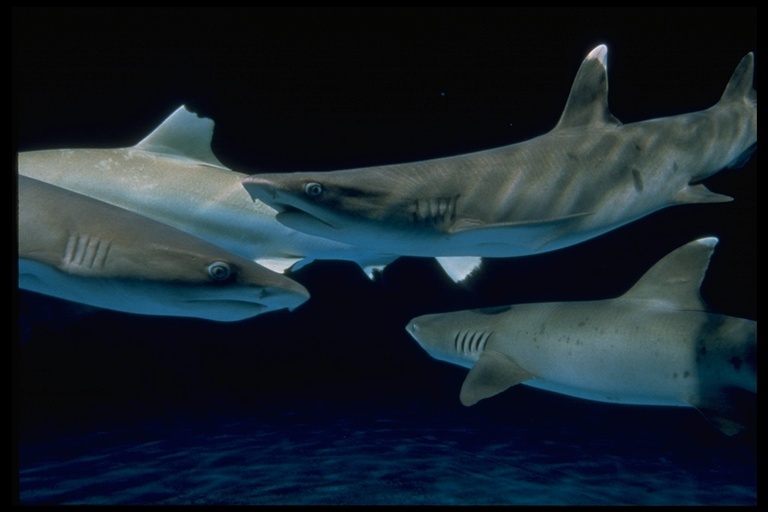
The whitetip reef shark (Triaenodon obesus) is a species of requiem shark, in the family Carcharhinidae. It is the only extant species of genus Triaenodon. A small shark that does not usually exceed 1.6 m (5.2 ft) in length, this species is easily recognizable by its slender body and short but broad head, as well as tubular skin flaps beside the nostrils, oval eyes with vertical pupils, and white-tipped dorsal and caudal fins. One of the most common sharks found on Indo-Pacific coral reefs, the whitetip reef shark occurs as far west as South Africa and as far east as Central America. It is typically found on or near the bottom in clear water, at a depth of 8–40 m (26–131 ft).
During the day, whitetip reef sharks spend much of their time resting inside caves. Unlike other requiem sharks, which rely on ram ventilation and must constantly swim to breathe, this shark can pump water over its gills and lie still on the bottom. At night, whitetip reef sharks emerge to hunt bony fishes, crustaceans, and octopus in groups, their elongate bodies allowing them to force their way into crevices and holes to extract hidden prey. Individuals may stay within a particular area of the reef for months or years, frequently returning to the same shelter. This species is viviparous, in which the developing embryos are sustained by a placental connection to their mother.
Excerpted from Wikipedia’s “Whitetip reef shark” article, available under the CC BY-SA 4.0 licence.