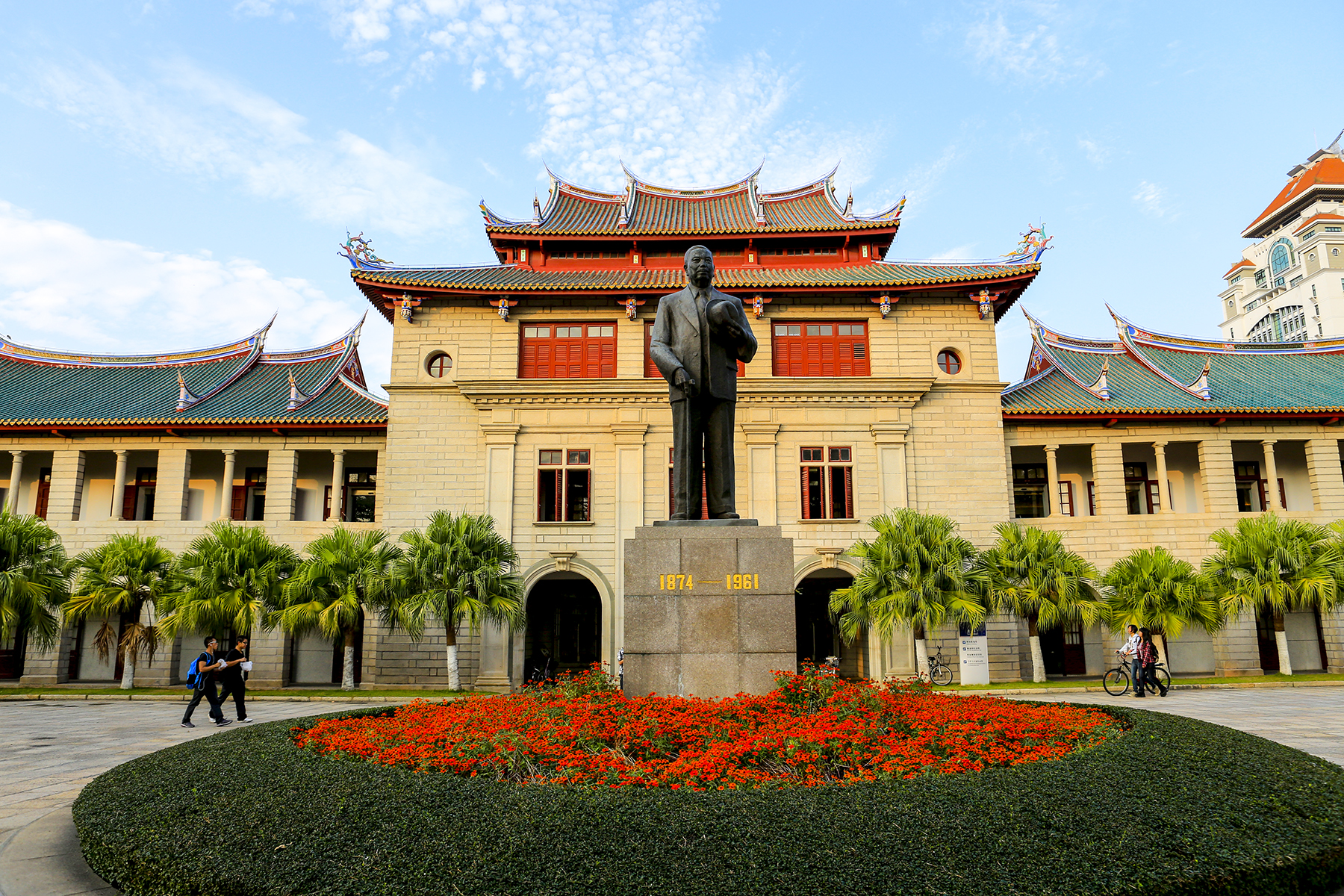
Xiamen
Sign in to saveAlso known as Amoy, Siamen, Hsiamen, Aimoey, Xia-men, Hiamen
Xiamen, historically romanized as Amoy, is a sub-provincial city in southeastern Fujian, People's Republic of China, beside the Taiwan Strait. It is divided into six districts: Huli, Siming, Jimei, Tong'an, Haicang, and Xiang'an. All together, these cover an area of with a population of 5,163,970 as of 2020 and estimated at 5.35 million as of 31 December 2024. The urbanized area of the city has spread from its original island to include most parts of all six of its districts, as well as 4 Zhangzhou districts (Xiangcheng, Longwen, Longhai and Changtai), which form a built-up area of 7,284,148 i
OverviewAI-generated
Xiamen is a prefecture-level city and sub-province-level division located in Fujian Province, China. It serves as the capital of Siming District and contains the administrative entities of Siming, Haicang, Huli, and Jimei Districts. The city has a population of 5,163,970 and covers an area of 1,699.39 square kilometers. Its official name is 厦门市, and it operates in the UTC+08:00 time zone.
The city is twinned with Dushanbe, Kaunas, Marathon, and Cardiff. Xiamen has an elevation of 7 meters and uses the postal code 361000. The local dialing code is 00592, and the license plate code is 闽D.
Synthesized by Vinony from 53 facts across 7 sources: Wikidata, Open Meteo, Openweathermap, OpenStreetMap, GeoNames, Vinony graph, Geo. Generated from structured data (not the Wikipedia text) and checked against those facts — may still contain errors.
Weather now
7-day forecast
via Open-Meteo
Place details
- Locality
- 厦门市
- Region
- 福建省
- Country
- 中国
- Population
- 4,617,251
- Timezone
- Asia/Shanghai
via OpenStreetMap · GeoNames
Wikipedia views (30d)
25,022 totalvia Wikimedia Pageviews API
Key facts
- Settlement.name
- Xiamen
- Settlement.native_name
- 厦门市
- Settlement.native_name_lang
- zh-Hans
- Settlement.other_name
- Amoy
- Settlement.settlement_type
- Prefecture-level and Sub-provincial city
- Settlement.motto
- (Comfortable city, oceanfront garden)
- Settlement.image_map1
- Locator map Xiamen in Fujian.svg
- Settlement.mapsize1
- 240px
- Settlement.map_caption1
- Location of Xiamen City jurisdiction in Fujian
- Settlement.pushpin_map
- China
- Settlement.pushpin_label_position
- right
- Settlement.pushpin_map_caption
- Location in China
- Settlement.subdivision_type
- Country
- Settlement.subdivision_type1
- Province
- Settlement.subdivision_name1
- Fujian
- Settlement.seat_type
- Municipal seat
- Settlement.seat
- Siming District
- Settlement.parts_type
- County-leveldivisions
via Wikipedia infobox
Wikidata facts
- Instance of
- prefecture-level city
- Official name
- 厦门市
- Country
- Republic of China
- Located in
- Fujian
- Contains
- Xiang'an District
- Population
- 5163970
- Area
- 1699.39
- Time zone
- UTC+08:00
- Capital of
- Siming District
- Official website
- www.xiamen.gov.cn
- Image
- Xiamen night cityscape 2018 - Flickr - Jaykhuang.jpg
- Dialing code
- 00592
- Licence plate code
- 闽D
Show 10 more facts
- twinned administrative body
- George Town
- Commons category
- Xiamen
- topic's main category
- Category:Xiamen
- postal code
- 361000
- described by source
- Encyclopædia Britannica 11th edition
- category for people born here
- Category:Births in Xiamen
- native label
- 厦门市
- category of associated people
- Category:People from Xiamen
- hashtag
- Xiamen
- P12749
- Helmut Fischer
via Wikidata · CC0
Travel guide
Understand
The core of the city is on Xiamen Island. The mainland suburbs Jimei, Tong'an, Xiang'an, and Haicang, as well as the small island of Gulangyu, are separate, but all these areas are administered as parts of Xiamen.
Until 1840, Western "barbarians" were only allowed to conduct trade in Guangzhou under strict restrictions. After China's defeat in the First Opium War, the British seized Hong Kong, and China was forced to open five treaty ports: Guangzhou, Xiamen, Fuzhou, Ningbo, and Shanghai. Gulangyu became a concession administered by foreign powers, hosting consulates and luxurious residences. Today, Gulangyu is just a five-minute ferry ride from the main urban area and remains a picturesque and peaceful (car-free) destination.
During the early days of Cold War, Xiamen was a battlefront between the Communists and Nationalists — propaganda broadcast, frogman infiltration, as well as shelling across Xiamen and the neighbouring island of Kinmen were the norm. The giant slogan that promotes Mainland China's "One Country, Two Systems" policy towards reunification (in contrast of the opposing slogan on Kinmen that advocates the Three Principles of the People) is a remanent from that period of prolonged conflict.
In 1980, Xiamen became one of China’s first Special Economic Zones, aimed at encouraging development and opening up the country. Since then, Xiamen has flourished. It has received more Taiwanese investment than any other Chinese city, partly because both southern Fujian a…
Get in
Xiamen has a major airport and good road and rail connections; it is easily reached from anywhere in China and many places beyond.
Get around
Local public transit is easiest to pay for with the Xiamen public transit mini-app on Alipay or WeChat.
If you are planning on staying in Xiamen for a significant amount of time, you can also get an eKatong (e卡通) stored value card. It can be used in different forms of public transport not only in Xiamen, but also in the neighbouring cities of Quanzhou and Zhangzhou.
The local bus system is very good, but the normal bus routes are listed in Chinese and do not have English on the signs. Signs in the BRT and Metro are bilingual in Chinese and English, while announcements are trilingual in Mandarin, Minnan and English. thumb|BRT on bus-only elevated roads thumb|Metro lines in Xiamen Taxis are cheap, starting at ¥8 (plus ¥3 fuel tax – so ¥11) for the first 3 km. After the first 3 km, the meter charge will go up based on distance. Although the meter may read with a decimal, most taxi drivers will round up. On the other hand, as anywhere in China, tipping is not expected.
During the day time, you should be able to get anywhere on Xiamen island, including the airport, for under ¥40. But be wary that some taxi drivers might take advantage of you if they know that you are not a local and might take the longer route to your destination. For example, if the driver says "Huándǎo Lù" after you tell him where you want to go, say bù (no), because that is the ring road that circles the entire island and although it is scenic, it is likely the most expensive way to go.
thumb|Bicy…
Eat
For restaurant listings, see the district articles. Here we list some local specialties that may be worth looking for.
thumb|Mr Lin's deluxe seafood shacha noodles, [[Gulangyu]] thumb|Sea worm jelly snack time!
Shacha noodles (沙茶面 shāchá miàn) — Likely the most famous dish in Xiamen, the Minnan reading sa-te mi hints at their origin: the peanutty broth originates from the Malay satay. Oyster omelette (海蛎煎 hǎilìjiān in Mandarin, 蚵仔煎 ô-á-chian in Minnan) - Small oysters, eggs, sweet potato starch and garlic shoots fried together. For umami lovers. If you've visited Taiwan before, don't be fooled by the name, as the Xiamen version of the dish is quite different from the Taiwanese version. Sea worm jelly (土笋冻 tǔsǔndòng) — Surely Xiamen's most infamous dish, it's just what it says on the tin: marine worms served in aspic with a little soy sauce and chilli to wash it down. The worms are basically tasteless but the texture is distinctly chewy. Xiamen Vermicelli Noodles in Thick Broth 面线糊 miànxiàn hú Xiamen Fish Balls 厦门鱼丸 xiàmén yúwán Shrimp Noodle Soup 虾面 xiāmiàn Xiamen Spring Roll 春卷 chūnjuǎn Xiamen Glutinous Rice Wrap 厦门烧肉粽 xiàmén shāoròu zòng Peanut Soup 花生汤 huāshēng tāng Xiamen Chive Pockets 韭菜盒 jiǔcài hé Crab Porridge 蟹米粥 xièmǐ zhōu Braised Duck with Ginger 姜母鸭 jiāngmǔyā Xiamen Wonton Soup 扁食汤 biǎnshítāng Xiamen Grass Jelly 烧仙草 shāo xiān cǎo Xiamen Four Fruit Soup 四果汤 sì guǒ tāng
Go next
Hakka Tulou – 3–5 hours west of Xiamen are these large earthen structures where a number of residences are built inside a single fortified compound, a UNESCO World Heritage Site. Kinmen – Islands controlled by Taiwan have charming villages with traditional Fujianese architecture and interesting cold war defenses. One-hour ferry ride from Dongdu Wharf, or 30 minutes from Shuitou Wharf. Going to Kinmen is considered to be leaving China and will use up a single-entry visa. Quanzhou – This ancient city has come down in the world a bit since Marco Polo sailed home from there around 1290 and described it as one of the two busiest ports on Earth and incredibly rich. However, it is still well worth a visit. The old fortress town of Chongwu is located farther east, and has direct buses from Xiamen. Liu'ao – a windswept peninsula with long beaches and strange rock formations, south of Xiamen. Chaozhou – Just across the border in Guangdong province, main center of Teochew culture, and whose Teochew dialect is closely related to Minnan.
Travel guide from Wikivoyage (CC BY-SA 4.0)
~81 min read
Encyclopedic overview
106 sectionsContents
- Name
- Geography
- Climate
- History
- Demographics
- Languages
- Religion
- Administration
- Economy
- Financial services
- Development zones
- Gulangyu Island-Wanshi Mountain Scenic Spot
- Key industries
- Panel display industry
- Computer and communication equipment industry
- Semiconductor and integrated circuits industry
- Software and information services industry
- Machinery and equipment industry
- New materials industry
- Tourism industry
- Exhibition industry
- Culture and creativity industry
- Modern logistics industry
- Financial services industry
- Bio-medicine and health industry
- Urban modern agriculture industry
- Automotive
- Transportation
- Local transportation
- Railway
- Road
- Bridge
- Undersea tunnel
- Subway
- BRT
- Cycle-way
- Air
- Sea
- Ferries
- Port
- Tourism
- Tourist attractions
- Gulangyu Island
- Sunlight rock
- Kulangsu Historic International Settlement
- Yundang Lake
- Hulishan Fortress
- Zengcuoan
- Shapowei
- Aotou village
- Arcade Building
- Xiamen Horticulture Expo Garden
- Chengyi Discovery Center
- Museums
- Xiamen Museum
- Tan Kah Kee Memorial Museum
- Overseas Chinese Museum
- Gulangyu Piano Museum
- Xiamen Olympic Museum
- Oriental Fish Bone Gallery
- Museum of 'incessant' Xiamen memories
- Culture
- Folk customs
- Gongfu tea
- Jianggu
- Mid-Autumn mooncake gambling
- Sending off the Wang Boat
- Cuisine
- Music
- Opera
- Nanyin
- Gaojia Opera
- Gezai opera
- Dazuigu
- Chest-clapping dance
- Art
- Lacquer thread sculpture
- Bead embroidery
- Religion
- Nanputuo Temple
- Brahma Temple
- Belief in Life Protection Emperor
- Belief in Lord Chi
- Belief in Fude Zhengshen
- Media
- Colleges and universities
- Public universities
- Private universities
- Public higher vocational schools
- Private higher vocational schools
- Continuing education
- Non-degree higher learning institutions
- Military
- Notable people
- International relations
- Consulates
- Sister cities
- Friendly exchange cities
- Sister ports
- Friendly cooperation ports
- Notes
- References
- Citations
- General and cited sources
- Further reading
- External links
Xiamen, historically romanized as Amoy, is a sub-provincial city in southeastern Fujian, People's Republic of China, beside the Taiwan Strait. It is divided into six districts: Huli, Siming, Jimei, Tong'an, Haicang, and Xiang'an. All together, these cover an area of with a population of 5,163,970 as of 2020 and estimated at 5.35 million as of 31 December 2024. The urbanized area of the city has spread from its original island to include most parts of all six of its districts, as well as 4 Zhangzhou districts (Xiangcheng, Longwen, Longhai and Changtai), which form a built-up area of 7,284,148 inhabitants. This area also connects with Quanzhou in the north, making up a metropolis of nearly ten million people. The Kinmen Islands (Quemoy) administered by the Republic of China (Taiwan) lie less than away separated by Xiamen Bay. As part of the Opening Up Policy under Deng Xiaoping, Xiamen became one of China's original four special economic zones opened to foreign investment and trade in the early 1980s.
Xiamen Island possessed a major international seaport. The port of Xiamen is a well-developed first-class trunk line port in the Asia-Pacific region. It is ranked the 7th-largest container port in China and ranks 14th in the world. It is the 4th port in China with the capacity to handle 6th-generation large container ships. On 31 August 2010, Xiamen Port incorporated the neighboring port of Zhangzhou to form the largest port of China's Southeast. Ever since the 12th century, Xiamen was also an important origin for many migrants to Singapore, Malaysia, Indonesia and the Philippines. The overseas Chinese used to support Xiamen's educational and cultural institutions. Xiamen is classified as a Large-Port Metropolis.
Excerpted from Wikipedia’s “Xiamen” article, available under the CC BY-SA 4.0 licence.
Gallery (52)
On the map
3 mapped locations
Available in 74 languages
- Español
- Français
- Deutsch
- 中文
- 日本語
- Русский
- Português
- Italiano
- العربية
- Afrikaans
- Albanian
- Armenian
- Asturian
- Bahasa Indonesia
- Balinese
- Bangla
- Basque
- Belarusian
Show 55 more
- Breton
- Bulgarian
- Catalan
- cdo
- Cebuano
- Croatian
- Czech
- Danish
- Esperanto
- Estonian
- Filipino
- Finnish
- Galician
- Gan Chinese
- Georgian
- Greek
- Hakka Chinese
- Hausa
- Hebrew
- Hungarian
- Icelandic
- Kikuyu
- Kurdish
- Latvian
- Lithuanian
- Malagasy
- Malay
- Marathi
- Mazanderani
- Mingrelian
- Nederlands
- Norwegian
- Norwegian Nynorsk
- Ossetic
- Pampanga
- Polski
- Quechua
- Serbian
- simple
- Svenska
- Tiếng Việt
- Türkçe
- Ukrainian
- Urdu
- Uyghur
- Waray
- Welsh
- Western Panjabi
- Wu Chinese
- zh_classical
- zh_min_nan
- zh_yue
- فارسی
- ไทย
- 한국어
via Wikidata sitelinks · CC0