Yemen
Sign in to saveAlso known as Republic of Yemen, ye, Rep. Yemen, YEM, YE
Yemen, officially the Republic of Yemen, is a country in West Asia. Including the Socotra Archipelago, mainland Yemen is located in southern Arabia; bordering Saudi Arabia to the north, Oman to the northeast, the south-eastern part of the Arabian Sea to the east, the Gulf of Aden to the south, and the Red Sea to the west, sharing maritime borders with Djibouti, Eritrea, Somaliland and Somalia across the Horn of Africa. Covering roughly 455,503 square kilometres (175,871 square miles), with a coastline of approximately , Yemen is the second largest country on the Arabian Peninsula by area, and
OverviewAI-generated
Yemen, officially the Republic of Yemen, is a country in Western Asia. Its capital is Sana'a, and its official language is Arabic. The nation operates as a republic with a presidential system, where the head of state holds the office of President of Yemen and the head of government holds the office of Prime Minister of Yemen. Diplomatic relations exist with the United States, Iran, Saudi Arabia, and Russia.
The country has a population of 32,684,503 and covers an area of 527,968. The currency is the Yemeni Rial, and the time zone is UTC+03:00. Public holidays include Eid al-Adha, Eid al-Fitr, International Workers' Day, and Yemeni unification. The Gini coefficient is 35.9, and the Gini coefficient is 35.9. The Gini coefficient is 35.9. The Gini coefficient is 35.9.
Synthesized by Vinony from 68 facts across 9 sources: Wikidata, REST Countries, Openweathermap, Open Meteo, World Bank, OpenStreetMap, PubMed, Vinony graph, Geo. Generated from structured data (not the Wikipedia text) and checked against those facts — may still contain errors.
In the Vinony graph
Yemen is indexed among the 215 entries in Vinony's Countries collection.
Vinony's link graph records 13,335 inbound references to Yemen, and connects out to Republic of Yemen Armed Forces, Zaidism and Yemeni civil war.
The entry is geolocated on the map in YE, across 3 mapped points.
It sits within the topics 1990 establishments in Yemen, Arabian Peninsula and Countries and territories where Arabic is an official language.
Weather now
cached 4h ago7-day forecast
via Open-Meteo
Country
- Capital
- Sana'a
- Population
- 32,684,503
- Region
- Asia · Western Asia
- Demonym
- Yemeni
- Currencies
- YER (﷼)
- Languages
- Arabic
- Calling code
- +967
- Drives on
- Right
- Gini
- 36.7 (2014)
- FIFA code
- YEM
- TLD
- .ye
- Timezones
- UTC+03:00
- Borders
- OMN, SAU
via REST Countries
Indicators · World Bank
- GDP
- $21.6B(2018)
- Population
- 40,583,164(2024)
- Life expectancy
- 69.4 yrs(2024)
- Unemployment
- 17.3 %(2025)
- Urban population
- 36.8 %(2024)
- Internet users
- 17.5 %(2019)
- Forest area
- 1 %(2023)
- Renewable energy
- 3.7 %(2021)
via World Bank Open Data · CC BY 4.0
Wikipedia views (30d)
115,959 totalvia Wikimedia Pageviews API
Key facts
- Country.conventional_long_name
- Republic of Yemen
- Country.common_name
- Yemen
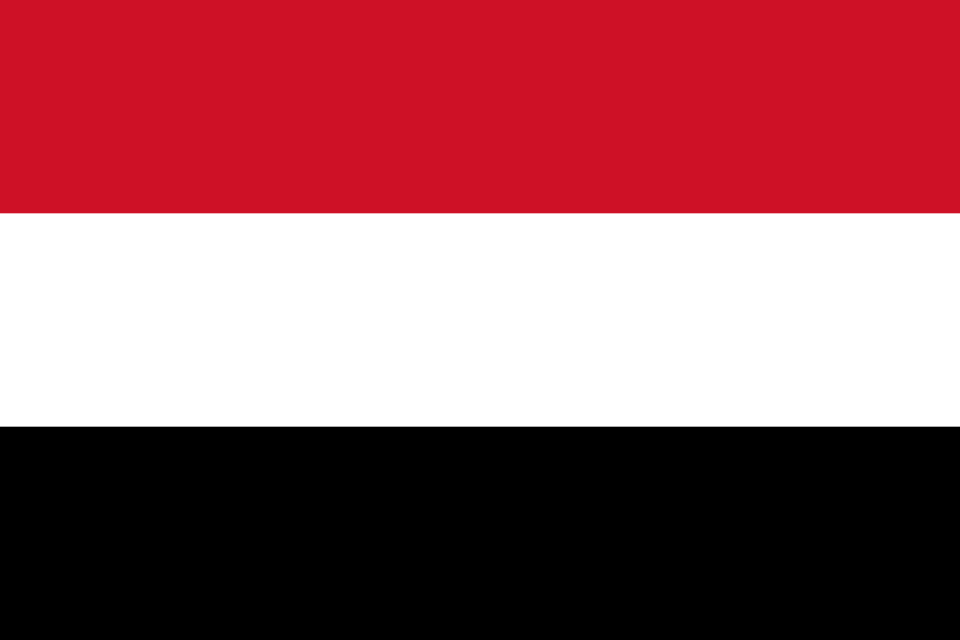
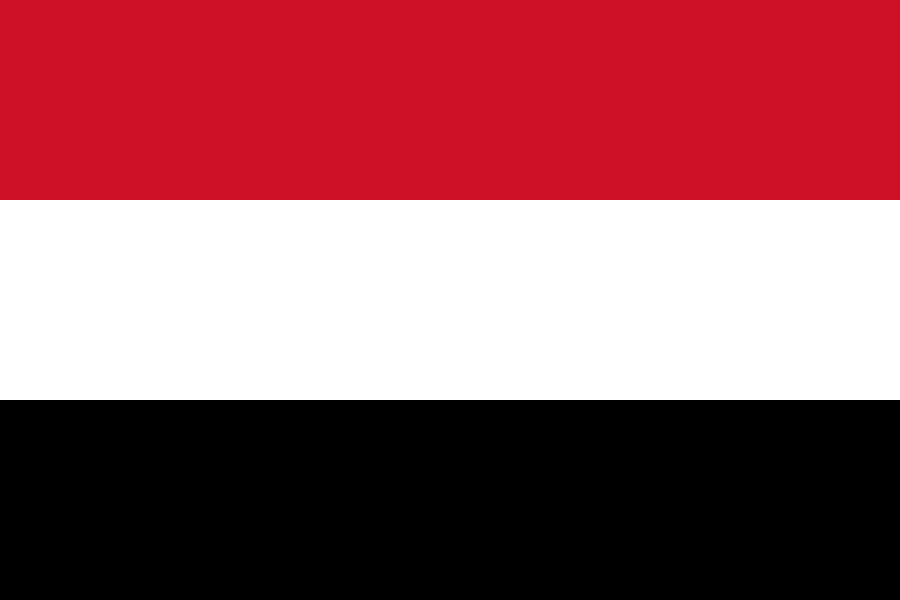
- Country.image_flag
- Flag of Yemen.svg
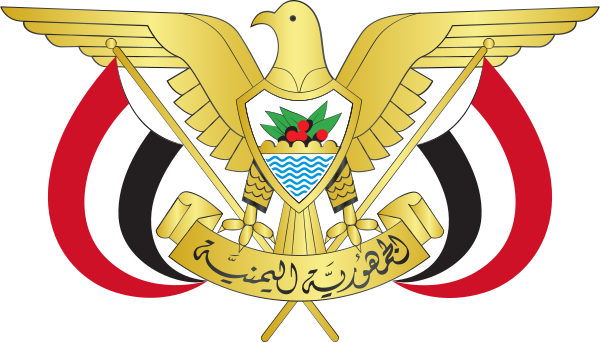
- Country.image_coat
- Emblem of Yemen (2).svg
- Country.coa_size
- 120px
- Country.symbol_type
- Emblem
- Country.national_motto
- "God, the Homeland, Revolution, Unity"
- Country.national_anthem
- "United Republic"
- Country.capital
- Sanaa
- Country.admin_center
- Aden
- Country.admin_center_type
- Government seat
- Country.religion_year
- 2020
- Country.largest_city
- capital
- Country.languages_type
- Official languageand national language
- Country.languages
- Arabic
- Country.demonym
- Yemeni Yemenite
- Country.government_type
- Unitary semi-presidential republic under a provisional government
- Country.leader_title1
- President of the Presidential Leadership Council
via Wikipedia infobox
Research
7,423 papers- Yemen's Cholera Epidemic Is a One Health Issue.ReviewJournal of preventive medicine and public health = Yebang Uihakhoe chi · 2020Ng QX, De Deyn MLZQ, Loke W et al.DOI: 10.3961/jpmph.20.154
- Yemen: current peace talks must also prioritise health.BMJ (Clinical research ed.) · 2023Attal B, Dureab F, Abbara ADOI: 10.1136/bmj.p1242
- Cancer statistics in Yemen: incidence and mortality, in 2020.ReviewBMC public health · 2024Ibrahim A, El Baldi M, Mohammed S et al.DOI: 10.1186/s12889-024-18207-4
- Yemen's silent killers.Lancet (London, England) · 2017The LancetDOI: 10.1016/S0140-6736(17)30390-2
- Yemen needs a concrete plan-now.The Lancet. Global health · 2019The Lancet Global HealthDOI: 10.1016/S2214-109X(18)30536-9
- Behavior of Coronavirus pandemic in Yemen: practical experience review.ReviewMinerva cardiology and angiology · 2023Al-Maimoony T, Al-Sageer N, Bahaj S et al.DOI: 10.23736/S2724-5683.22.06109-9
- Infectious diseases in Yemen.The Lancet. Infectious diseases · 2021Burki TDOI: 10.1016/S1473-3099(21)00218-8
- Cholera in Yemen.The Lancet. Infectious diseases · 2017Balakrishnan VSDOI: 10.1016/S1473-3099(17)30352-3
via PubMed
Wikidata facts
- Instance of
- country
- Part of
- West Asia
- Official name
- الجمهورية اليمنية
- Demonym
- Éimineach
- Country
- Yemen
- Contains
- Hajjah Governorate
- Continent
- Africa
- Capital
- Aden
- Official language
- Arabic
- Currency
- Yemeni Rial
- Population
- 28250420
- Area
- 555000
- Body of water
- Arabian Sea
- Head of government
- Ahmad Awad Bin Mubarak
- Head of state
- Rashad al-Alimi
- Form of government
- presidential system
- Anthem
- National anthem of Yemen
- Shares border with
- Oman
- Highest point
- Jabal an Nabi Shu'ayb
- Official website
- www.yemen.gov.ye
- Image
- MallaDistrict.jpg
- Life expectancy
- 64
- Unemployment rate
- 60
- Calling code
- +967
Show 67 more facts
- Licence plate code
- YAR
- Electrical plug type
- BS 1363
- Mains voltage
- 230
- Motto
- Duw, Gwlad, Chwyldro, Undod
- Flag
- flag of Yemen
- Coat of arms
- Emblem of Yemen
- topic's main Wikimedia portal
- Portal:Yemen
- Unicode character
- 🇾🇪
- category of associated people
- Category:Yemeni people
- geography of topic
- Geography of Yemen
- office held by head of government
- Prime Minister of Yemen
- Gini coefficient
- 35.9
- public holiday
- Yemeni unification
- number of out-of-school children
- 2546754
- diplomatic relation
- Hungary
- office held by head of state
- President of Yemen
- Commons gallery
- اليمن
- trunk prefix
- 0
- mobile country code
- 421
- history of topic
- history of Yemen
- replaces
- South Yemen
- marriageable age
- 15
- total fertility rate
- 4.16
- maritime identification digits
- 475
- topic's main category
- Category:Yemen
- central bank
- Central Bank of Yemen
- age of majority
- 16
- located in/on physical feature
- Arabian Peninsula
- category for films shot at this location
- Category:Films shot in Yemen
- category for people born here
- Category:Births in Yemen
- category for people who died here
- Category:Deaths in Yemen
- Commons category
- Yemen
- top-level Internet domain
- .ye
- official symbol
- Eagle of Saladin
- short name
- اليمن
- rural population
- 17955000
- driving side
- right
- lowest point
- Arabian Sea
- urban population
- 7280000
- described by source
- Encyclopædia Britannica 11th edition
- language used
- Hobyót
- inception
- 1990-05-22
- culture
- culture of Yemen
- BTI Status Index
- 1.41
- BTI Governance Index
- 1.51
- economy of topic
- economy of Yemen
- demographics of topic
- demographics of Yemen
- official religion
- Islam
- madhhab
- Zaidism
- Democracy Index
- 1.95
- native label
- الجمهوريّة اليمنية
- Human Development Index
- 0.455
- P11012
- silbo Gomero
- hashtag
- yemen
- on focus list of Wikimedia project
- Wikipedia:Vital articles/Level/4
- Happy Planet Index score
- 44.6
- Inequality-adjusted Human Development Index
- 0.307
- coastline
- 2500
- social media followers
- 21678
- P12749
- Wyoming
- birth rate
- 29.919
- male population
- 17023203
- death rate
- 6.824
- female population
- 16673411
- P8168
- Fra Dolcino
- ethnic group
- Somalis
Sources (15)
via Wikidata · CC0
Travel guide
Get around
thumb|4WD pickup trucks are the way to go Yemen is not an easy country to get around, since foreign nationals need travel permits and, in some regions, independent travel is not possible. There is a lack of road infrastructure in the eastern Mahra region, while all other Yemeni regions have hundreds of kilometres of newly built roads. If you are an intrepid traveller, the local transport (taxis, buses, aircraft) is perfect to get around on the cheap. More expensive, but more efficient travel is to book your tour via one of the registered tour operators, that are found on the Yemen Ministry of Tourism webpage. Be aware that there are many non-registered tour operators in Yemen offering lower quality services, providing non-relevant information and many times tourists do not get all the paid services. In case of any problem, the Ministry of tourism will not be able to help you if you choose to travel with a non-registered tour operator or services provider.
For trips outside the capital, many travellers prefer a car (preferably 4WD) and may choose to hire a driver through a local travel agency. More intrepid travellers should certainly take advantage of the local intracity bus service, which is cheap, comfortable, and a wonderful way to see the country. The buses usually take a pit stop every hour or so, making this a slower but much more interesting way to travel for those who are up for an adventure and some friendly conversation. The biggest company in Yemen is Yemitco, the…
See
thumb|upright=1.3|The old city of Sana'a. Sana'a: Babel Yemen (old city), Wadi Dhar (Dar al-Hadschar Palace—also known as the rock house). Sana'a is at over 2,200 metres (7,200 feet) in elevation. The old city is a mystical and amazing place and also a UNESCO World Heritage site. The streets are alive and bustling around gingerbead-like houses several stories high, one of the oldest cities in the world.
Socotra: Off the south coast of Yemen—an idyllic island untouched by modern man and home to many rare species and plants. The seas are turquoise blue and the sands white and unspoiled. One of the most valuable islands on the planet, often described as the most alien-looking place on Earth. Its beaches resemble those of the Caribbean and its mountains and Yemeni mountains covered in 300 species only found in Socotra. A must-see.
Kawkaban: An old fortress-city northwest of Sana'a 3,000 m (10,000 feet) high, with elegant old buildings an artefacts from the old Himyar civilization 2,000 years ago. Himyaric inscriptions can be seen and so can old Stars of David from the old Jewish roots of Himyar. Below the mountain is a magnificent view of a plain dotted by old towns made of mud-brick.
Sa'dah: The northernmost major town in Yemen, with its old city made entirely out of strong mud that keeps internal temperature warm during the bitter winter. Its surroundings are known for its delicious grapes, raisins, date palms, and other fruits.
Al Mahweet: A northwest town from Sana'a, Al …
Do
Although the accommodation might not be the best, the country holds so many treasures that appeal to any open-minded visitor. The sights are amazing, the people are friendly, their culture is unique, and their food is tasty. Take trips with a personal driver through the mountains to see natural beauty found nowhere else on the planet. See the historical role Yemen played as it survived even during the times of the Sumerians and the Ancient Egyptians, and how no one was able to completely conquer Yemen. And enjoy what the country provides, like gemstones literally littered throughout the mountains, precious beaches, and historical artifacts from this multi-faced nation.
Eat
Yemeni cuisine differs markedly from the rest of the Arabian Peninsula, and is a real highlight of any trip to the country—particularly if shared by locals (which is an invitation most visitors will receive more often than they might expect).
The signature dish is salta, a meat-based stew spiced with fenugreek and generally served at the end of the main course. The taste may take newcomers by surprise, but it is a taste well worth acquiring.
Mandi is a popular dish of meat and rice with spices originating in the Hadhramaut region. What distinguishes mandi from other similar dishes in the rest of the Middle East and South Asia is that the meat is cooked in a clay oven and hung over the rice, allowing the juices to drip onto the rice as it is cooked.
Yemeni honey is particularly famous throughout the region, and most desserts will feature a liberal serving of it. Bint al-sahn is a sort of flat dough dish which is drenched in honey. Other sweet foods well worth the trying are Yemeni raisins.
While not a "food" per se, something else to put in one's mouth is the qat leaf. This is the Yemeni social drug and is chewed by almost all of the population from after lunch until roughly dinnertime. The plant is cultivated all over the country, and most Yemenis are more than happy to offer visitors a branch or two. Chewing qat is something of an art, but the general idea is to chew the small, soft leaves, the soft branches (but not hard ones) and to build up a large ball of the stuff i…
Drink
Yemen is officially a dry country; however, non-Muslims are entitled to bring up to two bottles of any alcoholic beverage into the country. These may be drunk only on private property, but venturing outside while under the influence is not a wise decision.
Many juices and soft drinks are readily available, but you should avoid more scruffy-looking juice shops as they might be using tap water as base. Many Yemenis will drink tea (shay) or coffee (qahwa or bun) with their meals. Yemeni coffee is considerably weaker than the strong Turkish coffee found elsewhere in peninsular Arabia.
Tap water should be avoided. This is comparatively easy to do, as bottled water—both chilled and at room temperature—is readily available everywhere.
Sleep
thumb|Sunset in Aden Outside of the capital and the major centres (Sana'a, Aden and al-Mukalla), accommodation tends to be rather basic and generally of the mattress-on-the-floor variety, generally with shared shower rooms and WCs. Most larger villages will have at least one funduq, which will provide this sort of accommodation. The places tend to be named the [Name of Village] Tourist Hotel. Electricity supplies tend to be a little erratic, so hot water cannot always be counted on.
Funduq accommodation is not rated on the star scale used in other countries, but rather on the Yemeni "sheet" scale, with "no-sheet" being the most basic and "two-sheet" the top of the line. Some other hotels, mostly in Sana'a, go by the star scale, most notably the Movenpick, Sheraton, and the Hilton. This does not mean that in a "no-sheet" funduq one will not receive a sheet, although in some places it may be worthwhile to bring one! Most funduqs will offer some food, almost invariably local cuisine, and the better ones will serve it in a diwan-style room, where one can eat while reclining on cushions. In some funduqs, dinner will be followed by a "party", featuring performances of traditional music and jambiya dances—sometimes with audience participation.
Stay safe
Yemen is at war, under international attack, and is heavily damaged; see the warning at the top of this page. In addition, there have been problems with terrorism and kidnappings of people including foreigners.
Once it is possible to visit Yemen again, the following will again become relevant: The public consumption of alcohol is punishable under Islamic law in Yemen. Homosexual acts are also prohibited and may result in the death penalty. Driving is on the right. While Yemeni drivers have something of a reputation for bad driving, the reality is slightly more nuanced. Risks are taken, particularly in Sana'a, which would not normally be taken in other places, but the locals expect this to happen and compensate accordingly. For trips outside Sana'a, however, a 4-wheel-drive is almost mandatory as most roads away from the routes connecting main cities are not paved. Travellers should also give serious consideration to hiring a local driver/guide, as maps tend not to be as useful as they can be in other countries. A city limits border pass is required as only the cities are well protected by the military. It is also worth noting that Yemen has one of the largest populations of armed civilians in the world, so be polite.
Stay healthy
thumb|Local woman fetching water from a reservoir in Kawkaban Health care facilities are seriously underdeveloped in Yemen. If you fall seriously ill during your stay, it is advised that you go to neighbouring Oman or Saudi Arabia.
The country in the midst of a cholera outbreak. Wash your hands often, cook food well, and clean up well. For more information on how to stay safe, you may view more information here.
Tap water should be avoided. To stay safe, it is recommended to stick to the bottled variety.
The country is exceptionally dusty. Travelers with breathing difficulties (such as asthma) may encounter problems in more remote destinations.
The dry air (especially from September 'til April) can be bothersome, causing cracked lips and sometimes nosebleeds. Always carry a Vaseline stick with you, available in most pharmacies in Yemen, and a packet of tissues.
Particularly when hiking, remember that much of the country is at altitude. Therefore, as well as taking the usual steps of drinking plenty of water and protection from the sun (which can be very harsh in Yemen), be aware of any dizziness you may be experiencing due to rapid ascents. Many of the more popular hiking routes are covered in loose stones, so be careful of your footing. Some peak ascents can be at a near 70-80 degree angle, so any fall will be devastating. Be prepared with bandages and/or anti-bacterial creams just in case you get a cut, which is normal during hiking.
Malaria is present in low-lying …
Respect
Yemenis, North Africans, and Arabs in the Gulf share a common culture; therefore, what is considered good manners in Arab world is applicable to Yemen.
Travel guide from Wikivoyage (CC BY-SA 4.0)
~40 min read
Encyclopedic overview
57 sectionsContents
- Etymology
- History
- Ancient history
- Middle Ages
- Advent of Islam and the three dynasties
- Sulayhid dynasty (1047–1138)
- Ayyubid conquest (1171–1260)
- Rasulid dynasty (1229–1454)
- Tahirid dynasty (1454–1517)
- Portuguese (1498–1756)
- Modern history
- The Zaydis and Ottomans
- Great Britain and the nine regions
- Ottoman return
- Mutawakkilite Kingdom
- Colonial Aden
- Two states
- Unification and civil war
- Contemporary Yemen
- Revolution and aftermath
- Geography
- Regions and climate
- Biodiversity
- Government and politics
- Administrative divisions
- Foreign relations
- Military
- Human rights
- Economy
- Agriculture
- Industry
- Export and import
- State budget
- Water supply and sanitation
- Demographics
- People
- Languages
- Religion
- Education
- Health
- Culture
- Architecture
- World Heritage sites
- Theatre
- Media
- Sport
- See also
- Notes
- Language notes
- General notes
- References
- Sources
- External links
- Government
- History
- Tourism
- Maps
Yemen, officially the Republic of Yemen, is a country in West Asia. Including the Socotra Archipelago, mainland Yemen is located in southern Arabia; bordering Saudi Arabia to the north, Oman to the northeast, the south-eastern part of the Arabian Sea to the east, the Gulf of Aden to the south, and the Red Sea to the west, sharing maritime borders with Djibouti, Eritrea, Somaliland and Somalia across the Horn of Africa. Covering roughly 455,503 square kilometres (175,871 square miles), with a coastline of approximately 2,000 kilometres (1,200 miles), Yemen is the second largest country on the Arabian Peninsula by area, and the largest by population.
Sanaa is its constitutional capital and largest city. Yemen's estimated population is 34.7 million, mostly Arab Muslims, which is estimated to be greater than that of Saudi Arabia. It is a member of the Arab League, the United Nations, the Non-Aligned Movement and the Organisation of Islamic Cooperation.
Excerpted from Wikipedia’s “Yemen” article, available under the CC BY-SA 4.0 licence.
Gallery (59)
On the map
3 mapped locations
Available in 252 languages
- Español
- Français
- Deutsch
- 中文
- 日本語
- Русский
- Português
- Italiano
- العربية
- हिन्दी
- Abkhazian
- abstract
- Achinese
- Adyghe
- Afrikaans
- Albanian
- Albanian
- Amharic
Show 233 more
- ami
- Angika
- Aragonese
- Aramaic
- Armenian
- Arpitan
- Assamese
- Asturian
- Avaric
- Awadhi
- azb
- Azerbaijani
- Bahasa Indonesia
- Balinese
- Bangla
- Bashkir
- Basque
- bat_smg
- Bavarian
- be_x_old
- Belarusian
- Betawi
- Bhojpuri
- Bikol
- Bishnupriya
- Bislama
- Bosnian
- Breton
- btm
- Buginese
- Bulgarian
- Buriat
- Burmese
- Catalan
- cbk_zam
- cdo
- Cebuano
- Central Dusun
- Central Kurdish
- Chechen
- Chuvash
- Cornish
- Corsican
- Crimean Tatar
- Croatian
- Czech
- dag
- Danish
- Divehi
- dty
- Egyptian Arabic
- Esperanto
- Estonian
- Extremaduran
- Faroese
- Fiji Hindi
- Filipino
- Finnish
- fiu_vro
- Fula
- Gagauz
- Galician
- gcr
- Georgian
- Gilaki
- Goan Konkani
- Greek
- Guarani
- Gujarati
- Haitian Creole
- Hakka Chinese
- Hausa
- Hawaiian
- Hebrew
- Hungarian
- hyw
- Icelandic
- Ido
- Iloko
- Inari Sami
- Interlingua
- Interlingue
- Irish
- Jamaican Creole English
- Javanese
- Kabardian
- Kabyle
- kai
- Kannada
- Kara-Kalpak
- Karachay-Balkar
- Kashmiri
- Kashubian
- Kazakh
- kbp
- kge
- Khmer
- Kikuyu
- Kinyarwanda
- Komi
- Kongo
- Kurdish
- Kyrgyz
- Ladino
- Lao
- Latin
- Latvian
- Lezghian
- Ligurian
- Limburgish
- Lingala
- Lingua Franca Nova
- Lithuanian
- lld
- Lombard
- Low German
- Lower Sorbian
- Luxembourgish
- Macedonian
- Madurese
- Maithili
- Malagasy
- Malay
- Malayalam
- Maltese
- Manipuri
- Manx
- Māori
- Marathi
- Mazanderani
- Minangkabau
- Mingrelian
- Mirandese
- Moksha
- Mongolian
- Moroccan Arabic
- Navajo
- Neapolitan
- Nederlands
- Nepali
- Newari
- Northern Frisian
- Northern Sami
- Norwegian
- Norwegian Nynorsk
- Novial
- Occitan
- Odia
- Old English
- olo
- Oromo
- Ossetic
- Pampanga
- Papiamento
- Pashto
- Piedmontese
- Polski
- Punjabi
- Quechua
- Romanian
- Rusyn
- Samoan
- Sanskrit
- Santali
- Sardinian
- Saterland Frisian
- Scots
- Scottish Gaelic
- Serbian
- Serbian (Latin)
- Shan
- Shona
- Sicilian
- Silesian
- simple
- Sindhi
- Sinhala
- skr
- Slovak
- Slovenian
- Somali
- Standard Moroccan Tamazight
- Sundanese
- Svenska
- Swahili
- Swati
- szy
- Tajik
- Talysh
- Tamil
- Taroko
- Tatar
- tay
- tdd
- Telugu
- Tetum
- Tibetan
- Tiếng Việt
- Tok Pisin
- Toki Pona
- Tongan
- Tumbuka
- Türkçe
- Turkmen
- Udmurt
- Ukrainian
- Upper Sorbian
- Urdu
- Uyghur
- Uzbek
- Venetian
- Veps
- Volapük
- Waray
- Welsh
- West Flemish
- Western Frisian
- Western Panjabi
- Wolof
- Wu Chinese
- Yakut
- Yiddish
- Yoruba
- Zaza
- Zeelandic
- zh_classical
- zh_min_nan
- zh_yue
- Zhuang
- Zulu
- فارسی
- ไทย
- 한국어
via Wikidata sitelinks · CC0