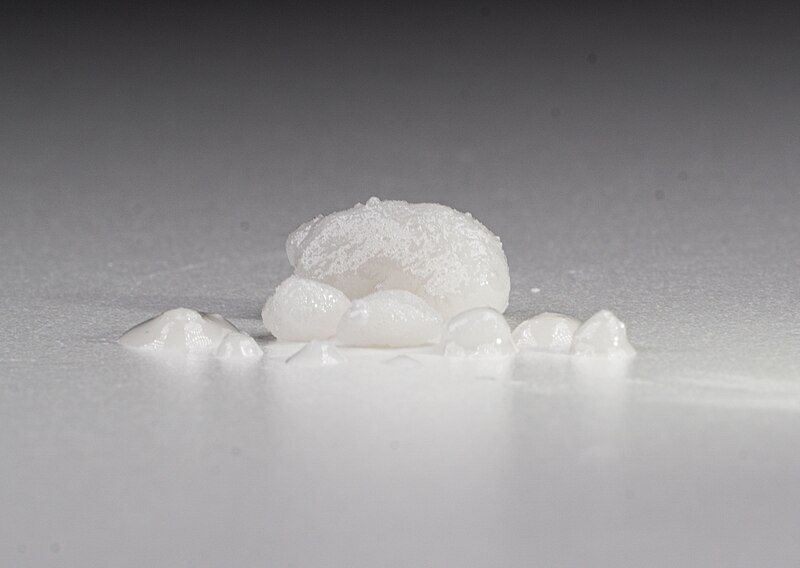
File:Zinc_chloride_anhydrous.jpg · Wikimedia Commons · See Wikimedia Commons
zinc chloride
Sign in to saveAlso known as zinc chloride, anhydrous, zinc(II) chloride, dichlorozinc, butter of zinc, zinc dichloride, ZnCl₂, ZnCl2
chemical compound
OverviewAI-generated
Zinc chloride is a chemical compound with the formula ZnCl₂, also represented as Cl₂Zn. Its IUPAC name is dichlorozinc. The substance has a density of 2.91 and a mass of 133.86684756. It melts at 554 and boils at 1350. The vapor pressure is 0, and its solubility is 435.
Safety guidelines for zinc chloride include a time-weighted average exposure limit of 1 and a short-term exposure limit of 2. The immediately dangerous to life or health level is 50. The compound has a charge of 0, with no hydrogen bond donors or acceptors. It is referenced by 401 other encyclopedia articles.
Synthesized by Vinony from 26 facts across 4 sources: Wikidata, PubMed, PubChem, Vinony graph. Generated from structured data (not the Wikipedia text) and checked against those facts — may still contain errors.
Chemical data
- Formula
- Cl2Zn
- Molecular weight
- 136.3 g/mol
- IUPAC name
- dichlorozinc
- SMILES
- Cl[Zn]Cl
- InChIKey
- JIAARYAFYJHUJI-UHFFFAOYSA-L
- Polar surface area
- 0 Ų
- H-bond donors
- 0
- H-bond acceptors
- 0
- Formal charge
- 0
via PubChem
Drug data · ChEMBL
- Max clinical phase
- Approved
- Molecule type
- Small molecule
- First approval
- 1986
- Admin. routes
- parenteral
via ChEMBL · EBI
Research
2,743 papers- Effectiveness of sodium bicarbonate and zinc chloride mouthwashes in the treatment of oral mucositis and quality of life in patients with cancer under chemotherapy.Nursing open · 2022
- Zinc chloride affects chondrogenesis via VEGF signaling.Experimental cell research · 2021
- Zinc chloride is effective as an antibiotic in biofilm prevention following septoplasty.Scientific reports · 2023
- The toxicology of zinc chloride smoke producing bombs and screens.Clinical toxicology (Philadelphia, Pa.) · 2017
- Recent Development of Active Ingredients in Mouthwashes and Toothpastes for Periodontal Diseases.Molecules (Basel, Switzerland) · 2021
via PubMed
Wikidata facts
- Subclass of
- zinc compound
- Has part
- chlorine
- Mass
- 133.86684756
Show 15 more facts
- NIOSH Pocket Guide ID
- 0674
- Commons category
- Zinc chloride
- density
- 2.54
- color
- white
- immediately dangerous to life or health
- 50
- melting point
- 325
- boiling point
- 732
- vapor pressure
- 0
- time-weighted average exposure limit
- 1
- short-term exposure limit
- 2
- canonical SMILES
- Cl[Zn]Cl
- has characteristic
- hygroscopy
- chemical formula
- Cl₂Zn
- medical condition treated
- common cold
- subject has role
- mouthwash
via Wikidata · CC0
~15 min read
Encyclopedic overview
Zinc chloride is an inorganic chemical compound with the formula ZnCl2·nH2O, with n ranging from 0 to 4.5, forming hydrates. Zinc chloride, anhydrous and its hydrates, are colorless or white crystalline solids, and are highly soluble in water. Five hydrates of zinc chloride are known, as well as four polymorphs of anhydrous zinc chloride.
All forms of zinc chloride are deliquescent. They can usually be produced by the reaction of zinc or its compounds with some form of hydrogen chloride. Anhydrous zinc compound is a Lewis acid, readily forming complexes with a variety of Lewis bases. Zinc chloride finds wide application in textile processing, metallurgical fluxes, chemical synthesis of organic compounds, such as benzaldehyde, and processes to produce other compounds of zinc.
Excerpted from Wikipedia’s “zinc chloride” article, available under the CC BY-SA 4.0 licence.