Category
page 15th-century BC Greek poets

Sophocles
Sophocles (; , , Sophoklễs; 497/496 – winter 406/405 BC) was an ancient Greek tragedian, one of three from whom at least two plays have survived in full. His first plays were written later than, or contemporary with, those of Aeschylus and earlier than, or contemporary with, those of Euripides. Sophocles wrote more than 120 plays, but only seven have survived in a complete form: Ajax, Antigone, Women of Trachis, Oedipus Rex, Electra, Philoctetes, and Oedipus at Colonus. For almost 50 years, Sophocles was the most celebrated playwright in the dramatic competitions of the city-state of Athens, w

Euripides
Euripides (; , ; ) was a Greek tragedian of classical Athens. Along with Aeschylus and Sophocles, he is one of the three authors of Greek tragedy for whom any plays have survived in full. Some ancient scholars attributed ninety-five plays to him, but the Suda says it was ninety-two at most. Nineteen plays attributed to Euripides have survived more or less complete, although one of these (Rhesus) is often considered not to be genuinely his work. Many fragments (some of them substantial) survive from most of his other plays. More of his plays have survived intact than those of Aeschylus and Soph

Aeschylus
Aeschylus (, ; ; /524 – /455 BC) was an ancient Greek tragedian often described as the father of tragedy. Academic knowledge of the genre begins with his work, and understanding of earlier Greek tragedy is largely based on inferences made from reading his surviving plays. According to Aristotle, he expanded the number of characters in the theatre and allowed conflict among them. Formerly, characters interacted only with the chorus.
.jpg)
Aristophanes
Aristophanes (; ; ) was an Ancient Greek comic playwright from Athens. He wrote forty plays, of which eleven survive virtually complete. The majority of his surviving plays belong to the genre of comic drama known as Old Comedy and are considered its most valuable examples. Aristophanes's plays were performed at the religious festivals of Athens, mostly the City Dionysia and the Lenaia, and several of them won the first prize in their respective competitions.

Parmenides

Empedocles
Empedocles (; ; , 444–443 BC) was a Greek pre-Socratic philosopher and a native citizen of Akragas, a Greek city in Sicily. Empedocles' philosophy is known best for originating the cosmogonic theory of the four classical elements. He also proposed forces he called Love and Strife which would mix and separate the elements, respectively.

Pindar
Pindar (; ; ; ) was an Ancient Greek lyric poet from Thebes. Of the canonical nine lyric poets of ancient Greece, his work is the best preserved. Quintilian wrote, "Of the nine lyric poets, Pindar is by far the greatest, in virtue of his inspired magnificence, the beauty of his thoughts and figures, the rich exuberance of his language and matter, and his rolling flood of eloquence, characteristics which, as Horace rightly held, make him inimitable." His poems can also, however, seem difficult and even peculiar. The Athenian comic playwright Eupolis once remarked that they "are already reduced

Xenophanes
Xenophanes of Colophon ( ; ; – c. 478 BC) was a Greek philosopher, theologian, poet, and critic of Homer. He was born in Ionia and travelled throughout the Greek-speaking world in early classical antiquity.
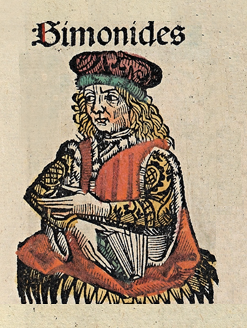
Simonides of Ceos
Greek lyric poet (c. 556–468 BC)

Critias
Critias (; , Kritias; – 403 BC) was an ancient Athenian poet, philosopher and political leader. He is known today for being a student of Socrates, a writer of some regard, and for becoming the leader of the Thirty Tyrants, who ruled Athens for several months after the conclusion of the Peloponnesian War in 404/403.

Bacchylides
right|thumb|A Musician by Albert Joseph Moore
Bacchylides (; Bakkhulides; – ) was a Greek lyric poet. Later Greeks included him in the canonical list of Nine Lyric Poets, which included his uncle Simonides. The elegance and polished style of his lyrics have been noted in Bacchylidean scholarship since at least Longinus. Some scholars have characterized these qualities as superficial charm. He has often been compared unfavourably with his contemporary, Pindar, as "a kind of Boccherini to Pindar's Haydn". However, the differences in their styles do not allow for easy comparison, and translator R
Epicharmus of Kos
late 6th/early 5th century BC Greek dramatist and philosopher

Agathon
thumb|This painting by Anselm Feuerbach re-imagines a scene from [[Plato's Symposium, in which the tragedian Agathon welcomes the drunken Alcibiades into his home. 1869.]]
Cratinus
Cratinus (; 519 BC – 422 BC) was an Athenian comic poet of the Old Comedy.
Eupolis
Eupolis (; 446 411 BC) was an Athenian poet of the Old Comedy, who flourished during the time of the Peloponnesian War.
%2C%20from%20the%20portico%20of%20the%20Triclinium%20of%20the%20Three%20Exedras%20at%20Hadrian's%20Villa%2C%20117%20-%20138%20AD%2C%20Palazzo%20Massimo%20alle%20Terme%2C%20Rome%20(22573628774).jpg)
Praxilla
thumb|upright|Marble sculpture of a dancing female figure, sometimes identified as Lysippus' sculpture of Praxilla.
Praxilla (), was a Greek lyric poet of the 5th century BC from Sicyon on the Gulf of Corinth. Five quotations attributed to Praxilla and three paraphrases from her poems survive. The surviving fragments attributed to her come from both religious choral lyric and drinking songs (skolia); the three paraphrases are all versions of myths. Various social contexts have been suggested for Praxilla based on this range of surviving works. These include that Praxilla was a hetaira (courtes
Phrynichus
late 6th/early 5th century BC Athenian playwright
Diagoras of Melos
5th-century BC Greek poet and sophist
Ion of Chios
5th-century BC Greek poet, dramatist and philosopher

Telesilla
thumb|right|Illustration of Telesilla by Lucien Lévy-Dhurmer, from Les Kitharèdes by [[Renée Vivien]]
Telesilla () was an ancient Greek lyric poet from Argos, active in the fifth century BC. She is known for her supposed role in the defence of Argos in 494 BC, which is doubted by modern scholars. Only a few fragments of her poetry survive, several of which reference the gods Apollo and Artemis. The longest surviving fragment, only two lines, is quoted by the grammarian Hephaestion to illustrate the Telesillan metre, named after her. She was apparently famous in antiquity, included by Antipater
Sophron
Sophron of Syracuse (, fl. 430 BC), Magna Graecia, was a writer of mimes (μῖμος, a kind of prose drama).
Panyassis
Panyassis of Halicarnassus, sometimes known as Panyasis (), was a 5th-century BC Greek epic poet from Halicarnassus in the Persian Empire (modern-day Bodrum, Turkey).
Pherecrates
Pherecrates (Greek: Φερεκράτης) was a Greek poet of Athenian Old Comedy, and a rough contemporary of Cratinus, Crates and Aristophanes.
Crates
5th-century BC Athenian Old Comedy poet
Hermippus
Hermippus (; fl. 5th century BC) was the one-eyed Athenian writer of the Old Comedy, who flourished during the Peloponnesian War.
Achaeus of Eretria
5th-century BC Greek playwright
Choerilus of Samos
5th century BC Greek epic poet
Plato the Comic
5th/4th century BC Athenian Old Comedy poet
Chionides
Chionides (Greek: Χιονίδης or Χιωνίδης) an Athenian comic poet of the 5th century BC, contemporary of Magnes. The Suda says that Chionides flourished eight years before the Greco-Persian Wars, that is, 487 BC. But Augustus Meineke thinks that Chionides flourished no earlier than 460 BC. In confirmation of this date he quotes from Athenaeus, who quoted a fragment of Chionides' Πτωχοί (Beggars), which mentions Gnesippus, a poet contemporary with Cratinus. Aristotle also notes that Chionides "lived long after Epicharmus". But Athenaeus also noted that some critics at the time regarded Chionides'
Phrynichus
5th-century BC Greek poet of Old Attic comedy
Euenus
Euenus (or Evenus) of Paros, (), was a 5th-century BC poet who was roughly contemporary with Socrates.
Aristarchus of Tegea
ancient Greek writer
Ameipsias
Ameipsias (, fl. late 5th century BC) of Athens was an Ancient Greek comic poet, a contemporary of Aristophanes, whom he twice bested in the dramatic contests. His Konnos () gained a second prize at the City Dionysia in 423, when Aristophanes won the third prize with The Clouds.
Phormis
Phormis (; fl. c. 478 BC) is one of the originators of Greek comedy, or of a particular form of it. Aristotle identified him as one of the originators of comedy, along with Epicharmus of Kos. He was said to be the first to introduce actors with robes reaching to the ankles, and to ornament the stage with skins dyed purple—as drapery it may be presumed.
Magnes
Athenian poet of Old Comedy
Iophon
Iophon (, fl. 428 BC – 405 BC) was a Greek tragic poet, son of Sophocles, and brother to Ariston.

Hegemon of Thasos
ancient Greek poet
Pigres of Halicarnassus
ancient Greek poet
Euphorion
5th-century BC Greek playwright, son of Aeschylus

Timocreon
right|thumb|A lip cup from Ialysos, dated around 550–540 BC, showing couples in athletic poses. Timocreon, also from Ialysos, composed songs for drinking parties and was himself an athlete
Timocreon of Ialysus in Rhodes (, gen.: Τιμοκρέοντος) was a Greek lyric poet who flourished about 480 BC, at the time of the Persian Wars. His poetry survives only in a very few fragments, and some claim he has received less attention from modern scholars than he deserves. He seems to have composed convivial verses for drinking parties. However, he is remembered particularly for his bitter clashes with Themi
Choerilus
ancient Athenian writer of tragedies
Xenocles
Xenocles () was an ancient Greek tragedian. He won a victory at the Dionysia in 415 BC with the plays Oedipus, Lycaon, and Bacchae with the satyr play Athamas. Other plays by Xenocles include Licymnius, parodied by Aristophanes in The Clouds, and perhaps Myes. Aristophanes also refers negatively to Xenocles in the Thesmophoriazusae and Frogs.
Cinesias
Athenian dithyrambic poet (c.450–390 BC)
Melanippides
Melanippides of Melos (), one of the most celebrated lyric poets in the use of dithyramb, and an exponent of the "new music."
Philotas
ancient Greek musician
Archippus
Late 5th-century BC Athenian poet of Old Comedy
Sannyrion
Sannyrion () was an Athenian comic poet of the late 5th century BC, and a contemporary of Diocles and Philyllius, according to the Suda. He belonged to the later years of Old Comedy and the start of Middle Comedy.
Aristias
Aristias (), son of Pratinas, was a dramatic poet of ancient Greece whose tomb Pausanias saw at Phlius, and whose satyric dramas, with those of his father, were considered to be surpassed only by those of Aeschylus. Aristias is mentioned in the life of Sophocles as one of the poets with whom the latter contended. Besides two dramas, which were undoubtedly satyr plays, the Keres (Κῆρες) and Cyclops, Aristias wrote three others, Antaeus, Orpheus, and Atalante, which may have been tragedies.
Cyclic Poets
ancient Greek epic poets
Theopompus
Athenian poet of Middle Comedy
Polyidus
ancient Greek dithyrambic poet
Aristomenes
Athenian poet of Old Comedy

Neophron
Neophron of Sicyon (Νεόφρων, -ονος) was one of the most prolific of the ancient Greek dramatists, to whom are accredited one hundred and twenty pieces, of which only a few fragments of his Medea remain. This, it is said, Euripides used in his tragedy which bears the same title, although modern scholarship is divided on which tragedy came first. Neophron likely lived in the second half of the fifth century B.C. and was a rough contemporary of Euripides.
Dionysius Chalcus
ancient Greek writer
Metagenes
Athenian poet of Old Comedy

Charixene
Charixene, or Charixena (5th-century BC), was an Ancient Greek musician, poet and composer. She was a professional fluteplayer. She was active as a poet and achieved some fame, and Eustathios lists her among Sappho and Korinna as a woman poet worthy of praise. She also wrote erotic songs, and composed tunes for wind instruments. She was respected as an artist, but as a person, many comic poets of the time referred to her as stupid and naive, and her name became an expression of stupidity.
Philocles
Philocles (), was an Athenian tragic poet during the 5th century BC. Through his mother, Philopatho (), he had three famous uncles: Aeschylus, the famous poet, Cynaegirus, hero of the battle of Marathon, and Ameinias, hero of the battle of Salamis. The Suda claims that Philocles was the father of the tragic playwright Morsimus, who was in turn the father of the tragedian Astydamas the Elder and was in his turn the father of the tragedian Astydamas the Younger.
Cleitagora
Cleitagora or Clitagora or Kleitagora () was a lyric poet mentioned by Aristophanes in his Wasps and his lost play the Danaïdes; a fragment of Cratinus also mentions her. A drinking song named "Cleitagora" is mentioned in Aristophanes' Lysistrata.
Scythinus of Teos
ancient Greek poet