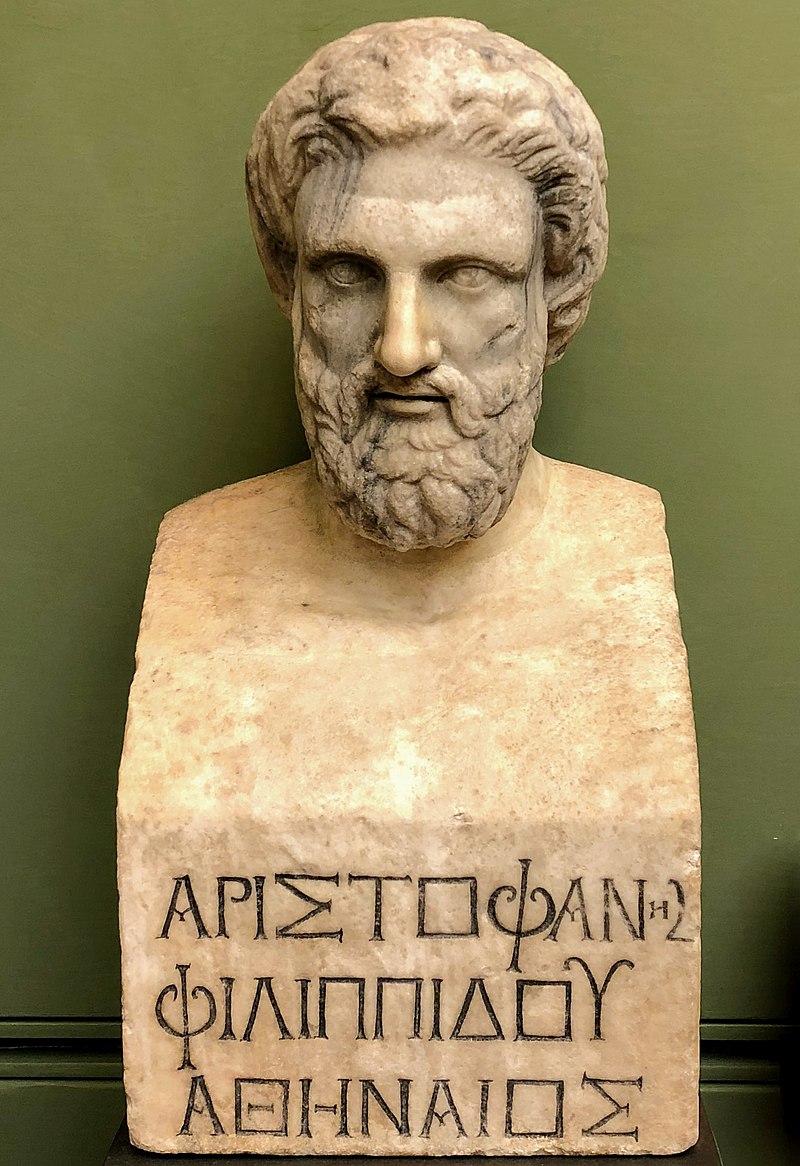
File:Bust_of_Aristophanes.jpg · Wikimedia Commons · See Wikimedia Commons
Aristophanes
Sign in to saveAlso known as Father of Comedy
Aristophanes (; ; ) was an Ancient Greek comic playwright from Athens. He wrote forty plays, of which eleven survive virtually complete. The majority of his surviving plays belong to the genre of comic drama known as Old Comedy and are considered its most valuable examples. Aristophanes's plays were performed at the religious festivals of Athens, mostly the City Dionysia and the Lenaia, and several of them won the first prize in their respective competitions.
OverviewAI-generated
Aristophanes (Ἀριστοφάνης) was a male playwright, poet, and writer from Classical Athens, where he was born and died. A member of the deme Kydathenaion, he wrote in Ancient Greek and is associated with the Old Comedy movement. His works fall within the fields of literature and drama.
Notable works include The Acharnians, The Birds, The Clouds, and Assemblywomen. Other titles listed are Ornithes, Vatrachoi tou Aristophanē, Hippeis tou Aristophanē, and Thesmophoriazousai. He was influenced by Pindar, Euripides, and Socrates. He had a child named Araros.
His works are held in the collection of the Stedelijk Museum Amsterdam. He is described by sources such as the Brockhaus and Efron Encyclopedic Dictionary, Encyclopædia Britannica 11th edition, Pauly–Wissowa, and The Nuttall Encyclopædia.
Synthesized by Vinony from 25 facts across 4 sources: Wikidata, Europeana Sparql, Open Library, TMDb. Generated from structured data (not the Wikipedia text) and checked against those facts — may still contain errors.
Person · Open Library
- Born
- ca. 450 B.C.
- Died
- ca. 385 B.C.
- Works
- 424
Top works
- Ornithes
- Vatrachoi tou Aristophanē
- Hippeis tou Aristophanē
- Thesmophoriazousai
- Acharnēs
via Open Library + Wikidata
Film & TV
Athens, Greece
Aristophanes Ancient Greek: Ἀριστοφάνης, c. 446 – c. 386 BC), son of Philippus, of the deme Kydathenaion (Latin: Cydathenaeum), was a comic playwright or comedy-writer of ancient Athens and a poet of Old Attic Comedy. Eleven of his forty plays survive virtually complete. These provide the most valuable examples of a genre of comic drama known as Old Comedy and are used to define it, along with…
via TMDB
Key facts
- Person.name
- Aristophanes
- Person.image
- Bust of Aristophanes.jpg
- Person.caption
- Bust with the inscription "Aristophanes, (son) of Philippides, the Athenian", 1st century AD
- Person.birth_place
- Athens, Greece
- Person.death_date
- (aged c. 60)
- Person.occupation
- Playwright (comedy)
- Person.years_active
- 427 BC – 386 BC
- Person.known_for
- Playwright and director of Old Comedy
via Wikipedia infobox
Wikidata facts
- Instance of
- human
- Gender
- male
- Citizenship
- Classical Athens
- Place of birth
- Classical Athens
- Place of death
- Classical Athens
- Child
- Araros
- Occupation
- writer
- Languages spoken
- Ancient Greek
- Notable work
- Peace
- Field of work
- drama
- Movement
- Old Comedy
- Image
- Bust of Aristophanes.jpg
Show 13 more facts
- topic's main category
- Category:Aristophanes
- date of death
- 0388-00-00
- date of birth
- 0445-00-00
- Commons Creator page
- Aristophanes
- Commons category
- Aristophanes
- influenced by
- Socrates
- Commons gallery
- Aristofane
- member of the deme
- Kydathenaion
- writing language
- Ancient Greek
- has works in the collection
- Stedelijk Museum Amsterdam
- name in native language
- Ἀριστοφάνης
- on focus list of Wikimedia project
- Wikipedia:Vital articles/Level/4
- P12674
- Batumi Oblast
Sources (12)
via Wikidata · CC0
Works in European collections
21 objects attributed to Aristophanes, held across European museums, libraries & archives · via Europeana
Chmury
Gromiwoja
Frogs
Comoediae novem (graece)

Aristofanous Kōmōdiai ennea meta scholiōn pollōn palaiōn kai pany ōfelimón, kai dyo aneu scholiōn, syn pinaki aphthonotatō hapantōn tōn axiologōn =

Aristophanus Eutra Pelōta tu Kōmōdiai hendeka =

Aristophanis Comicorvm Principis Comoediae vndecim /

Le Comedie Del Facetissimo Aristofane /

Ioachimi Perionii Cormoeriaceni, uiri doctissimi, De dialectica libri III :

Untitled

Untitled

Untitled
Untitled

Untitled
Untitled
Untitled
Untitled

Untitled

Untitled

Untitled

Untitled
~32 min read
Encyclopedic overview
23 sectionsContents
- Biography
- Plato's ''Symposion''
- Use of language
- Aristophanes and Old Comedy
- Dramatic structure of Aristophanes's plots
- Parabasis
- Influence and legacy
- Literature
- Radio shows
- Music
- Greek Language
- Translation of Aristophanes
- Works
- Surviving plays
- Datable non-surviving (lost) plays
- Undated non-surviving (lost) plays
- Attributed (doubtful, possibly by Archippus)
- See also
- Notes
- References
- Sources
- Further reading
- External links
Aristophanes (; ; ) was an Ancient Greek comic playwright from Athens. He wrote forty plays, of which eleven survive virtually complete. The majority of his surviving plays belong to the genre of comic drama known as Old Comedy and are considered its most valuable examples. Aristophanes's plays were performed at the religious festivals of Athens, mostly the City Dionysia and the Lenaia, and several of them won the first prize in their respective competitions.
Also known as "The Father of Comedy" and "the Prince of Ancient Comedy", Aristophanes wrote plays that often dealt with real-life figures, including Euripides and Alcibiades, and contemporary events, such as the Peloponnesian War. He has been said to recreate the life of ancient Athens more convincingly than any other author. His plays are characterized by preposterous premises, explicit language, wordplays, and political satire. His powers of ridicule were feared and acknowledged by influential contemporaries; Plato singled out Aristophanes's play The Clouds as slander that contributed to the trial and subsequent condemning to death of Socrates, although other satirical playwrights had also caricatured the philosopher.
Excerpted from Wikipedia’s “Aristophanes” article, available under the CC BY-SA 4.0 licence.
Gallery (162)
Available in 100 languages
- Español
- Français
- Deutsch
- 中文
- 日本語
- Русский
- Português
- Italiano
- العربية
- हिन्दी
- Afrikaans
- Albanian
- Albanian
- Aragonese
- Armenian
- Asturian
- Azerbaijani
- Bahasa Indonesia
Show 81 more
- Bangla
- Bashkir
- Basque
- be_x_old
- Belarusian
- Bosnian
- Breton
- Bulgarian
- Burmese
- Catalan
- Croatian
- Czech
- Danish
- Egyptian Arabic
- Esperanto
- Estonian
- Fiji Hindi
- Filipino
- Finnish
- fiu_vro
- Galician
- Georgian
- Greek
- Haitian Creole
- Hebrew
- Hungarian
- Icelandic
- Ido
- Interlingua
- Kannada
- Kazakh
- Kotava
- Kurdish
- Kyrgyz
- Latin
- Latvian
- Limburgish
- Lingua Franca Nova
- Lithuanian
- Macedonian
- Malagasy
- Malay
- Malayalam
- Mazanderani
- Mingrelian
- Mirandese
- Nederlands
- Newari
- Norwegian
- Norwegian Nynorsk
- Occitan
- Pampanga
- Polski
- Punjabi
- Romanian
- Scots
- Serbian
- Serbian (Latin)
- simple
- Slovak
- Slovenian
- Svenska
- Tajik
- Tamil
- Tiếng Việt
- Toki Pona
- Türkçe
- Ukrainian
- Urdu
- Uzbek
- Waray
- Welsh
- Western Frisian
- Western Panjabi
- Wu Chinese
- Zaza
- zh_min_nan
- zh_yue
- فارسی
- ไทย
- 한국어
via Wikidata sitelinks · CC0