Category
page 1Ancient Greek architecture

acropolis
thumb|upright=1.5|Acropolis of Athens in Athens, Greece
An acropolis was the settlement of an upper part of an ancient Greek city, especially a citadel, and frequently a hill with precipitous sides, mainly chosen for purposes of defense. The term is typically used to refer to the Acropolis of Athens, yet nearly every Greek city had an acropolis of its own. The term derives from the homonymous Greek word "Ακρόπολις", composed from "akron" (ἄκρον), which means "top", and "polis" (πόλις), which means "city".

Ionic order
one of the 3 orders of classical architecture (along with Doric and Corinthian), characterized by the use of volutes; columns stand on a base which separates the shaft of the column from the stylobate; the cap is usually enriched with egg-and-dart

Doric order
ancient Greek architectural order

Corinthian order
latest of the three principal classical orders of ancient Greek and Roman architecture

ancient Greek architecture
era of architecture

caryatid
thumb|260px|right|The caryatid porch of the Erechtheion in [[Athens, Greece. These are now replicas. The originals are in the Acropolis Museum (with one in the British Museum).]]
thumb|175px|The caryatid standing in contrapposto, originally part of the [[Erechtheion, was removed by Lord Elgin and is now displayed at the British Museum]]
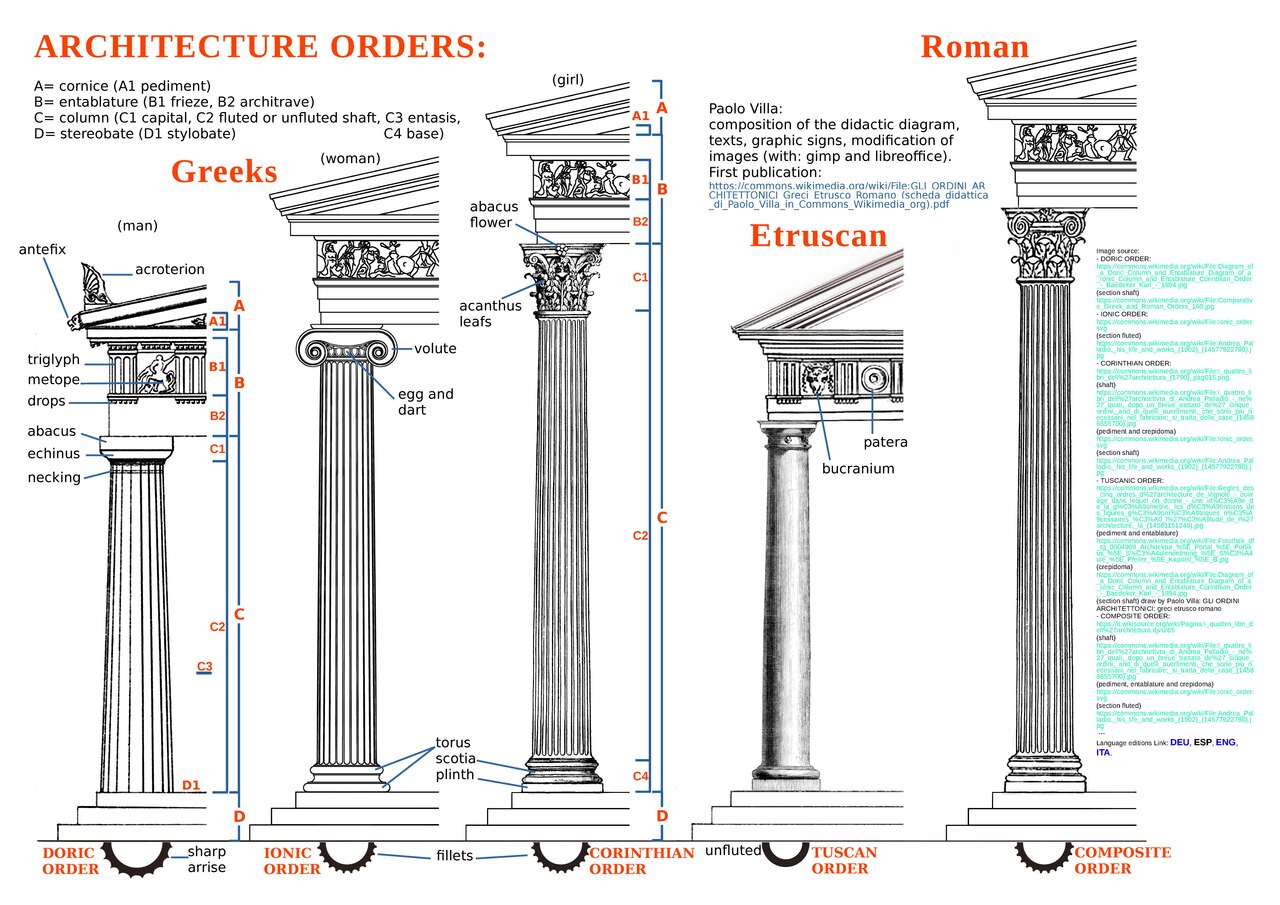
architectural order
styles of classical architecture, most readily recognizable by the type of column employed
%20(2)%20(cropped).jpg)
metope
thumb|Metope from the Elgin Marbles|Parthenon marbles depicting part of the battle between the Centaurs and the Lapiths; 442–438 BC; marble; height: 1.06 m; [[British Museum (London)]]

acroterion
thumb|right|Examples of acroteria

peripteral
thumb|200px|A peripteros surrounded by a Peristasis (architecture)|peristasis

stylobate
thumb|upright=2.0

cella
thumb|right|200px|Temple layout with cella highlighted in gray
atlas
architectural support
acanthus
ornamental motif based on a characteristic Mediterranean plant with jagged leaves, Acanthus spinosus
ancient Greek temple
structures built to house deity statues within Greek sanctuaries

antefix
thumb|upright=2|Reproduction antefixes with anthemion|anthemia, Athens

amphiprostyle
thumb|Northeast view of the Temple of Athena Nike, an amphiprostyle temple.
thumb|Plan of the temple at Jebel Khalid
In classical architecture, amphiprostyle (from the Greek (amphi), on both sides, and (prostylos), a portico) denotes an ancient temple with a portico both at the front and the rear, where the columns on the narrow sides are not between antae. The number of columns rarely exceeded four in the front and four in the rear. The best-known example is the tetrastyle small Temple of Athena Nike at Athens. Other known examples are the Temple of Artemis Agrotera outside Athens, and the he

adyton
thumb|right|Location of the adyton within a temple
thumb|The adyton in the Temple of Apollo in Didyma

impluvium
thumb|300px|A domus, with impluvium numbered 7

opisthodomos
thumb|right|200px|Plan of a temple with opisthodomos highlighted.

crepidoma
thumb|upright=2.0
anta (architecture)
projecting wall element in architecture

pseudoperipteral
thumb|right|The Maison Carrée at [[Nîmes, a hexastyle pseudoperipteral Roman temple]]
Aeolic order
classic order similar to the Ionic order, but its capital presents a palmette between two volutes

orthostates
thumb|On either side of a doorway, the wall of the Lycosura#Temple of Despoina, Stoa, and altars|Temple of Despoina at [[Lycosura has a course of orthostates with string courses above them]]

peribolos
thumb|Sanctuary of Poseidon, Kalaureia
In ancient Greek and Roman architecture, a peribolos was a court enclosed by a wall, especially one surrounding a sacred area such as a temple, shrine, or altar. This area, however, is not a necessary element to these structures since those built earlier only included markers (e.g. horoi or boundary stones) to indicate imaginary boundaries. Excavations reveal that there are sanctuaries that included a peribolos later in its history, signifying a change in religious mentality. During the Roman times, there were pereboloi used as meeting places to conduct b
Opus isodomum
wall building technique with ashlar blocks of equal height

geison
thumb|400px|Labeled image of the Doric order entablature
Geison ( – often interchangeable with somewhat broader term cornice) is an architectural term of relevance particularly to ancient Greek and Roman buildings, as well as archaeological publications of the same. The geison is the part of the entablature that projects outward from the top of the frieze in the Doric order and from the top of the frieze course (or sometimes architrave) of the Ionic and Corinthian orders; it forms the outer edge of the roof on the sides of a structure with a sloped roof. The upper edge of the exterior often ha

hypaethral
thumb|260px|Trajan's Kiosk on Agilkia Island
Peristasis
hallway of columns in some styles of Greek temple
Temple of Hera, Paestum
building in Capaccio, Italy

anathyrosis
thumb|(L) Anathyrosis on a restored stone (below) and an ancient stone (above) in the Erechtheion in [[Athens, Greece]]
Anathyrosis is the technical word for the ancient method of dressing the joints of stone blocks in dry stone construction, i. e., masonry without mortar, which was then commonly used. Because the stone blocks are set in immediate contact with each other without gaps, their joints must be exactly dressed. In order to reduce the time required to sculpt such joints, the faces of the stones to be joined were finished and smoothed only in narrower margins on the sides and top of t
Prostyle
thumb|Northeast view of the Temple of Athena Nike, a prostyle temple (but also an [[amphiprostyle temple, since there is a row of columns at the back as well)]]
thumb|The Roman temple of Bziza, a [[tetrastyle prostyle temple]]

Pompeion
The Pompeion () was a building made of Hymettian marble located in the Kerameikos of Athens between the Sacred Gate and the Dipylon, .
sima
upturned edge of an ancient roof
antae temple
special name given to a type of ancient Greek or Roman temple
xystus
architectural element
euthynteria
Euthynteria is the ancient Greek term for the uppermost course of a building's foundations, partly emerging from groundline. The superstructure of the building (stylobate, columns, walls, and entablature) were set on the euthynteria. Archaeologists and architects use the term in discussion of Classical architecture.
imbrex and tegula
overlapping roof tiles used in ancient Greek and Roman architecture as a waterproof and durable roof covering
phallic architecture
archiitectural or sculptural structures that symbolically or realistically emanate the semblance with human penis
distyle
thumb|upright|Neoclassical chapel shaped as a Roman distyle temple with Doric order|Doric columns
In classical architecture, a distyle is a small temple-like structure with two columns to the sides of the entrance, forming a porch. By extension, a distyle can also mean a distyle in antis, the original design of the Greek temple, where two columns are set between two antae.