Category
page 1Ancient Greek astronomy

heliocentrism
thumb|upright=1.2|Andreas Cellarius's illustration of the Copernican system, from the Harmonia Macrocosmica

geocentric model
thumb|upright=1.35|Figure of the heavenly bodies – An illustration of a Ptolemaic geocentric system by Portuguese cosmographer and cartographer Bartolomeu Velho, 1568 (Bibliothèque Nationale, Paris)

astrolabe
alt=Planispheric Astrolabe made of brass, cast, with fretwork rete and surface engraving|thumb|upright=1.2|North African, planispheric astrolabe. Khalili Collections|Khalili Collection.
thumb|upright|A modern astrolabe made in 2013, in Tabriz, Iran.

Antikythera mechanism
ancient analog computer designed to calculate astronomical positions

Urania
Urania ( ; ; meaning "heavenly" or "of heaven") was, in Greek mythology, the muse of astronomy and astrology. In ancient art, her attributes include the globe and the pointer.
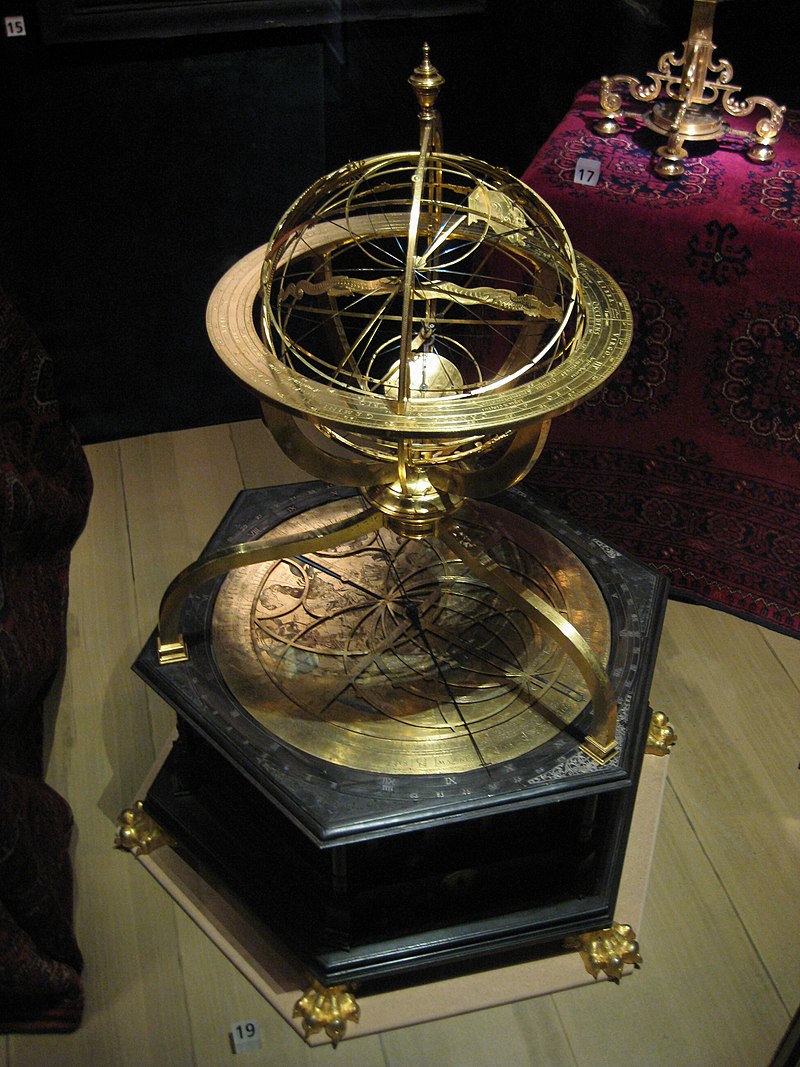
armillary sphere
model of objects in the sky

astronomical clock
clock with special mechanisms and dials to display astronomical information

gnomon
thumb|right|The gnomon is the triangular blade in this sundial.

Metonic cycle
period of very close to 19 years that is nearly a common multiple of the solar year and the synodic (lunar) month
epicycle
model of planetary motion in which planets moved in a small circle which in turn moves around the Earth
ancient Greek astronomy
Astronomy as practiced in the Hellenistic world of classical antiquity
spherical Earth
assertion that the Earth is (at least approximately) spherical

Counter-Earth
thumb|250px|right|Philolaus believed there was a "Counter-Earth" (Antichthon) orbiting the "Central Fire" (not labeled) that was not visible from Earth. The upper illustration depicts Earth at night while the lower one depicts Earth in the day.
The Counter-Earth is a hypothetical body of the Solar System that orbits on the other side of the Solar System from Earth, e.g. at the L3 Lagrange point of the Sun–Earth system. A Counter-Earth, or Antichthon (), was hypothesized by the pre-Socratic Greek philosopher Philolaus () to support his non-geocentric cosmology, in which all objects in the unive
Great Year
Length of time

The Sand Reckoner
work by Archimedes

Dioptra
thumb|Graphic reconstruction of the dioptra, by Venturi, in 1814. (An incorrect interpretation of Heron's description)
celestial spheres
in ancient cosmological models, rotating spheres made of aether in which the stars or planets are embedded
triquetrum
medieval name for an ancient astronomical instrument
Sublunary sphere
Metaphysical description of part of the universe

equant
250px|right|thumb|The basic elements of Ptolemaic astronomy, showing a planet on an [[epicycle (smaller dashed circle), a deferent (larger dashed circle), the eccentric (×) and an equant (•).]]
Pythagorean astronomical system
system
Callippic cycle
a period of 76 years
exeligmos
An exeligmos () is a period of 54 years, 33 days that can be used to predict successive eclipses with similar properties and location. For a solar eclipse, after every exeligmos a solar eclipse of similar characteristics will occur in a location close to the eclipse before it. For a lunar eclipse the same part of the earth will view an eclipse that is very similar to the one that occurred one exeligmos before it (see main text for visual examples). The exeligmos is an eclipse cycle that is a triple saros, three saroses (or saroi) long, with the advantage that it has nearly an integer number of
mural instrument
angle-measuring device used for astronomical purposes
octaeteris
In astronomy, an octaeteris (, plural: octaeterides) is the period of eight solar years after which the moon phase occurs on the same day of the year plus one or two days.
astronomical rings
early astronomical instrument
Equatorial ring
instrument to determine the moment of the equinoxes
Scaphe
[[File:Bowl of Ahaz refracting scaphe sundial, by Georg Hartman, Nuremberg, c. 1525-1564 - Putnam Gallery - Harvard University - DSC07927.jpg|thumb|right|"Georg Hartmann, German, 1525-1564, Bowl of Ahaz [Refracting scaphe sundial], Nuremberg, 1548, Brass Collection of Historical Scientific Instruments, Department of the History of Science, Harvard"]]
The scaphe (; also known as a skaphe, scaphion (diminutive) or ) was a sundial said to have been invented by Aristarchus of Samos (3rd century BC). There are no original works still in existence by Aristarchus, but the adjacent picture is an image
Hipparchic cycle
astronomical cycle he created