Category
page 1Chemical properties

atomic number
number of protons found in the nucleus of an atom

electric charge
physical property that quantifies an object's interaction with electric fields

atomic mass
rest mass of an atom in its ground state

vapor
thumb|An ampule of nitrogen oxide vapor: brown [[nitrogen dioxide and colorless dinitrogen tetroxide, in equilibrium]]
In physics, a vapor (American English) or vapour (Commonwealth English; see spelling differences) is a substance in the gas phase at a temperature lower than its critical temperature, which means that the vapor can be condensed to a liquid by increasing the pressure on it without reducing the temperature of the vapor. A vapor is different from an aerosol. An aerosol is a suspension of tiny particles of liquid, solid, or both within a gas.

oxidation number
number that describes degree of oxidation of an atom in a chemical compound; the hypothetical charge that an atom would have if all bonds to atoms of different elements were fully ionic

speed of sound
distance travelled during a unit of time by a sound wave propagating through an elastic medium

electronegativity
thumb|alt=A water molecule is put into a see-through egg shape, which is color-coded by electrostatic potential. A concentration of red is near the top of the shape, where the oxygen atom is, and gradually shifts through yellow, green, and then to blue near the lower-right and lower-left corners of the shape where the hydrogen atoms are.|upright=1.5|right|Electrostatic potential map of a water molecule, where the oxygen atom has a more negative charge (red) than the positive (blue) hydrogen atoms
Electronegativity, symbolized as χ, is the tendency for an atom of a given chemical element to att

valence
measure of an element's combining capacity with other atoms when it forms chemical compounds or molecules

mass number
number of heavy particles in the atomic nucleus

molar mass
mass per amount of substance
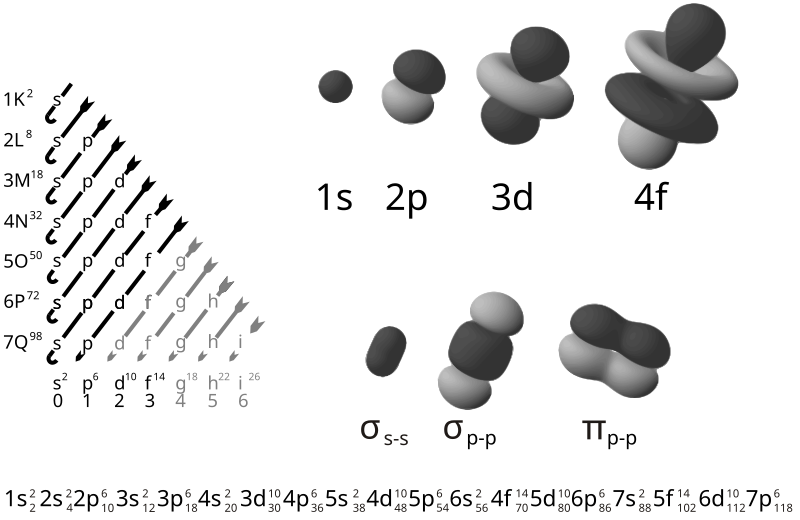
electron configuration
mode of arrangement of electrons in different shells of an atom

solubility
thumb|Example of a dissolved solid (left)
thumb|upright|Formation of crystals in a 4.2 Molar concentration|M [[ammonium sulfate solution. The solution was initially prepared at 20 °C and then stored for 2 days at 4 °C.]]
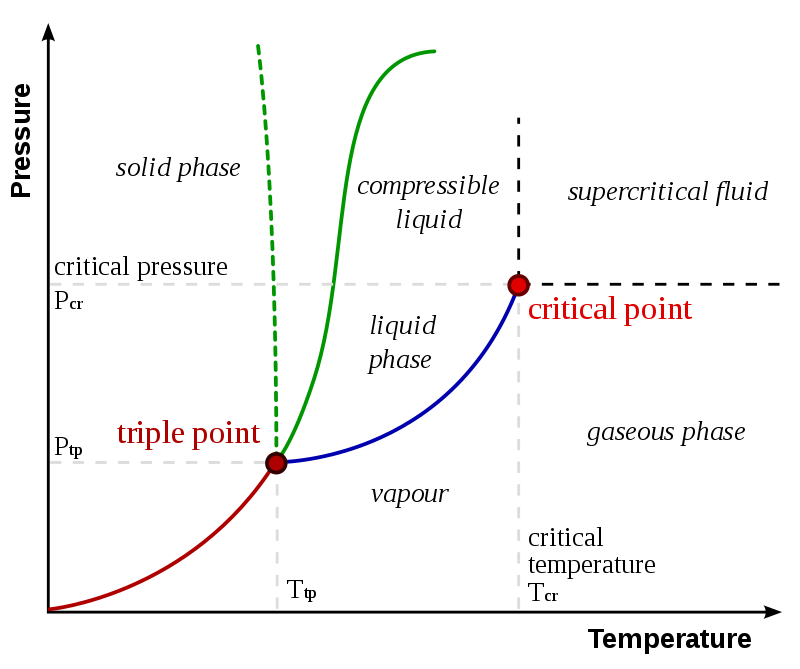
triple point
thermodynamic point where three matter phases exist

ionization energy
minimum amount of energy required to remove an electron from an atom or molecule in the gaseous state

crystal structure
unique arrangement of atoms or molecules in a crystalline liquid or solid
molecular mass
sum of atomic masses of all atoms in a molecule

adhesion
thumb|Dew drops adhering to a [[spider web]]
thumb|thumbtime=7|Adhesion of a frog on a wet vertical glass surface.
thumb|Concave meniscus (liquid)|meniscus is caused due to adhesion.
thumb|

oxidizing agent
chemical compound used to oxidize another substance

amphoterism
In chemistry, an amphoteric compound () is a molecule or ion that can react both as an acid and as a base. What exactly this can mean depends on which definitions of acids and bases are being used.

covalent radius
measure of the size of an atom that forms part of one covalent bond
hygroscopy
Hygroscopy is the phenomenon of attracting and holding water molecules via either absorption or adsorption from the surrounding environment, which is usually at normal or room temperature. If water molecules become suspended among the substance's molecules, adsorbing substances can become physically changed, e.g. changing in volume, boiling point, viscosity or some other physical characteristic or property of the substance. For example, a finely dispersed hygroscopic powder, such as a salt, may become clumpy over time due to collection of moisture from the surrounding environment.
van der Waals radius
in chemistry, a measure for the size of an atom that is not chemically (ionically or covalently) bound; half the closest distance of two equal, non-covalently bound, atoms

energy level
different states of quantum systems

aqueous solution
solution in which the solvent is water

electron affinity
amount of energy released when an electron is attached to a neutral atom or molecule in the gaseous state to form a negative ion
chemical property
any of a substance's properties that becomes evident during, or after, a chemical reaction

hydrophobe
thumb|165° water contact angle on a surface modified using plasma technology system surface chemistry. The contact angle is the red angle plus 90°.
thumb|Dew drop on a hydrophobic leaf surface
thumb|Cutting a water droplet using a [[superhydrophobic knife on superhydrophobic surfaces]]
thumb|Water drops on the hydrophobic surface of grass
relative atomic mass
dimensionless physical quantity: ratio of the average mass of atoms of an element to one unified atomic mass unit
chemical polarity
electrostatic property of a molecule
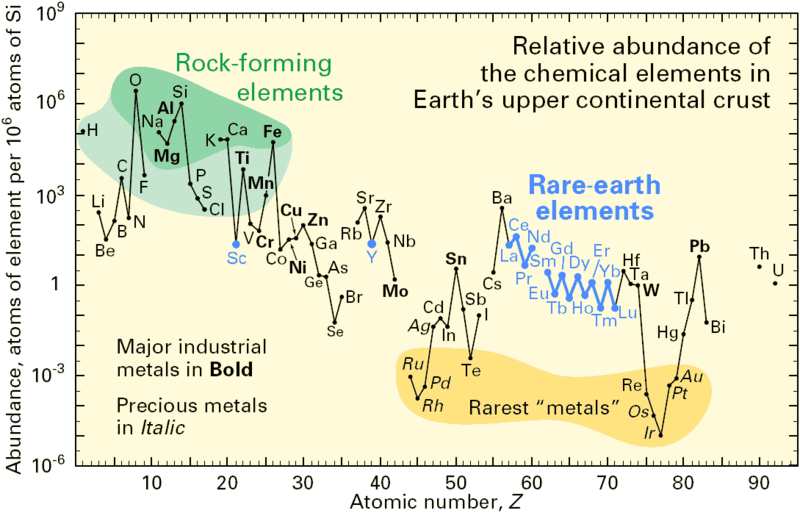
natural abundance
relative proportion of an isotope as found in nature; abundance of isotopes of a chemical element as naturally found on a planet

metastability
250px|thumb|A metastable state of weaker bond (1), a transitional "saddle" configuration (2) and a stable state of stronger bond (3).

refractory
thumb|Refractory bricks in a Ladle transfer car|torpedo car used for hauling molten iron
flammability
ability to easily ignite in air at ambient temperatures
hydrophile
thumb|Schedorhinotermes termites use hydrophilic surfaces on body and wings to attach themselves to plants they colonize.
autoignition temperature
lowest temperature at which a material spontaneously ignites in a normal atmosphere without an external source of ignition
volatility
tendency of a substance to vaporize
lipophilicity
Lipophilicity (from Greek λίπος "fat" and φίλος "friendly") is the ability of a chemical compound to dissolve in fats, oils, lipids, and non-polar solvents such as hexane or toluene. Such compounds are called lipophilic (translated as "fat-loving" or "fat-liking"). Such non-polar solvents are themselves lipophilic, and the adage "like dissolves like" generally holds true. Thus lipophilic substances tend to dissolve in other lipophilic substances, whereas hydrophilic ("water-loving") substances tend to dissolve in water and other hydrophilic substances.
boiling-point elevation
phenomenon where the boiling point of a liquid is higher when another compound is added
molality
In chemistry, molality is a measure of the amount of solute in a solution relative to a given mass of solvent. This contrasts with the definition of molarity which is based on a given volume of solution.
chemical composition
concept in chemistry that has different, but similar, meanings if referred to a single pure substance or a mixture
freezing-point depression
process in which adding a solute to a solvent decreases the freezing point of the solvent
smoke point
burning point of oil and fats

miscibility
thumb|Diesel fuel is immiscible in [[water. The bright rainbow pattern is the result of thin-film interference.]]
Miscibility () is the property of two substances to mix in all proportions (that is, to fully dissolve in each other at any concentration), forming a homogeneous mixture (a solution). Such substances are said to be miscible (etymologically equivalent to the common term "mixable"). The term is most often applied to liquids, but also applies to solids and gases. An example in liquids is the miscibility of water and ethanol as they mix in all proportions.

amphiphilic entity
thumb|Phospholipids, such as this [[glycerophospholipid, have amphipathic character.|251x251px]]
thumb|250px|right|Cross-section view of the structures that can be formed by phospholipids|biological amphiphiles in aqueous solutions. Unlike this illustration, micelles are usually formed by non-biological, single-chain, amphiphiles, soaps or detergents, since it is difficult to fit two chains into this shape

pyrophoricity
thumb | right | alt=Plutonium pyrophoricity (spontaneously burning in contact with air, causes it to glow like an ember). | Plutonium pyrophoricity (spontaneously burning in contact with air, causes it to glow like an ember).
A substance is pyrophoric (from , , 'fire-bearing') if it ignites spontaneously in air at or below (for gases) or within five minutes after coming into contact with air (for liquids and solids). Examples are organolithium compounds and triethylborane. Pyrophoric materials are often water-reactive as well and will ignite when they contact water or humid air. They can be ha
reactivity
impetus for which a chemical substance undergoes a chemical reaction, either by itself or with other materials, with an overall release of energy
fire point
lowest temperature at which a fuel will burn continuously
standard molar entropy
Standard entropy content of one mole of a substance under a standard state
inertness
chemical property of low reactivity
galvanic series
ordering of metals by nobility (ease of galvanisation)
lipophobicity
Lipophobicity, also sometimes called lipophobia (from the Greek λιποφοβία from λίπος lipos "fat" and φόβος phobos "fear"), is a chemical property of chemical compounds which means "fat rejection", literally "fear of fat". Lipophobic compounds are those not soluble in lipids or other non-polar solvents. From the other point of view, they do not absorb fats.
list of materials properties
Wikimedia list article
anhydrous
A substance is anhydrous if it contains no water. Many processes in chemistry can be impeded by the presence of water; therefore, it is important that water-free reagents and techniques are used. In practice, however, it is very difficult to achieve perfect dryness; anhydrous compounds gradually absorb water from the atmosphere so they must be stored carefully.
specific rotation
optical property of chiral chemical compounds
pour point
Temperature below which a liquid loses its ability to flow
standard atomic weight
relative atomic mass, in samples by standard, as published by IUPAC (CIAAW)

acidity function
measure of acidity of a solvent system

dopant
A dopant (also called a doping agent) is a small amount of a substance added to a material to alter its physical properties, such as electrical or optical properties. The amount of dopant is typically very low compared to the material being doped.
mixing ratio
abundance of one component of a mixture relative to others
proton affinity
Property of ions and molecules