File:Electrostatic_Potential.jpg · Wikimedia Commons · See Wikimedia Commons
electronegativity
Sign in to saveAlso known as electron negativity
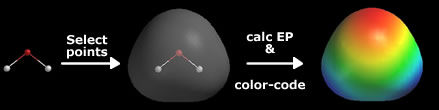
thumb|alt=A water molecule is put into a see-through egg shape, which is color-coded by electrostatic potential. A concentration of red is near the top of the shape, where the oxygen atom is, and gradually shifts through yellow, green, and then to blue near the lower-right and lower-left corners of the shape where the hydrogen atoms are.|upright=1.5|right|Electrostatic potential map of a water molecule, where the oxygen atom has a more negative charge (red) than the positive (blue) hydrogen atoms Electronegativity, symbolized as χ, is the tendency for an atom of a given chemical element to att
Electronegativity is the tendency of an atom to attract electrons toward itself when bonded with other atoms. This property matters because it determines how electrons are distributed in chemical bonds, which affects how molecules behave and what properties they have—as shown in water, where the oxygen atom's high electronegativity pulls electron density away from the hydrogen atoms.
AI-generated from the Wikipedia summary — may contain errors.
Wikidata facts
Show 5 more facts
- Commons category
- Electronegativity
- facet of
- chemical element
- opposite of
- electropositivity
- quantity symbol (string)
- χ
- on focus list of Wikimedia project
- Wikipedia:Vital articles/Level/4
Sources (2)
via Wikidata · CC0
~22 min read
Encyclopedic overview
17 sectionsContents
- Methods of calculation
- Pauling electronegativity
- Mulliken electronegativity
- Allred–Rochow electronegativity
- Sanderson electronegativity equalization
- Allen electronegativity
- Correlation of electronegativity with other properties
- Trends in electronegativity
- Periodic trends
- Variation of electronegativity with oxidation number
- Electronegativity and hybridization scheme
- Group electronegativity
- Electropositivity
- See also
- References
- Bibliography
- External links
thumb|alt=A water molecule is put into a see-through egg shape, which is color-coded by electrostatic potential. A concentration of red is near the top of the shape, where the oxygen atom is, and gradually shifts through yellow, green, and then to blue near the lower-right and lower-left corners of the shape where the hydrogen atoms are.|upright=1.5|right|Electrostatic potential map of a water molecule, where the oxygen atom has a more negative charge (red) than the positive (blue) hydrogen atoms Electronegativity, symbolized as χ, is the tendency for an atom of a given chemical element to attract shared electrons (or electron density) when forming a chemical bond. An atom's electronegativity is affected by both its atomic number and the distance at which its valence electrons reside from the charged nucleus. The higher the associated electronegativity, the more an atom or a substituent group attracts electrons. Electronegativity serves as a simple way to quantitatively estimate the bond energy, and the sign and magnitude of a bond's chemical polarity, which characterizes a bond along the continuous scale from covalent to ionic bonding. The loosely defined term electropositivity is the opposite of electronegativity: it characterizes an element's tendency to donate valence electrons.
On the most basic level, electronegativity is determined by factors like the nuclear charge (the more protons an atom has, the more "pull" it will have on electrons) and the number and location of other electrons in the atomic shells (the more electrons an atom has, the farther from the nucleus the valence electrons will be, and as a result, the less positive charge they will experience—both because of their increased distance from the nucleus and because the other electrons in the lower energy core orbitals will act to shield the valence electrons from the positively charged nucleus).
Excerpted from Wikipedia’s “electronegativity” article, available under the CC BY-SA 4.0 licence.
Gallery (21)
Available in 80 languages
- Español
- Français
- Deutsch
- 中文
- 日本語
- Русский
- Português
- Italiano
- العربية
- हिन्दी
- Afrikaans
- Albanian
- Aragonese
- Armenian
- Asturian
- Azerbaijani
- Bahasa Indonesia
- Bangla
Show 61 more
- Bashkir
- Basque
- Belarusian
- Bosnian
- Bulgarian
- Burmese
- Catalan
- Chuvash
- Croatian
- Czech
- Danish
- Esperanto
- Estonian
- Extremaduran
- Finnish
- Galician
- Georgian
- Greek
- Haitian Creole
- Hebrew
- Hungarian
- Irish
- Kannada
- Kazakh
- Latvian
- Lithuanian
- Lombard
- Low German
- Lower Sorbian
- Macedonian
- Malay
- Malayalam
- Mongolian
- Moroccan Arabic
- Nederlands
- Norwegian
- Norwegian Nynorsk
- Occitan
- Polski
- Romanian
- Serbian
- Serbian (Latin)
- simple
- Slovak
- Slovenian
- Svenska
- Tamil
- Tiếng Việt
- Türkçe
- Ukrainian
- Upper Sorbian
- Urdu
- Uzbek
- Waray
- Welsh
- Western Panjabi
- Wu Chinese
- zh_yue
- فارسی
- ไทย
- 한국어
via Wikidata sitelinks · CC0