Category
page 1Concepts in astronomy

star
A star is a luminous spheroid of plasma held together by self-gravity. The nearest star to Earth is the Sun. Many other stars are visible to the naked eye at night; their immense distances from Earth make them appear as fixed points of light. The most prominent stars have been categorised into constellations and asterisms, and many of the brightest stars have proper names. Astronomers have assembled star catalogues that identify the known stars and provide standardized stellar designations. The observable universe contains an estimated to stars. Only about 4,000 of these stars are visible to t

planet
thumb|upright=1.5|The eight planets of the Solar System with size to scale (up to down, left to right): [[Saturn, Jupiter, Uranus, Neptune (outer planets), Earth, Venus, Mars, and Mercury (inner planets)]]
A planet is a large, rounded astronomical body that is generally required to be in orbit around a star, stellar remnant, or brown dwarf, and is not one itself. The Solar System has eight planets by the most restrictive definition of the term: the terrestrial planets Mercury, Venus, Earth, and Mars, and the giant planets Jupiter, Saturn, Uranus, and Neptune. The best available theory of plane

universe
The universe comprises all of existence: all forms of matter and energy, and the structures they form, from sub-atomic particles to entire galactic filaments. Since the early 20th century, the field of cosmology establishes that space and time emerged together at the Big Bang ago and that the universe has been expanding since then. The portion of the universe that can be seen by humans is approximately 93 billion light-years in diameter at present, but the total size of the universe is not known.
.jpg)
comet
A comet is an icy, small Solar System body or interstellar object that warms and begins to release gases when passing close to the Sun, a process called outgassing. This produces an extended, gravitationally unbound atmosphere or coma surrounding the nucleus, and sometimes a tail of gas and dust gas blown out from the coma. These phenomena are due to the effects of solar radiation and the outstreaming solar wind plasma acting upon the nucleus of the comet. Comet nuclei range from a few hundred meters to tens of kilometers across and are composed of loose collections of ice, dust, and small roc

Black hole
A black hole is an astronomical body so compact that its gravity prevents anything, including light, from escaping. Albert Einstein's theory of general relativity, which describes gravitation as the curvature of spacetime, predicts that any sufficiently compact mass will form a black hole. The boundary of no escape is called the event horizon. In general relativity, crossing a black hole's event horizon traps an object inside but produces no locally detectable change. General relativity also predicts that every black hole should have a central singularity, where the curvature of spacetime is infinite.
galaxy
A galaxy is a system of stars, stellar remnants, interstellar gas, dust, and dark matter bound together by gravity. The word is derived from the Greek '''' (), meaning 'milky', a reference to the Milky Way galaxy that contains the Solar System. Galaxies, averaging an estimated 100million stars, range in size from dwarfs with less than a thousand stars to the largest galaxies known—supergiants with one hundredtrillion stars, each orbiting its galaxy's center of mass. Most of the mass in a typical galaxy is in the form of dark matter, with only a few percent of that mass visible in the form of s

Big Bang
hypothetical begin of the Universe through expansion out of an infinitely small and infinitely dense state

light-year
A light-year, alternatively spelled light year (ly or lyr), is a unit of length used to express astronomical distances and is equal to exactly , which is approximately 9.46 trillion kilometres or 5.88 trillion miles. As defined by the International Astronomical Union (IAU), a light-year is the distance that light travels in vacuum in one Julian year (365.25 days). Despite its inclusion of the word "year", the term is not a unit of time.

constellation
A constellation is an area on the celestial sphere in which a group of visible stars forms a perceived pattern or outline, typically representing an animal, mythological subject, or inanimate object.

dwarf planet
planetary-mass object in hydrostatic equilibrium which is not a satellite of another one, but which has still not significantly cleared its neighborhood to dominate it gravitationally and maintain its cohesion

general relativity
standard and classical physics theory of gravity and space

nebula
thumb|right|upright=1.5|True color image of the Trifid Nebula, showing complex gas and plasma structure

orbit
right|thumb|Variation of orbital eccentricity

exoplanet
alt=Timelapse of exoplanets orbit motion|thumb|upright=1.5|Four exoplanets of the HR 8799 system imaged by the [[W. M. Keck Observatory over the course of seven years. Motion is interpolated from annual observations.]]
thumb|295x295px|Comparison of the size of exoplanets orbiting Kepler-37 to Mercury, Mars and Earth
An exoplanet or extrasolar planet is a planet outside of the Solar System. The first confirmed detection of an exoplanet was in 1992 around a pulsar, and the first detection around a main-sequence star was in 1995. A different planet, first detected in 1988, was confirmed in 2003.

eclipse
thumb|Totality during the solar eclipse of August 11, 1999, showing the [[solar corona and prominences]]
thumb|The lunar umbra on Earth during the solar eclipse of August 21, 2017, as seen from space

dark matter
mysterious non-luminous matter (and/or radiation) comprising most of the matter in our observable universe

Newton's law of universal gravitation
classical mechanics physical law

quasar
thumb|upright=1.35|Artist's image of the accretion disc in ULAS J1120+0641, a very distant quasar containing a supermassive black hole with a mass two billion times that of the Sun
thumb|The Chandra X-ray Observatory|Chandra X-ray image of [[PKS 1127-145, a quasar about 10 billion light-years from Earth. An X-ray jet extends at least a million light-years from the quasar. Image is 60 arcseconds on a side. RA 11h 30m 7.10s Dec −14° 49' 27" in Crater. Observation date: May 28, 2000. Instrument: ACIS]]

parsec
The parsec (symbol: pc) is a unit of length used to measure the large distances to astronomical objects outside the Solar System, approximately equal to or (au), i.e. . The parsec unit is obtained by the use of parallax and trigonometry, and is defined as the distance at which 1 au subtends an angle of one arcsecond ( of a degree). The nearest star, Proxima Centauri, is about from the Sun: from that distance, the gap between the Earth and the Sun spans slightly less than one arcsecond. Most stars visible to the naked eye are within a few hundred parsecs of the Sun, with the most distant a

cosmic radiation
high-speed, i.e. high-energy particle, mainly originating in outer space, outside the Solar system

redshift
thumb|upright|Spectral line|Absorption lines in the [[visible spectrum of a supercluster of distant galaxies (right), as compared to absorption lines in the visible spectrum of the Sun (left). Arrows indicate redshift. Wavelength increases up towards the red and beyond (frequency decreases).]]

spectroscopy
thumb|A Prism (optics)|prism separates white light by dispersing it into its component colors, which can then be studied using spectroscopy.

dark energy
repulsive property with constant energy density theorized to make up most of the universe’s energy content to account for its observed expansion

interstellar medium
matter and radiation in the space between the star systems in a galaxy
gravitational wave
propagating spacetime ripple

cosmogony
thumb|The Big Bang theory of modern cosmology postulates the universe evolved from a hot dense state.
Cosmogony, also spelled as cosmogeny, or cosmogenesis, is any model concerning the origin of the cosmos or the universe.

Hertzsprung–Russell diagram
scatter plot of stars showing the relationship between the stars' absolute magnitudes (luminosities or brightness) versus their effective temperatures (stellar classifications or colour)

astronomical coordinate system
spherical coordinate system
main sequence
distinctive band of stars on Hertzsprung–Russell diagrams

variable star
star whose brightness as seen from Earth fluctuates

observable universe
spherical region of the Universe comprising all matter that can be observed from Earth at the present time

magnetosphere
thumb|300 px|Artist's impression of a magnetosphere
.jpeg)
cosmos
thumb|Stars rotating in the night sky
The cosmos (, ; ) is an alternative name for the universe or its nature or order. Usage of the word cosmos implies viewing the universe as a complex and orderly system or entity.

planetary system
set of non-stellar objects in orbit around a star
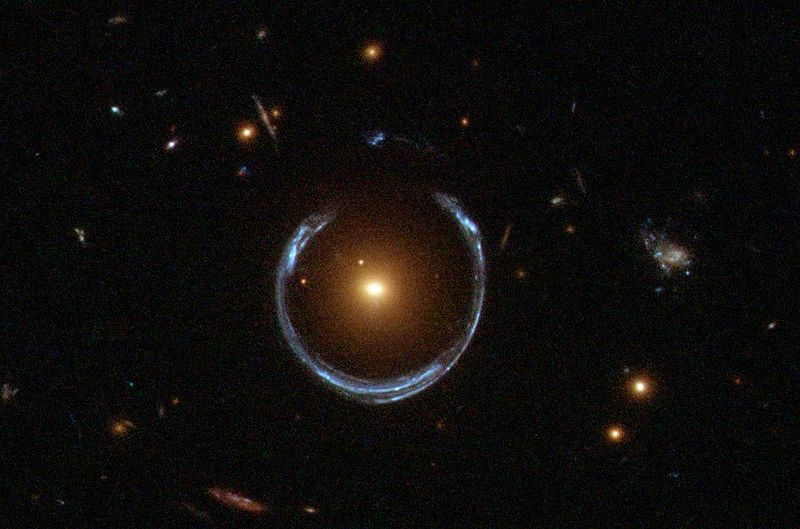
gravitational lens
distribution of matter between a distant light source and a observer

molecular cloud
type of interstellar cloud
inflation
theory of rapid universe expansion
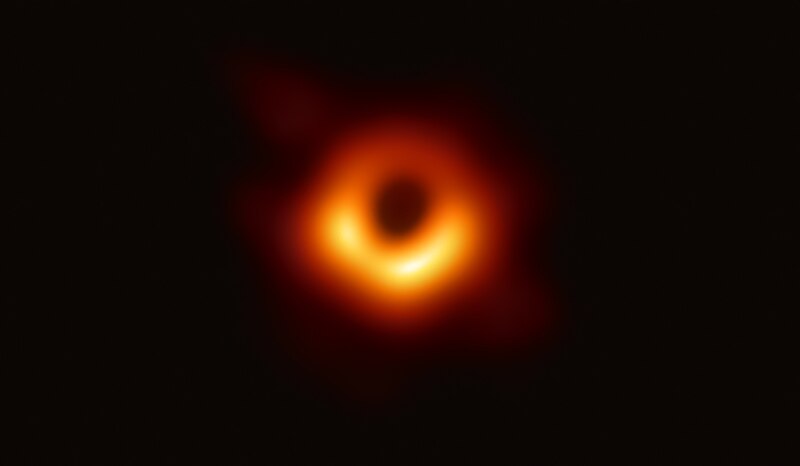
supermassive black hole
black hole with mass above 10⁵ solar masses, usually found at the centers of galaxies

stellar evolution
changes to a star over its lifespan

star formation
process by which dense regions within molecular clouds in interstellar space, sometimes referred to as "stellar nurseries" or "star-forming regions", collapse and form stars
white hole
hypothetical region of spacetime that serves as the opposite of a black hole
gravitational singularity
location in space-time where the gravitational field of a celestial body becomes infinite
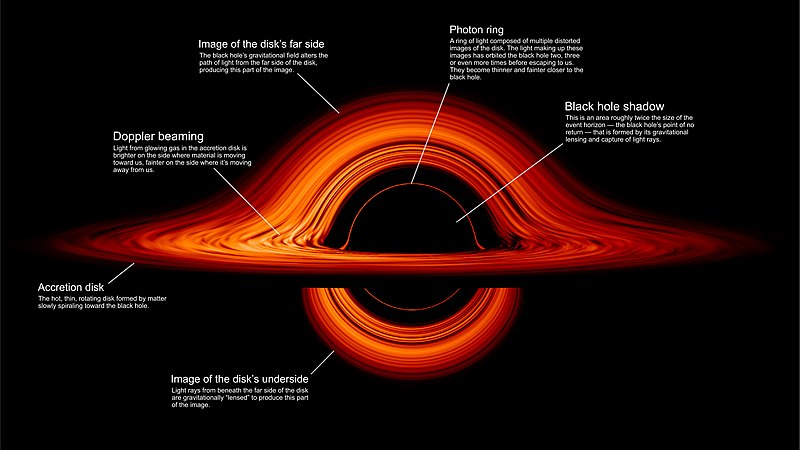
accretion disc
structure formed by diffuse material in orbital motion around a massive central body

metallicity
thumb|250px|right|The globular cluster M80. Stars in globular clusters are mainly older metal-poor members of [[population II.]]
In astronomy, metallicity is the abundance of elements present in an object that are heavier than hydrogen and helium. Most of the normal currently detectable (i.e. non-dark) matter in the universe is either hydrogen or helium, and astronomers use the word metals as convenient shorthand for all elements except hydrogen and helium. This word-use is distinct from the conventional chemical or physical definition of a metal as an electrically conducting element. Sta

proper motion
astronomical measure of the observed changes in the apparent places of stars in the sky
expansion of the universe
increase in distance between parts of the universe over time
age of the universe
time elapsed since the universe came into being

magnitude
logarithmic measure of the brightness of an astronomical object

active galactic nucleus
compact region at the center of a galaxy that has a much higher than normal luminosity over at least some portion – and possibly all – of the electromagnetic spectrum
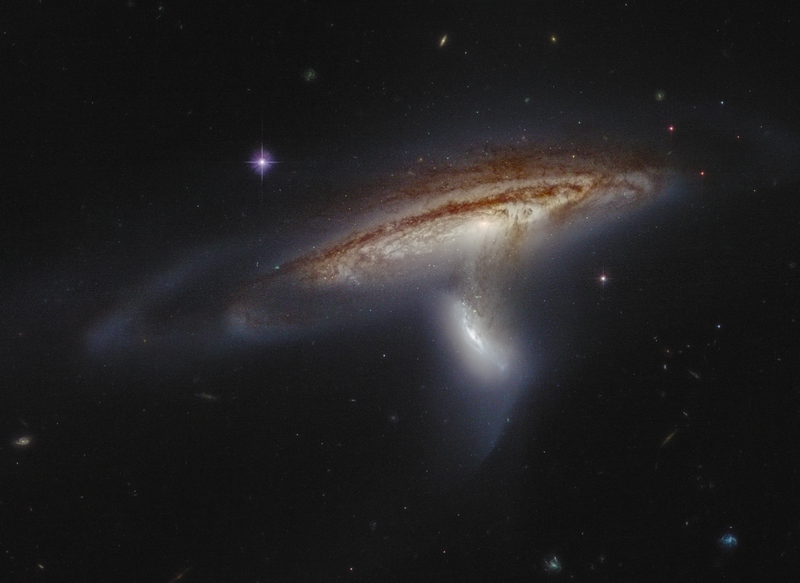
tidal force
secondary effect of the force of gravity of one body on another

radial velocity
component of the velocity in radial direction

stellar classification
classification of stars based on their spectral characteristics

compact object
classification in astronomy
hydrostatic equilibrium
in fluid mechanics, state in which compression due to gravity is balanced by a pressure gradient which creates a pressure gradient force in the opposite direction

effective temperature
estimated temperature of an astronomical body
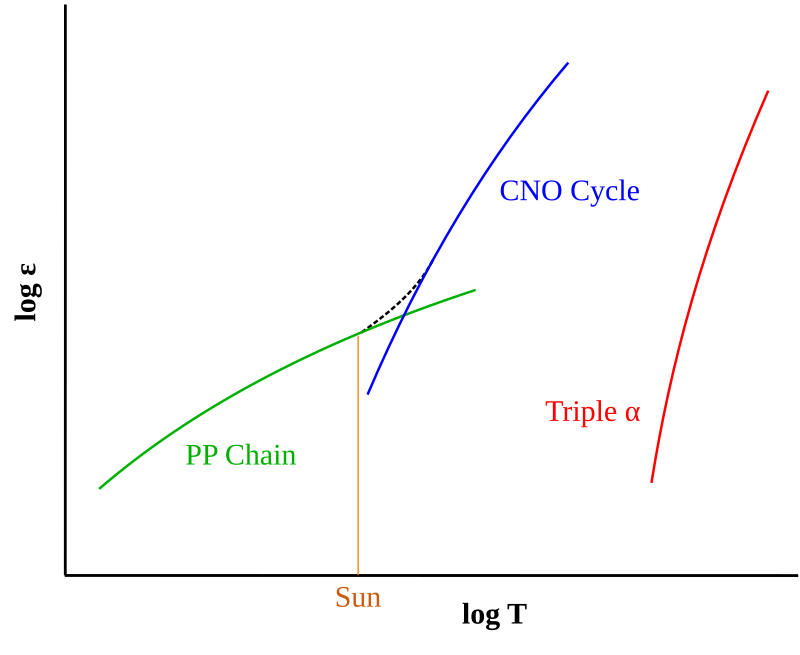
stellar nucleosynthesis
process by which the natural abundances of the chemical elements within stars change due to nuclear fusion reactions in the cores and their overlying mantles
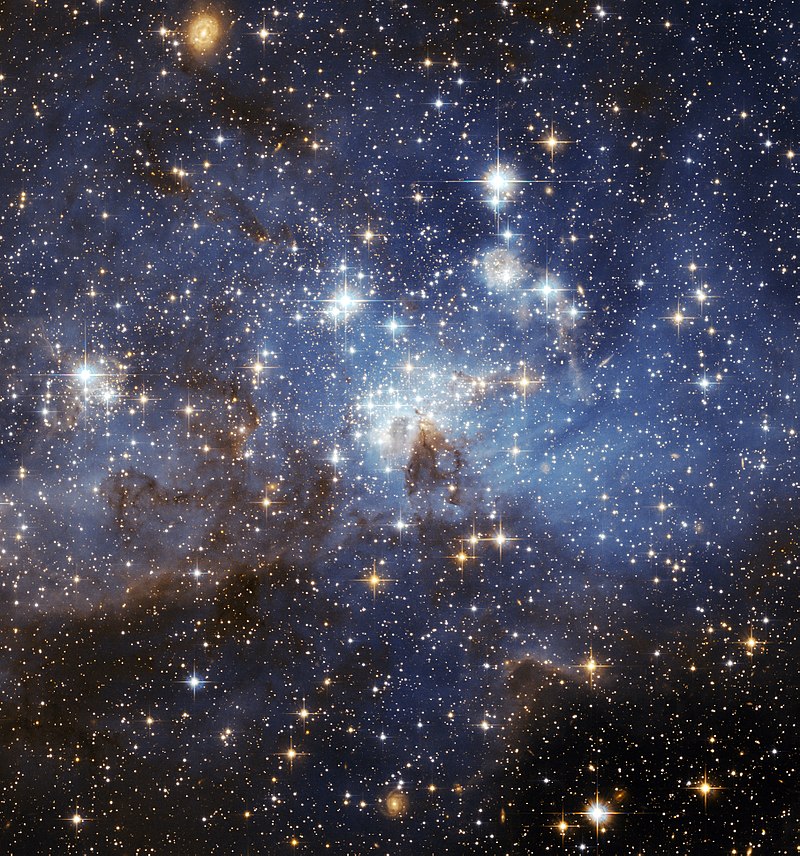
nebular hypothesis
astronomical theory that the Solar System formed from nebulous material
cosmological principle
notion that the spatial distribution of matter in the universe is homogeneous and isotropic at large scales
extinction
in astronomy, the absorption and scattering of electromagnetic radiation by dust and gas between an emitting astronomical object and the observer
astrophysical jet
beam of ionized matter flowing along the axis of a rotating astronomical object