Category
page 1Cubic minerals

gold
Gold is a chemical element; its chemical symbol is Au (from Latin ) and atomic number 79. In its pure form, it is a bright-metallic-yellow, dense, soft, malleable, and ductile metal. Chemically, gold is a transition metal, a group 11 element, and one of the noble metals. It is one of the least reactive chemical elements, being the second lowest in the reactivity series, with only platinum ranked as less reactive. Gold is solid under standard conditions.

iron
Iron is a chemical element; it has symbol Fe () and atomic number 26. It is a metal that belongs to the first transition series and group 8 of the periodic table. It is, by mass, the most common element on Earth, forming much of Earth's outer and inner core. It is the fourth most abundant element in the Earth's crust. In its metallic state it was mainly deposited by meteorites.

silver
Silver is a chemical element; it has symbol Ag () and atomic number 47. A soft, whitish-gray, lustrous transition metal, it exhibits the highest electrical conductivity, thermal conductivity, and reflectivity of any metal. Silver is found in the Earth's crust in the pure, free elemental form ("native silver"), as an alloy with gold and other metals, and in minerals such as argentite and chlorargyrite. Most silver is produced as a byproduct of copper, gold, lead, and zinc refining.

copper
Copper is a chemical element; it has symbol Cu (from Latin ) and atomic number 29. It is a soft, malleable, and ductile metal with very high thermal and electrical conductivity. A freshly exposed surface of pure copper has a pinkish-orange color. Copper is used as a conductor of heat and electricity, as a building material, and as a constituent of various metal alloys, such as sterling silver used in jewelry, cupronickel used to make marine hardware and coins, and constantan used in strain gauges and thermocouples for temperature measurement.

diamond
thumb|upright=1.25|Main diamond producing countries

platinum
Platinum is a chemical element; it has symbol Pt and atomic number 78. It is a dense, malleable, ductile, highly unreactive, precious, silverish-white transition metal. Its name originates from Spanish , a diminutive of "silver".

halite
Halite ( ), commonly known as rock salt, is a type of salt, the mineral (natural) form of sodium chloride (NaCl). Halite forms isometric crystals. The mineral is typically colorless or white, but may also be light blue, dark blue, purple, pink, red, orange, yellow or gray depending on inclusion of other materials, impurities, and structural or isotopic abnormalities in the crystals. It commonly occurs with other evaporite deposit minerals such as several of the sulfates, halides, and borates. The name halite is derived from the Ancient Greek word for "salt", ().

pyrite
The mineral pyrite ( ), or iron pyrite, also known as '''Fool's Gold''', is an iron sulfide with the chemical formula FeS2 (iron (II) disulfide). Pyrite is the most abundant sulfide mineral.

garnet group
Garnets () are a group of silicate minerals that have been used since the Bronze Age as gemstones and abrasives.

magnetite
thumb|upright=1.2|Magnetite is one of the very few minerals that is ferrimagnetic; it is attracted by a [[magnet as shown here]]
thumb|Unit cell of magnetite. The gray spheres are oxygen, green are divalent iron, blue are trivalent iron. Also shown are an iron atom in an octahedral space (light blue) and another in a tetrahedral space (gray).
Magnetite is a mineral and one of the main iron ores, with the chemical formula . It is one of the oxides of iron, and is ferrimagnetic; it is attracted to a magnet and can be magnetized to become a permanent magnet itself. With the exception of extremel

fluorite
Fluorite (also called fluorspar) is the mineral form of calcium fluoride, CaF2. It belongs to the halide minerals. It crystallizes in isometric cubic habit, although octahedral and more complex isometric forms are not uncommon.

galena
Galena, also called lead glance, is the natural mineral form of lead(II) sulfide (PbS). It is the most important ore of lead and an important source of silver.

spinel
thumb|Polyhedral representation of spinel MgAl2O4
Spinel () is the magnesium/aluminium member of the larger spinel group of minerals. It has the formula in the cubic crystal system. Its name comes from the Latin word , a diminutive form of spine, in reference to its pointed crystals.

sphalerite
Sphalerite is a sulfide mineral with the chemical formula . It is the most important ore of zinc. Sphalerite is found in a variety of deposit types, but it is primarily in sedimentary exhalative, Mississippi-Valley type, and volcanogenic massive sulfide deposits. It is found in association with galena, chalcopyrite, pyrite (and other sulfides), calcite, dolomite, quartz, rhodochrosite, and fluorite.

uraninite
Uraninite, also known as pitchblende, is a radioactive, uranium-rich mineral and ore with a chemical composition that is largely UO2 but because of oxidation typically contains variable proportions of U3O8. Radioactive decay of the uranium causes the mineral to contain oxides of lead and trace amounts of helium. It may also contain thorium and rare-earth elements.

chromite
Chromite is a crystalline mineral composed primarily of iron(II) oxide and chromium(III) oxide compounds. It can be represented by the chemical formula of FeCr2O4. It is an oxide mineral belonging to the spinel group. The element magnesium can substitute for iron in variable amounts as it forms a solid solution with magnesiochromite (MgCr2O4). Substitution of the element aluminium can also occur, leading to hercynite (FeAl2O4). Chromite today is mined particularly to make stainless steel through the production of ferrochrome (FeCr), which is an iron-chromium alloy.

almandine
Almandine (), also known as almandite, is a mineral belonging to the garnet group. The name is a corruption of alabandicus, which is the name applied by Pliny the Elder to a stone found or worked at Alabanda, a town in Caria in Asia Minor. Almandine is an iron aluminium garnet, of deep red color, inclining to purple. It is frequently cut with a convex face, or en cabochon, and is then known as carbuncle. Viewed through the spectroscope in a strong light, it generally shows three characteristic absorption bands.

cuprite
Cuprite is an oxide mineral composed of copper(I) oxide Cu2O, and is a minor ore of copper.
thumb|left|Cuprite from Tsumeb Mine (size:2.3 x 2.1 x 1.2 cm
Its dark crystals with red internal reflections are in the isometric system hexoctahedral class, appearing as cubic, octahedral, or dodecahedral forms, or in combinations. Penetration twins frequently occur. In spite of its nice color, it is rarely used for jewelry because of its low Mohs hardness of 3.5 to 4. It has a relatively high specific gravity of 6.1, imperfect cleavage and is brittle to conchoidal fracture. The luster is sub-metallic
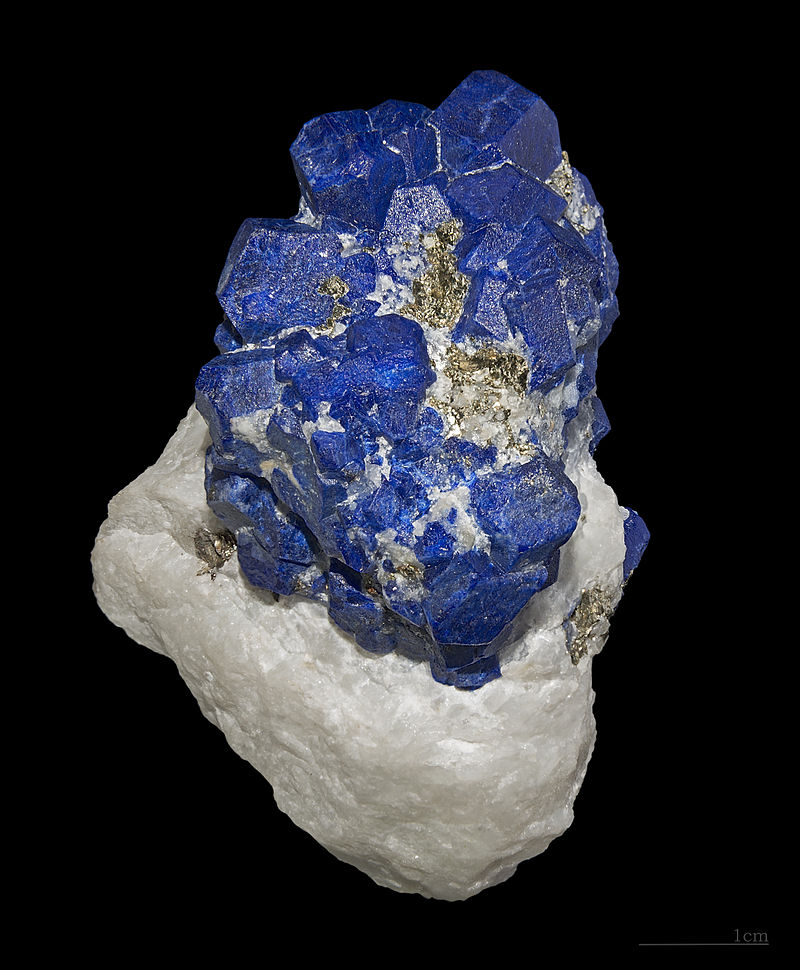
lazurite
Lazurite, old name Azure spar is a tectosilicate mineral with sulfate, sulfur and chloride with formula . It is a feldspathoid and a member of the sodalite group. Lazurite crystallizes in the isometric system although well‐formed crystals are rare. It is usually massive and forms the bulk of the gemstone lapis lazuli.

sylvite
Sylvite, or sylvine, is potassium chloride (KCl) in natural mineral form. It forms crystals in the isometric system very similar to normal rock salt, halite (NaCl). The two are, in fact, isomorphous. Sylvite is colorless to white with shades of yellow and red due to inclusions. It has a Mohs hardness of 2.5 and a specific gravity of 1.99. It has a refractive index of 1.4903. Sylvite has a salty taste with a distinct bitterness.

sodalite
Sodalite ( ) is a tectosilicate mineral with the formula , with royal blue varieties widely used as an ornamental gemstone. Although massive sodalite samples are opaque, crystals are usually transparent to translucent. Sodalite is a member of the sodalite group with hauyne, nosean, lazurite and tugtupite.

pentlandite
thumb|Pentlandite in pyrrhotite, ore specimen from the [[Sudbury Basin (field of view 3.4 cm)|300x300px]]
Pentlandite is an iron–nickel sulfide with the chemical formula . Pentlandite has a narrow variation range in nickel to iron ratios (Ni:Fe), but it is usually described as 1:1. In some cases, this ratio is skewed by the presence of pyrrhotite inclusions. It also contains minor cobalt, usually at low levels as a fraction of weight.

pyrope
thumb|Pyrope garnet in eclogite - Shibino, Ural Mountains, Russia.
The mineral pyrope is a member of the garnet group. Pyrope is the only member of the garnet family to always display red colouration in natural samples, and it is from this characteristic that it gets its name: from the Greek words for fire and eye. Despite being less common than most garnets, it is a widely used gemstone with numerous alternative names, some of which are misnomers. Chrome pyrope, and Bohemian garnet are two alternative names, the usage of the latter being discouraged by the Gemological Institute of America. Mi
barium sulfide
chemical compound
spessartine
Spessartine is a nesosilicate, manganese aluminium garnet species, Mn2+3Al2(SiO4)3. This mineral is sometimes mistakenly referred to as spessartite.
tetrahedrite series
Tetrahedrite is a copper antimony sulfosalt mineral with the formula: . It is the antimony endmember of the continuous solid solution series with arsenic-bearing tennantite. Pure endmembers of the series are rarely if ever seen in nature. Of the two, the antimony rich phase is more common. Other elements also substitute in the structure, most notably iron and zinc, along with less common silver, mercury and lead. Bismuth also substitutes for the antimony site and bismuthian tetrahedrite or annivite is a recognized variety. The related, silver dominant, mineral species freibergite, although rar
chlorargyrite
Chlorargyrite is the mineral form of silver chloride (AgCl). Chlorargyrite occurs as a secondary mineral phase in the oxidation of silver mineral deposits. It crystallizes in the isometric–hexoctahedral crystal class. Typically massive to columnar in occurrence it also has been found as colorless to variably yellow cubic crystals. The color changes to brown or purple on exposure to light. It is quite soft with a Mohs hardness of 1 to 2 and dense with a specific gravity of 5.55. It is also known as cerargyrite and, when weathered by desert air, as horn silver. Bromian chlorargyrite (or embolite

haüyne
Hauyne or haüyne, also called hauynite or haüynite ( ), old name Azure spar, is a rare tectosilicate sulfate mineral with endmember formula . As much as 5 wt % may be present, and also and Cl. It is a feldspathoid and a member of the sodalite group. Hauyne was first described in 1807 from samples discovered in Vesuvian lavas in Monte Somma, Italy, and was named in 1807 by Brunn-Neergard for the French crystallographer René Just Haüy (1743–1822). It is sometimes used as a gemstone.
native copper
mineral (as opposed to the chemical element)
gahnite
Gahnite, ZnAl2O4, is a rare mineral belonging to the spinel group. It forms octahedral crystals which may be green, blue, yellow, brown or grey. It often forms as an alteration product of sphalerite in altered massive sulphide deposits such as at Broken Hill, Australia. Other occurrences include Falun, Sweden where it is found in pegmatites and skarns; and, in the United States, Charlemont, Massachusetts; Spruce Pine, North Carolina; White Picacho district, Arizona; Topsham, Maine; and Franklin, New Jersey.
arsenolite
Arsenolite is an arsenic mineral, with chemical formula As2O3. It is formed as an oxidation product of arsenic sulfides. Commonly found as small octahedra, it is white, but impurities of realgar or orpiment may give it a pink or yellow hue. It can be associated with its dimorph claudetite (a monoclinic form of As2O3) as well as realgar (As4S4), orpiment (As2S3) and erythrite, Co3(AsO4)2·8H2O.
thorianite
Thorianite is a rare thorium oxide mineral, ThO2. It was originally described by Ananda Coomaraswamy in 1904 as uraninite, but recognized as a new species by Wyndham R. Dunstan. It was so named by Dunstan on account of its high percentage of thorium; it also contains the oxides of uranium, lanthanum, cerium, praseodymium and neodymium. Helium is present, and the mineral is slightly less radioactive than pitchblende, but is harder to shield due to its high energy gamma rays. It is common in the alluvial gem-gravels of Sri Lanka, where it occurs mostly as water-worn, small, heavy, black, cubic c
periclase
Periclase is a magnesium mineral that occurs naturally in contact metamorphic rocks and is a major component of most basic refractory bricks. It is a cubic form of magnesium oxide (MgO). In nature it usually forms a solid solution with wüstite (FeO) and is then referred to as ferropericlase or magnesiowüstite.
pyrochlore
Pyrochlore () is a mineral group of the niobium end member of the pyrochlore supergroup. Pyrochlore is also a term for the crystal structure Fdm. The name is from the Greek , fire, and , green because it typically turns green on ignition in classic blowpipe analysis.

pollucite
Pollucite is a zeolite mineral with the formula with iron, calcium, rubidium and potassium as common substituting elements. It is important as a significant ore of caesium and sometimes rubidium. It forms a solid solution series with analcime. It crystallizes in the isometric-hexoctahedral crystal system as colorless, white, gray, or rarely pink and blue masses. Well-formed crystals are rare. It has a Mohs hardness of 6.5 and a specific gravity of 2.9, with a brittle fracture and no cleavage.

tennantite
Tennantite is a copper arsenic sulfosalt mineral with an ideal formula . Due to variable substitution of the copper by iron and zinc the formula is . It is gray-black, steel-gray, iron-gray or black in color. A closely related mineral, tetrahedrite ) has antimony substituting for arsenic and the two form a solid solution series. The two have very similar properties and is often difficult to distinguish between tennantite and tetrahedrite. Iron, zinc, and silver substitute up to about 15% for the copper site.

salammoniac
thumb|upright|Salammoniac crystal from Ravat Village, Tajikistan. One of many unusual salammoniac crystal specimens found in the area of Ravat Village, near [[Yaghnob River, where the crystals have grown in a feather-like or three-dimensional arborescent. Size: miniature, 3.3 × 1.4 × 1.4 cm]]
altaite
Altaite, or lead telluride, is a yellowish white mineral with an isometric crystal structure. Altaite is in the galena group of minerals as it shares many of properties of galena. Altaite has an unusually high density for a light-colored mineral. Altaite and other rare tellurides are classified in the sulfide mineral class (Dana classification).

kamacite
Kamacite is an alloy of iron and nickel, which is found on Earth only in meteorites. According to the International Mineralogical Association (IMA) it is considered a proper nickel-rich variety of the mineral native iron. The proportion iron:nickel is between 90%:10% and 95%:5%; small quantities of other elements, such as cobalt or carbon may also be present. The mineral has a metallic luster, is gray and has no clear cleavage although its crystal structure is isometric-hexoctahedral. Its density is about 8 g/cm3 and its hardness is 4 on the Mohs scale. It is also sometimes called balkene
.png)
ringwoodite
thumb|Scanning electron microscope|SEM image of Ringwoodite (RGW) discovered in the Suizhou L6 [[chondrite meteorite. See image for details. ]]
gersdorffite
Gersdorffite or Nickel glance (trivial name) is a nickel arsenic sulfide mineral with formula NiAsS. It crystallizes in the isometric system showing diploidal symmetry. It occurs as euhedral to massive opaque, metallic grey-black to silver white forms. Gersdorffite belongs to a solid solution series with cobaltite, CoAsS. Antimony freely substitutes also leading to ullmannite, NiSbS. It has a Mohs hardness of 5.5 and a specific gravity of 5.9 to 6.33.
alabandite
Alabandite or alabandine, formerly known as manganese blende or bluemenbachite is a rarely occurring manganese sulfide mineral. It crystallizes in the cubic crystal system with the chemical composition Mn2+S and develops commonly massive to granular aggregates, but rarely also cubic or octahedral crystals to 1 cm.
nosean
Nosean, also known as noselite, is a mineral of the feldspathoid group with formula: . It forms isometric crystals of variable color: white, grey, blue, green, to brown. It has a Mohs hardness of 5.5 to 6 and a specific gravity of 2.3 to 2.4. It is fluorescent. It is found in low-silica igneous rocks. There is a solid solution between nosean and hauyne, which contains calcium.

skutterudite
Skutterudite is a cobalt arsenide mineral containing variable amounts of nickel and iron substituting for cobalt with the ideal formula CoAs3. Some references give the arsenic a variable formula subscript of 2–3. High nickel varieties are referred to as nickel-skutterudite, previously chloanthite. It is a hydrothermal ore mineral found in moderate to high temperature veins with other Ni-Co minerals. Associated minerals are arsenopyrite, native silver, erythrite, annabergite, nickeline, cobaltite, silver sulfosalts, native bismuth, calcite, siderite, barite and quartz. It is mined as an ore of
.jpg)
franklinite
Franklinite is an oxide mineral belonging to the normal spinel subgroup's iron (Fe) series, with the formula ZnFe3+2O4.
germanite
Germanite is a rare copper iron germanium sulfide mineral, Cu26Fe4Ge4S32. It was first discovered in 1922, and named for its germanium content. It is only a minor source of this important semiconductor element, which is mainly derived from the processing of the zinc sulfide mineral sphalerite. Germanite contains gallium, zinc, molybdenum, arsenic, and vanadium as impurities.

sperrylite
thumb|Sperrylite on chalcopyrite with [[magnetite, Oktyabersky Mine, Norilsk. Field of view 2.2 cm.]]
Sperrylite is a platinum arsenide mineral with the chemical formula and is an opaque metallic tin white mineral which crystallizes in the isometric system with the pyrite group structure. It forms cubic, octahedral or pyritohedral crystals in addition to massive and reniform habits. It has a Mohs hardness of 6–7 and a very high specific gravity of 10.6.

wüstite
thumb|Crystal structure of Wüstite
awaruite
Awaruite is a naturally occurring alloy of nickel and iron with a composition from Ni2Fe to Ni3Fe.
maghemite
Maghemite (Fe2O3, γ-Fe2O3) is a member of the family of iron oxides. It has the same formula as hematite, but the same spinel ferrite structure as magnetite () and is also ferrimagnetic. It is sometimes spelled as "maghaemite".

taenite
thumb|right|200px|Widmanstätten pattern showing the two forms of Nickel-Iron, Kamacite and Taenite, in an octahedrite meteorite
Taenite is a mineral found naturally on Earth mostly in iron meteorites. It is an alloy of iron and nickel, with a chemical formula of and nickel proportions of 20% up to 65%.

jacobsite
Jacobsite is a manganese iron oxide mineral. It is in the spinel group and forms a solid solution series with magnetite. The chemical formula is (Mn,Mg)Fe2O4 or with oxidation states and substitutions:
(Mn2+,Fe2+,Mg)(Fe3+,Mn3+)2O4.
thumb|left|Jacobsite, N'Chwaning Mines, Kuruman, Kalahari manganese fields, [[Northern Cape Province, South Africa. Size 3.8 x 3.5 x 3.2 cm]]

villiaumite
Villiaumite is a rare halide mineral composed of sodium fluoride, NaF. It is very soluble in water and some specimens fluoresce under long and short wave ultraviolet light. It has a Mohs hardness of 2.5 and is usually red, pink, or orange in color. It is toxic to humans.

domeykite
Domeykite is a copper arsenide mineral, Cu3As. It crystallizes in the isometric system, although crystals are very rare. It typically forms as irregular masses or botryoidal forms. It is an opaque, white to gray (weathers brassy) metallic mineral with a Mohs hardness of 3 to 3.5 and a specific gravity of 7.2 to 8.1.
greigite
Greigite is an iron sulfide mineral with the chemical formula . It is the sulfur equivalent of the iron oxide magnetite (Fe3O4). It was first described in 1964 for an occurrence in San Bernardino County, California, and named after the mineralogist and physical chemist Joseph W. Greig (1895–1977).
petzite
The mineral petzite, Ag3AuTe2, is a soft, steel-gray telluride mineral generally deposited by hydrothermal activity. It forms isometric crystals, and is usually associated with rare tellurium and gold minerals, often with silver, mercury, and copper.
bromargyrite
Bromyrite or bromargyrite is a natural mineral form of silver bromide found mainly in Mexico and Chile. Hardness is 1.5 to 2. Related are chlorargyrite and iodyrite.
avicennite
Avicennite (thallium(III) oxide) is an oxide mineral. It was discovered around the Dzhuzumli village, Samarqand, Uzbekistan. It is named after Avicenna, a Persian doctor and polymath.
betafite
thumb|Betafite, Gunnison, Colorado
boleite
Boleite is a complex halide mineral with formula: KPb26Ag9Cu24(OH)48Cl62. It was first described in 1891 as an oxychloride mineral. It is an isometric mineral which forms in deep-blue cubes. There are numerous minerals related to boleite, such as pseudoboleite, cumengite, and diaboleite, and these all have the same complex crystal structure. They all contain bright-blue cubic forms and are formed in altered zones of lead and copper deposits, produced during the reaction of chloride bearing solutions with primary sulfide minerals.