Category
page 1DNA

deoxyribonucleic acid
thumb|right|upright=1.33|The structure of the DNA double helix (type [[B-DNA). The atoms in the structure are colour-coded by element and the detailed structures of two base pairs are shown in the bottom right.]] thumb|Simplified diagram

Francis Crick
British molecular biologist, biophysicist, neuroscientist; co-discoverer of the structure of DNA

nucleic acids
large biomolecules essential to known life

genome
thumb|An image of the 46 chromosomes making up the diploid genome of a human male (the mitochondrial chromosomes are not shown).

nucleotide
thumb|275px|class=skin-invert-image|This nucleotide contains the five-carbon sugar deoxyribose (at center), a [[nucleobase called adenine (upper right), and one phosphate group (left). The deoxyribose sugar joined only to the nitrogenous base forms a Deoxyribonucleoside called deoxyadenosine, whereas the whole structure along with the phosphate group is a nucleotide, a constituent of DNA with the name deoxyadenosine monophosphate.]]

DNA replication
cellular metabolic process in which a cell duplicates one or more molecules of DNA

mitochondrial DNA
DNA located in organelles called mitochondria

DNA profiling
technique used to identify an individual on the basis of their DNA characteristics

nucleoside
Nucleosides are glycosylamines that can be thought of as nucleotides without a phosphate group. A nucleoside consists simply of a nucleobase (also termed a nitrogenous base) and a five-carbon sugar (ribose or 2'-deoxyribose) whereas a nucleotide is composed of a nucleobase, a five-carbon sugar, and one or more phosphate groups. In a nucleoside, the anomeric carbon is linked through a glycosidic bond to the N9 of a purine or the N1 of a pyrimidine. Nucleotides are the molecular building blocks of DNA and RNA.

intron
An intron is any nucleotide sequence within a gene that is not expressed or operative in the final RNA product. The word intron is derived from the term intragenic region, i.e., a region inside a gene. The term intron refers to both the DNA sequence within a gene and the corresponding RNA sequence in RNA transcripts. The non-intron sequences that become joined by this RNA processing to form the mature RNA are called exons.

exon
thumb|Introns are removed and exons joined in the process of RNA splicing. RNAs could be mRNA or [[non-coding RNA.]]
An exon is any part of a gene that will form a part of the final mature RNA produced by that gene after introns have been removed by RNA splicing. The term exon refers to both the DNA sequence within a gene and to the corresponding sequence in RNA transcripts. In RNA splicing, introns are removed and exons are covalently joined to one another as part of generating the mature RNA. Just as the entire set of genes for a species constitutes the genome, the entire set of exons consti

DNA polymerase
Enzyme that synthesizes DNA from a nucleic acid template

haplogroup
A haplotype is a group of alleles in an organism that are inherited together from a single parent, and a haplogroup (haploid from the , haploûs, "onefold, simple" and ) is a group of similar haplotypes that share a common ancestor with a single-nucleotide polymorphism mutation. More specifically, a haplotype is a combination of alleles at different chromosomal regions that are closely linked and tend to be inherited together. As a haplogroup consists of similar haplotypes, it is usually possible to predict a haplogroup from haplotypes. Haplogroups pertain to a single line of descent. Such as t
nucleotide base
nitrogen-containing biological compounds that form nucleosides
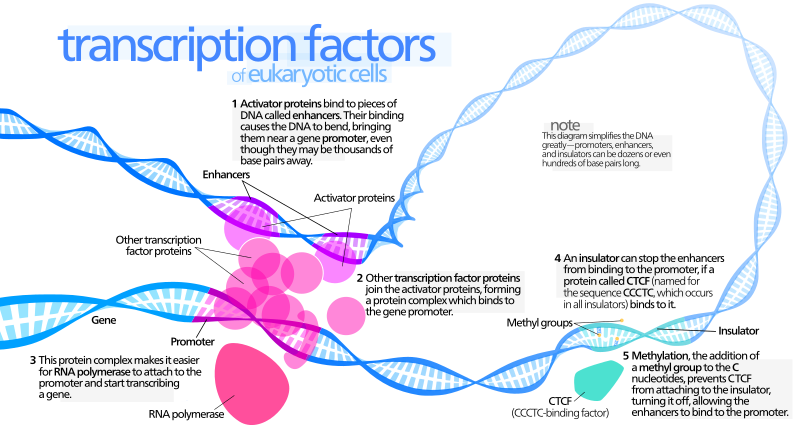
transcription factor
protein that binds to DNA and regulates gene expression by promoting or suppressing transcription
DNA virus
subclass of viruses
nucleic acid sequence
succession of letters that indicate the order of nucleotides within a DNA (using GACT) or RNA (GACU) molecule
noncoding DNA
DNA not coding for protein. Often translated to RNA and critical in regulating other genes
complementary DNA
single-stranded complementary DNA synthesized from an RNA template
DNA methylation
the covalent transfer of a methyl group to either N-6 of adenine or C-5 or N-4 of cytosine
DNA microarray
use of large set of oligonucleotide probes
regulation of gene expression
process that modulates frequency, rate or extent of gene expression
Meselson–Stahl experiment
experiment
genetic genealogy
use of DNA testing in combination with traditional genealogical methods to infer relationships between individuals and find ancestors
DNA computing
computing using molecular biology hardware
ancient DNA
DNA isolated from ancient specimens
directionality
End-to-end chemical orientation of a single strand of nucleic acid
DNA vaccine
novel type of vaccine
genetic marker
gene or DNA sequence with a known location on a chromosome that can be used to identify individuals or species
DNA supercoil
compressed DNA loop supercoiled by prokaryotes to fit within a small space
plastome
DNA located in cellular organelles called plastids
Holliday junction
Branched nucleic acid structure containing four double-stranded arms
Chargaff's rules
two rules about the percentage of A, C, G, and T in DNA strands

GC-content
thumb|400px|Nucleotide bonds showing AT and GC pairs. Arrows point to the hydrogen bonds.
In molecular biology and genetics, GC-content (or G+C content or guanine-cytosine content) is the percentage of nitrogenous bases in a DNA or RNA molecule that are either guanine (G) or cytosine (C). This measure indicates the proportion of G and C bases out of an implied four total bases, also including adenine and thymine in DNA and adenine and uracil in RNA.
whole genome sequencing
sequencing all the DNA of an individual at once
start codon
first codon of a messenger RNA transcript translated by a ribosome
sense
nature of the roles of nucleic acid molecules in specifying amino acids: DNA is positive-sense if an RNA version of the same sequence is translated or translatable into protein, negative-sense if not
A-DNA
right|200px|thumb|alt="The A-DNA structure"|The A-DNA structure.
gene silencing
process that prevents the expression of a gene
satellite DNA
repetitive DNA with distinct base composition observed using isopycnic centrifugation
nucleic acid double helix
the structure formed by double-stranded molecules of nucleic acids such as DNA.
nuclear DNA
Nuclear DNA is the DNA inside the nucleus of eukaryotic cells.

Z-DNA
right|frame|The Z-DNA structure.
Z-DNA is one of the many possible double helical structures of DNA. It is a left-handed double helical structure in which the helix winds to the left in a zigzag pattern, instead of to the right, like the more common B-DNA form. Z-DNA is thought to be one of three biologically active double-helical structures along with A-DNA and B-DNA.
Hachimoji DNA
synthetic nucleic acid (eight nucleobases — four natural, and four synthetic)

stem-loop
thumb|An example of an RNA stem-loop
genomic library
collection of the total genomic DNA from a single organism
Photo 51
photograph of X-ray diffraction image of DNA fibers

G-quadruplex
thumb|400px |Structure of a G-quadruplex. Left: a G-tetrad. Right: an intramolecular G4 complex.
coding region
portion of a gene's DNA or RNA, composed of exons, that codes for protein; composed of codons, which are decoded, translated into proteins by the ribosome; begins with the start codon and end with a stop codon
environmental DNA
DNA that is collected from a variety of environmental samples such as soil, seawater, snow or even air rather than directly sampled from an individual organism
CpG site
bacterial DNA fragments
consensus sequence
most common variant of a genetic sequence across samples
deoxyribonucleic acid extraction
isolation of DNA
genealogical DNA test
DNA-based genetic test
DNA gyrase
class of enzymes
DNA-DNA hybridization
technique used to measure similarity in DNA sequences
ribosomal DNA
specific region of DNA that that codes for ribosomal RNA
nucleic acid secondary structure
basepairing interactions within a single nucleic acid polymer or between two polymers, list of bases which are paired in a nucleic acid molecule
C-value
C-value is the amount, in picograms, of DNA contained within a haploid nucleus (e.g. a gamete) or one half the amount in a diploid somatic cell of a eukaryotic organism. In some cases (notably among diploid organisms), the terms C-value and genome size are used interchangeably; however, in polyploids the C-value may represent two or more genomes contained within the same nucleus. Greilhuber et al. have suggested some new layers of terminology and associated abbreviations to clarify this issue, but these somewhat complex additions are yet to be used by other authors.
nucleic acid structure
organization of DNA and RNA molecules at different scales